












Diaries From The Field: The disappearing islands
3 MIN READ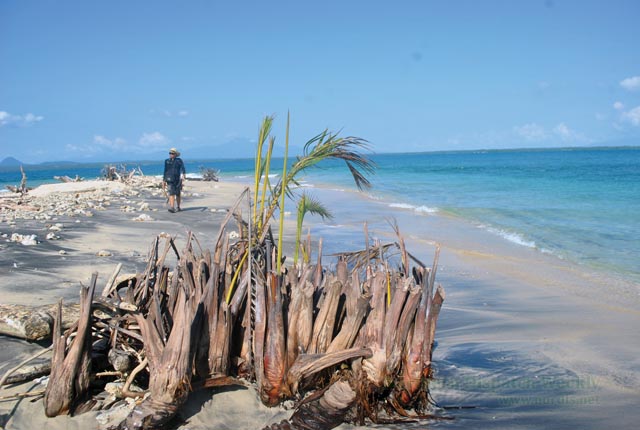
By JUDE BAGGO
www.nordis.net
Recently, my friends and I travelled to Bicol to visit a friend and experience the best of Bicolandia. The travel took us one day to reach our destination after long hours of queuing at the bus terminal going to Daet, Camarines Norte and enduring the crowded, non-air-conditioned bus. Adding to the discomfort inside the bus were the extra baggage of passengers since it was going to be a long holiday. One cannot also miss the inclusion of poultry – chickens and ducks that passengers wanted to bring home to Bicol.
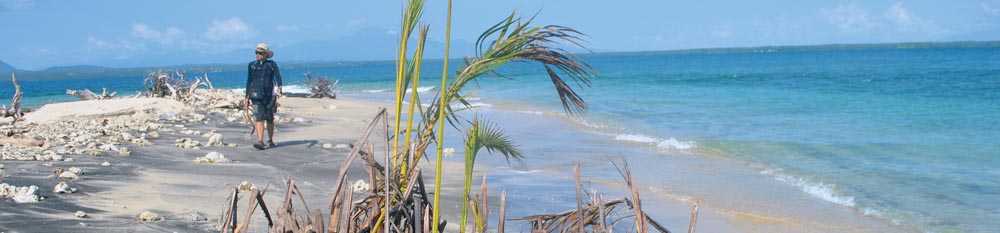
NO MORE LAND. The beautiful Calaguan Islands are not immune to the effects of Climate Change. The land area is getting smaller, constricting agriculture and residential areas. Photo by Jude Baggo
From the stressful heat, traffic and pollution of Manila, the bus led us to greener and fresher air. The view from Laguna to Quezon really surprised me. I have never seen so many coconut trees in my life. The seemingly endless coconut plantation extended even when we reached Camarines Norte. I only saw a few rice fields along the way. As a mountain person, passing thru the shorelines of Quezon is simply majestic. I tried to sleep but the smell of the sea kept me awake.
We reached Daet in the evening. Our gracious host prepared us Bicol seafood, laing, shrimps and more. And after a few minutes, the food on the table was gone. Then we were immediately brought to the famous people’s beach of Daet. Since it was evening, the moon was up and the reflection on the sea was just perfect. Locals and tourists were having bonfires, dancing or just strolling along the beach. There were also small accommodations and good bars along the beach.
The next day, we went to Mercedes town of Camarines Norte for island hopping. Again, as someone who grew up in the mountains, this invitation is difficult to resist. Our host rented a small boat marked “God is our refuge.” For the whole day, we used this boat to visit all the main islands of Calaguas. The islands are not far from each other. There were islands being developed into exclusive beach resorts.
The Calaguas Islands are beautiful. The sand is white and the waves are friendly. Since most of the islands are still covered with Agoho trees and other indigenous trees, bats and other birds are thriving. There are also caves in the islands to be discovered. Luckily, we were able to meet and talk with some local residents in some islands.
But despite the serenity of the Calaguas Islands, the impacts of Climate Change in the islands are alarming. It needs concrete intervention and assistance for the people. According to some local residents I interviewed and our boat operator, they observed the rising of sea levels during the 90’s. One can see ruins of houses along the beach. One can also see the fallen coconuts and trees along the coastline. The islands are literally getting smaller. One resident even told me that they can wade from their island to another island in the past. But today, they need to use boats to reach other islands.
Today, the island residents lack space to plant crops. The supply of fish is also decreasing. Fishermen need to go farther out to the sea to catch fish. As our boat operator said, during long typhoons when they cannot go out to fish, their families go hungry. But of course, I can see their resilience in these times of Climate Change. Manong boat operator said that as long as there is the sea, life must go on. If the islands will disappear, so will their livelihood and way of life.
As we went back to the main island, we were met by sudden rain and strong waves. While my friends and I were so nervous because of the situation, our hosts acted like it was an ordinary day out on the sea. They even told jokes while one of our companion had to hide in fear inside the boat. We also saw other boats going out to fish while others were going home to the other islands with passengers. I saw a father holding his child while clinging to a post of their banca. It was like an ordinary sunny day riding the strong waves.
Camarines Norte is amazing. Its food, scenery and people are one of the best. Next on the list is Albay. Let’s go. # nordis.net