Indigenous, environmental groups demand repeal of 30-year-old mining law
NEWS | March 4, 2025
3MIN READ
By SHERWIN DE VERA www.nordis.net
BAGUIO CITY—Thirty years after the enactment of the Mining Act of 1995 (RA 7942), indigenous groups and environmental advocates continue to urge its repeal, citing decades of destruction and displacement.
“(I)n 30 years, we have lost mountains and people, gaining the opposite of the prosperity that was promised,” said Ned Tuguinay, Cordillera Peoples Alliance (CPA) spokesperson.
Instead of economic development, the law encouraged transnational corporations to exploit the country’s mineral resources while allowing pre-existing mining companies to expand operations, causing environmental and social destruction.
Tuguinay cited several disastrous events, including the massive ground subsidence in Mankayan caused by Lepanto, the collapse of Philex’s Tailings Pond 3 in 2012, the Antamok open-pit mines of Benguet Corporation, and the deadly landslides in Itogon.
“In the 30 years of RA 7942, lands and lives were stolen from our people, and no amount of gold could ever amount to the price we were forced to pay,” he said.
The CPA emphasized that the Supreme Court’s reversal of its earlier nullification of certain provisions of the law favored foreign mining firms. Successive administrations reinforced the law—the Arroyo administration through the National Minerals Policy and Executive Order No. 79 issued by President Benigno Aquino III.
During the Duterte presidency, the government imposed a ban on small-scale mining that favored large-scale operations. The president also issued Executive Order No. 130, lifting a nine-year moratorium on mining and increasing mining applications.
Tuguinay said pro-mining policies continue under President Ferdinand Marcos Jr. “He is definitely setting the stage for a smooth-sailing process dedicated to large-scale mining firms.”
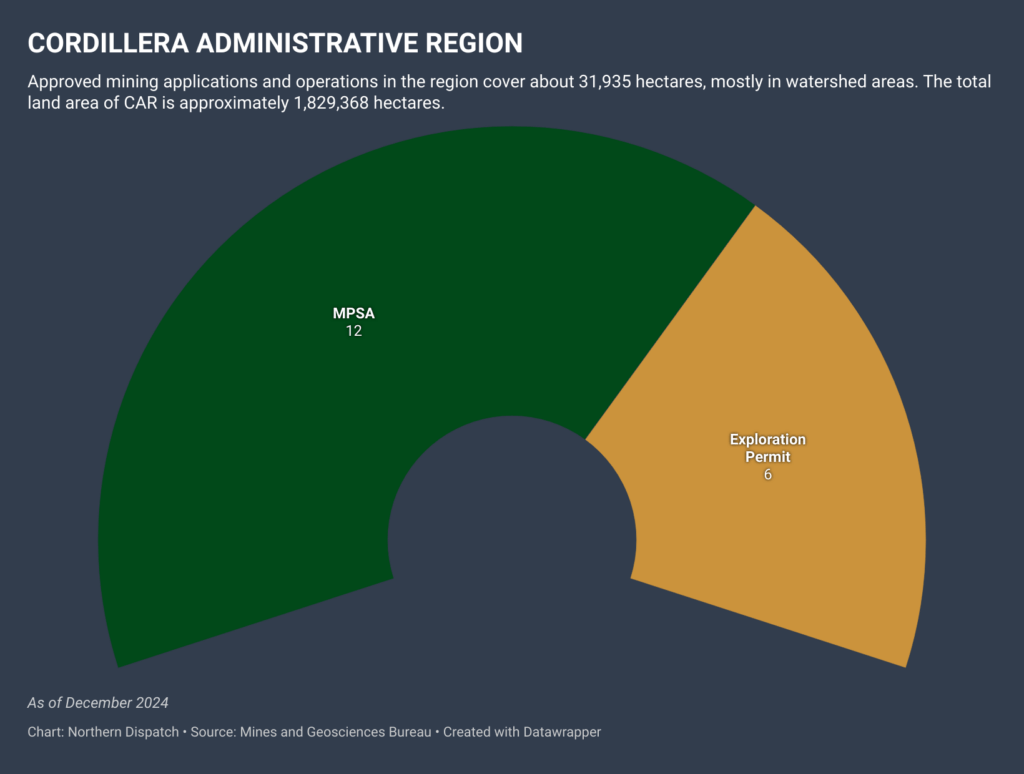
As of December 2024, there are 106 mining applications in the Cordillera, covering 34% of its land and mostly located in watershed areas.
The Maharlika Investment Corporation recently granted Makilala Mining Company Incorporated a US$76.4 million bridge loan, making it the first mining firm to receive funding from the administration’s controversial economic initiative.
Meanwhile, Panaghiusa Philippine Network to Uphold Indigenous Peoples’ Rights said the law has facilitated militarization, environmental destruction, displacement, and economic inequality in favor of foreign corporations and local elites.
“The opposition of communities against these destructive projects often escalates to militarization with the deployment of state forces, recruitment to paramilitary groups, and collusion with private armies,” said Beverly Longid, Panaghiusa co-convener.
Separate reports from Global Witness and Amnesty International revealed that under the pretext of extracting minerals for the transition to renewable energy, mining operations have trampled on indigenous peoples’ rights in the country.
“Our natural wealth must serve the people—not multinational corporations. It is time to dismantle the oppressive structures that prioritize profit over life and establish a mining policy rooted in justice, equity, and true environmental stewardship,” said Ana Celestial of Kalikasan People’s Network for the Environment during the launch of the Global Witness report in December 2024.
Meanwhile, the liberalization of the country’s mining regime has failed to deliver significant economic returns.
Think-tank IBON Foundation noted that the industry made P62.7 billion in profits in 2023 from US$7.1 billion in mineral exports. However, it only accounted for 0.7% of the country’s Gross Domestic Product and contributed just 0.5% to employment in 2024.
Statistics cited by Panaghiusa reflect an even grimmer reality, with the industry averaging only 1.02% of GDP between 2001 and 2020.
“The situation underscores the urgency of scrapping the Philippine Mining Act of 1995, which continues to prioritize foreign interests over the welfare of the Filipino people and the protection of the country’s natural resources,” Longid said.
The groups reiterated their call for the repeal of the law and the passage of sustainable, community-centered alternatives such as the People’s Mining Bill, advocated by the Makabayan bloc in the House of Representatives. # nordis.net