3 MIN READBy ARTHUR L. ALLAD-IW
www.nordis.net
BANGKOK, Thailand — Indigenous persons with disabilities (IPWDs) from various organizations in 12 countries of the Asia-Pacific region urged States in the region to improve their grim conditions by ratifying and implementing the United Nations Conventions on the Rights of Persons with Disabilities (UNCRPD) and the United Nations Declaration on the Rights of Indigenous Peoples (UNDRIP).
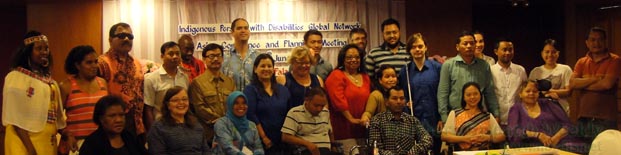
The indigenous persons with disabilities in the Bangkok Conference. Photo by Arthur L. Allad-iw
In the Bangkok declaration, some 30 conference participants said that the two UN instruments’ ratification and implementation would uplift their conditions as PWDS, indigenous peoples, and as members of the societies who are poor and marginalized.
Chol O Han, an officer of the United Nations Economic and Social Commission for Asia and the Pacific (UNESCAP), said that there are 650 million PWDs in the Asia-Pacific, and are two-thirds of the world’s PWDs. UNESCAP is the regional development arm of the UN in the region.
As the PWDs are most exposed to discrimination and oppression in every society, UNESCAP adopted the Inchon Strategy – a program that would “make right real” for persons with disabilities in the region, Chol explained.
The Strategy targets 10 goals for PWDs in the region: reduce poverty and enhance work and employment prospect, promote participation in political processes and decision making, enhance access to physical environment, public transportation, knowledge, information and communication, strengthen social protection, expand early intervention and education of children with disabilities, ensure gender equality and women’s empowerment, ensure disability-inclusive disaster risk reduction and management, improve the reliability and comparability of disability data, accelerate the ratification and implementation of the CRPD and the harmonization of national legislation with the convention, advance sub regional, regional and inter regional cooperation.
The Inchon Strategy serves as UNESCAP targets for the decades of PWDS in the Asia-Pacific, 2013-2022, Chol added.
The ratification of the convention is being seen as the lowest among regions. Only 27 states of the 54 UN member states in the Asia-Pacific region ratified the convention.
Thailand Senator Munthian Buntan, a blind member of the UNCRPD Committee, urged participants to lobby their governments’ ratification of the convention.
He explained that in order for the states’ violation be brought to the committee by victims, the states must ratify also the optional protocol for the CRPD which clearly outline such mechanisms.
He shared that only Nepal ratified the optional protocol, and earlier the convention.
The Philippines is a signatory to both the UNCRPD and the UNDRIP but not the optional protocol.
We must be vigilant in pushing for the ratification of the optional protocol, he said as he lauded participants that they can empower themselves to push for their rights and welfare as PWDs.
“Utilize this convention and its mechanisms for our rights to be tangible. Otherwise, it would not be different from a declaration,” Buntan reiterated.
The more or less 30 participants also pushed in their declaration for the Asia-Pacific states ratification of the United Nations Declaration on the Rights of Indigenous Peoples (UNDRIP). They said that states exploitation of their ancestral land, resources, and culture marginalized them more as human being as state-backed corporate projects usually deny them of their indigenous life ways.
The Bangkok declaration would be used by participants to push for their rights and welfare, including the lobbying of their governments for the recognition of their rights under the UNCRPD and UNDRIP.
The historic gathering of IPWDs which ended Sunday was realized through the Indigenous Persons with Disabilities Global Network and support from International Disability Alliance, Disability Rights Advocacy Fund, and the Asia Indigenous Peoples Pact. # nordis.net