FEATURE| November 29, 2009
3 MIN READBy ARTHUR L. ALLAD-IW
www.nordis.net
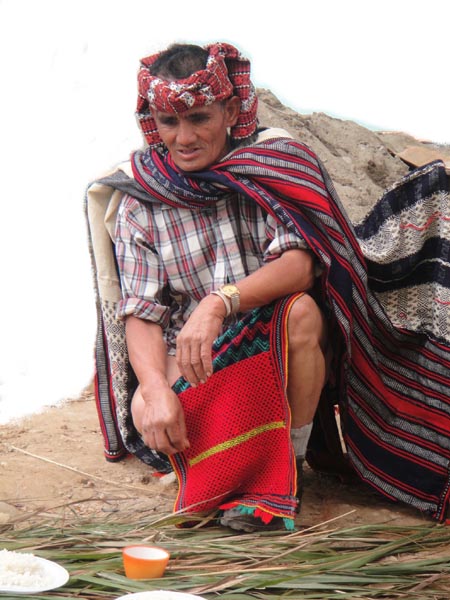
Mambunong (Igorot priest) Balili Gomez. Photo by Art Allad-iw
LITTLE KIBUNGAN, La Trinidad, Benguet – It was Saturday morning last week in Little Kibungan of this town, a mambunong (native priest) offers sliced native pig’s liver, meat, and tapey (rice wine) to the anitos (spirits). His chanted prayers: for the anitos to cleanse the villagers off any stain from their worst experience and guide them to start new lives.
Also, in attendance were media practitioners and rescue volunteers, who the mambunong claimed, should be subjected to the cleansing ritual as they also witnessed the worst disaster in the said village.
A Kankanaey mambunong from Ambiong, this town, Balili Gomez, 62, explained that the keydi (khey-di), a cleansing ritual, is also for the psychological and spiritual recovery of the survivors from what they had experienced and witnessed, which would continuously disturbed them from moving forward.
“Tapno sumardeng di didigra, gumawis nan lugar, maagasan nan sakit di nemnem, ken gumaget ay man-ubla (So that the disaster would stop, the place would recover, uplift the demoralized villagers, and regain the industry to work),” were among his prayers in the ritual done right in the devastated Kankanaey village.
From the more than 300 lives lost to landslides in the region during the height of Typhoon Pepeng, the Cordillera Regional Disaster Coordinating Council (CRDCC) said that 77 of these casualties were residents of Little Kibungan.
The avalanche from the Longlong Mountain above the village wiped out 32 houses below during the height of Typhoon Pepeng. Survivors from the totally destroyed houses already brought their dead love ones to Kibungan and other towns in Benguet after recovering their remains from the debris. “They can’t stand to come back here, as that disaster will always come back and may drive them crazy,” said a survivor.
Earlier ritual
On an earlier Saturday before the ritual, Gomez performed a ritual where seven pigs were offered for the 77 victims.
One iwik (a pointed tree branch) each was used for every native pig, said Gomez, pointing that was based on tradition. The iwik is used to hit the heart of the pig until it is dead.
After a pig is killed through the iwik, it will be burned well, sliced and the liver will be exposed for the bile reading. The pig will then be chopped based on tradition for cooking. The sliced pig’s liver and some meat and a wine – usually tapey- are used for the prayer.
In that earlier ritual however, the mambunong said that one of the pigs – after its heart was hit by the iwik and insured dead – moved while on the ground for minutes. He interpreted it as a bad omen, even if the bile position was fine. In cases like this which he says is rare, they need to repeat the ritual until it would all be fine, “as a curing remedy on the bad omen,” he said.
This is the reason why a native pig was also offered last Saturday to cure any bad omen in the last ritual.
Media participates in the ritual
The mambunong explained that the keydi ritual does not require again another seven pigs. He said that one pig is enough as what is important is the curing of any bad sign or signs that happened in the first ritual.
The Saturday ritual is a completion as the bile position is fine and that there is no more signs of bad omen.
Gomez claimed that the keydi ritual could be a blessing too. The journalists who covered the disaster in the village were not invited in the first ritual. But when they were invited last Saturday, the ritual turns to be good, he said in an interview where he was in his wanes (g-string) and apungot (head gear). The media practitioners were given watwat, pieces of meat, like the residents.
“Amin a nakita da a natay, dagidiay dakes ket sumngaw it bagi da. Isunga naawagan ti amin a tinmulong kas iti media” (All the dead bodies that they had seen, the bad things, would be cleansed from all those who witnessed the event like the journalists, explained Gomez, a native priest usually invited and without reservation goes to perform rituals when requested.
“I was taught of the various Kankanaey rituals by my ancestors (from Bakun, Benguet). I learned their legacy of performing these rituals to help people and communities, like in Little Kibungan village, move and start new lives,” he ended in Kankanaey reiterating that his function as a mambunong is a strong sense of community sacrifice and service – that is also strong in community cooperation as proven in the past Typhoon Pepeng. # nordis.net