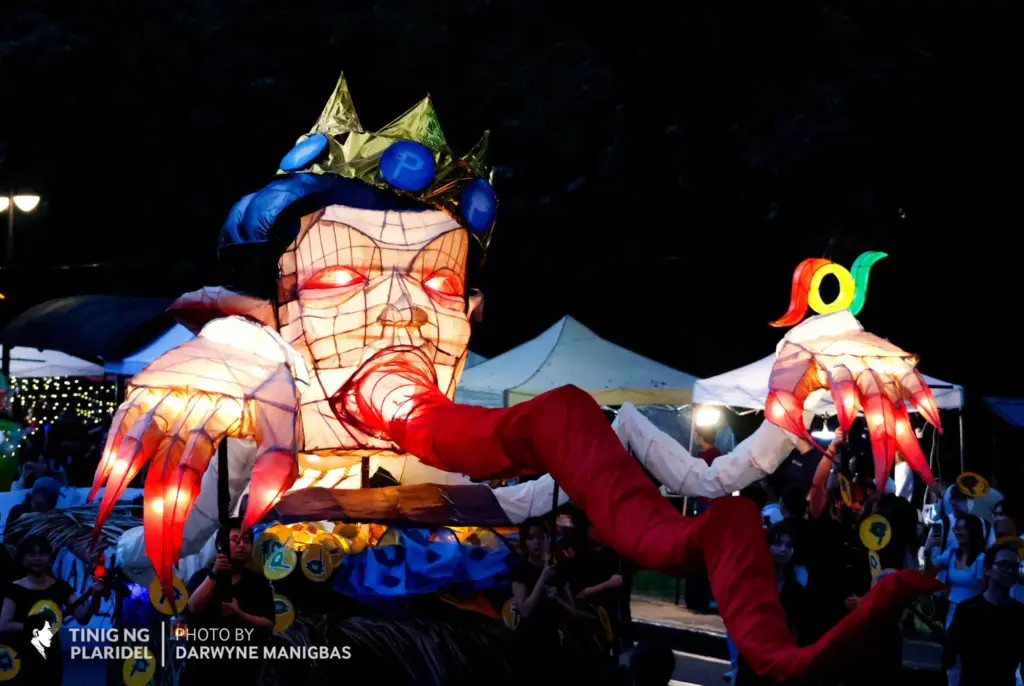
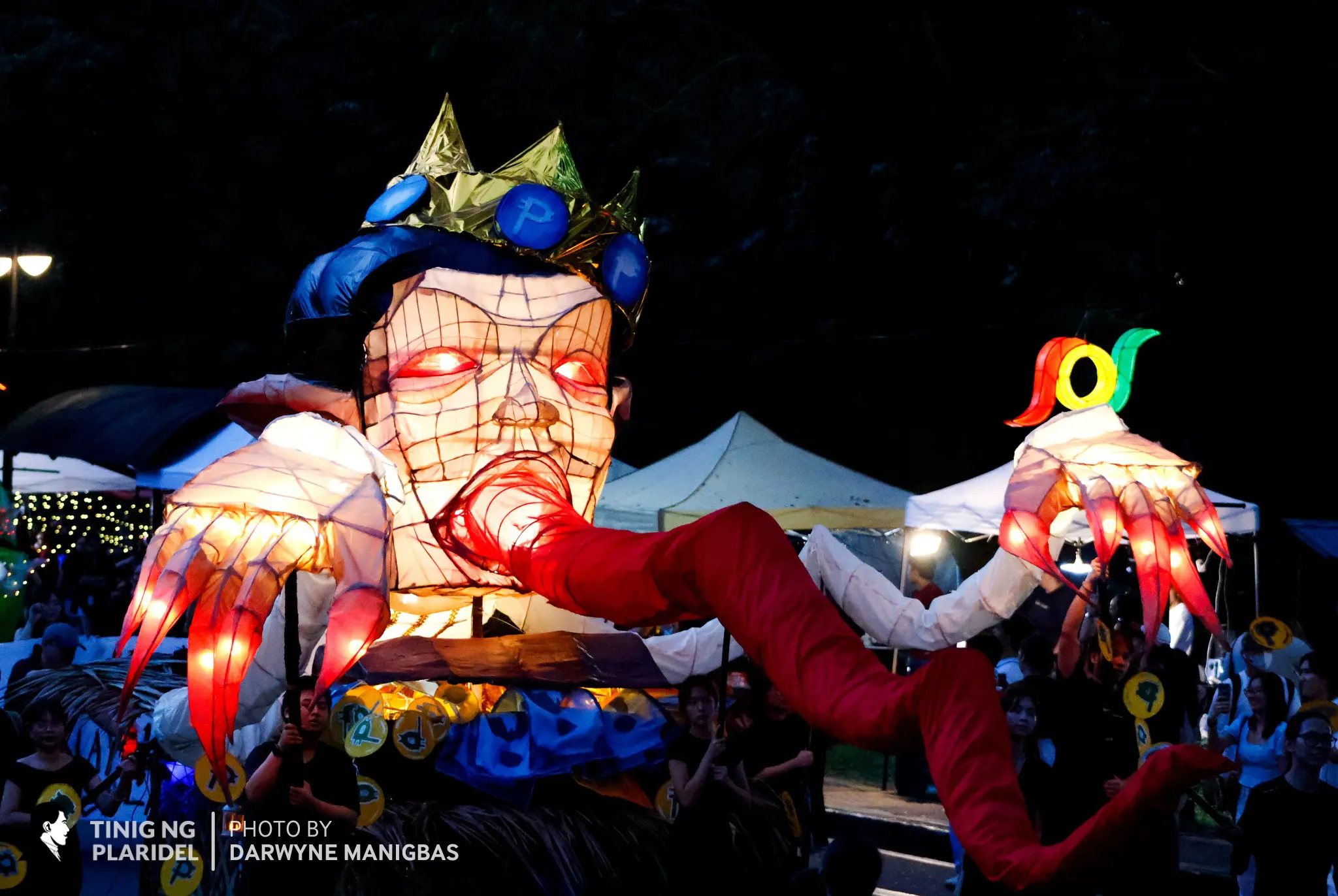
Vibrant floats depicting Filipino folklore monsters as symbols of corruption flooded the academic oval of the University of the Philippines (UP) Diliman during the annual Lantern Parade on December 17.
The 103-year-old tradition was kept alive as more than 30 lanterns were showcased.
The College of Fine Arts (CFA) “Maligno sa Gobyerno” contingent featured colorful, glowing, giant lanterns of paranormal creatures traditionally depicted as evil predators.
These creatures are linked to “corruption,” which manifests in two ways: the moral corruption of the creatures themselves and as metaphors for real-world political and societal corruption, greed, and systemic abuse of power.
The lantern titled “Manananggal” was declared first place, “Tikbalang” second place, “Bacobaco” third place, and “TikTik” fourth place.
Most of the entries are “Aswangs,” an umbrella term for shape-shifting evil creatures (vampires, ghouls, viscera suckers) described as “a community of predators, perfectly integrated into society, making it nearly impossible to tell the neighbor from the nightly ghoul.”
Manananggal is a self-segmenting creature whose upper body separates to fly and hunt for victims, while Tikbalang is a half-human, half-horse creature.
Bacobaco is a powerful, monstrous creature in Zambales mythology, often described as a giant sea turtle that can bore into mountains (such as Mt. Pinatubo) or even become an Aswang.
Tiktik appears as a bird or in other forms, known for its distinctive “tik-tik” sound. It often mimics natural sounds to deceive targets, embodying primal fears of unseen threats and hidden predators. The “tik-tik” sound signals its presence while hunting pregnant women and their unborn babies. It uses a long tongue to reach victims, and the sound grows quieter as it gets closer.
These creatures’ insatiable hunger for human flesh parallels the way corruption “eats away at the nation’s vital organs,” such as healthcare, education, and infrastructure funding.
They reflect the form of corruption that detaches itself from its human context and operates in the dark with impunity.
I have celebrated my birthday week on the UP Diliman campus several times, usually coinciding with the traditional Lantern Parade.
The parade traverses the UP Academic Oval, canopied by over a hundred-year-old, sturdy acacia trees that are silent witnesses to the travails of the Diliman denizens.
The Lantern Parade began in 1922, inspired by the folk practice of carrying lanterns of various shapes and sizes to light the way to the early-morning December Masses, or Misa de Gallo, during the Spanish period.
The lantern parade was institutionalized in 1934 by UP President Jorge Bocobo “so that students can have a frolicsome activity before the year ends.”
The Christmas event transformed into a venue for protest with an activist motif in 1969, just before Martial Law, and went on hiatus from 1970 until 1976.
During its comeback in 1977, participants carried torches as they paraded around the Academic Oval, unmoved by the ominous atmosphere of Martial Law.
“From its beginnings as a simple homage to an old Christmas tradition to the elegant, colorful, sometimes controversial creations that strut (or sometimes sputter) around the UPD academic oval each Yuletide, the Lantern Parade has evolved into an event that reflects both the people and milieu of its time, depicting the changing social and political landscape of the University and indeed, the country,” according to the UP website.
This year’s theme is “Abé-abé,” which means “togetherness” or “unity” in Kapampangan. The lanterns became platforms for larger messages addressing relevant national and global issues, including attacks on human rights, climate change, environmental degradation, and corruption.
Several lanterns depicted crocodiles as a symbol of corruption, echoing calls for accountability.
The entries were judged according to compliance with the theme, materials used, presentation, visual effects, and eco-friendliness. There are two sets of winners: the first from the entries of participating colleges and offices, and the second from the hall-of-famer CFA.
The carousel-themed lantern “Abé-abé sa KALsada” of the College of Arts and Letters won first place, followed by the Asian Institute of Tourism, the College of Architecture, the School of Archaeology, and the College of Home Economics.
“Let the brilliance of UP shine the light of hope. Today, in the midst of darkness, UP must be dealers in hope,” UP President Angelo Jimenez said in his message.
The lantern parade is a reminder that UP has molded us to fight for the causes we believe in, trained us in the skills we need to communicate ideas, and rallied others to effect change in society.#nordis.net
The author heads the Seafarers’ Division of the Sapalo Velez Bundang Bulilan Law Offices. For comments, e-mail info@sapalovelez.com, or call 09175025808 or 09088665786.