Baguio’s building permit maze: Challenges and calls for reform
FEATURE| January 12, 2025
7MIN READ
By LYNDEE BUENAGUA, RAHNDAL RICO, PILAR TORIBIO, VANYA BARACHITA www.nordis.net
Last of two parts
BAGUIO CITY—Just before 2024 ended, the Baguio City Council approved on first reading an ordinance waiving 80% of the local government’s share of administrative fines for unpermitted structures. The measure intends to provide relief for building owners fined under Presidential Decree 1096 or the National Building Code (NBC) for structures built before its enactment, acknowledging that such fines may impose an undue financial burden.
The city streamlined the process to encourage residents to comply. This includes an online platform for submitting the necessary documents and a commitment to process the application within five to thirty days of receiving the complete requirements. Building owners without permits can also submit an affidavit of undertaking, which grants them six months to process their documents.
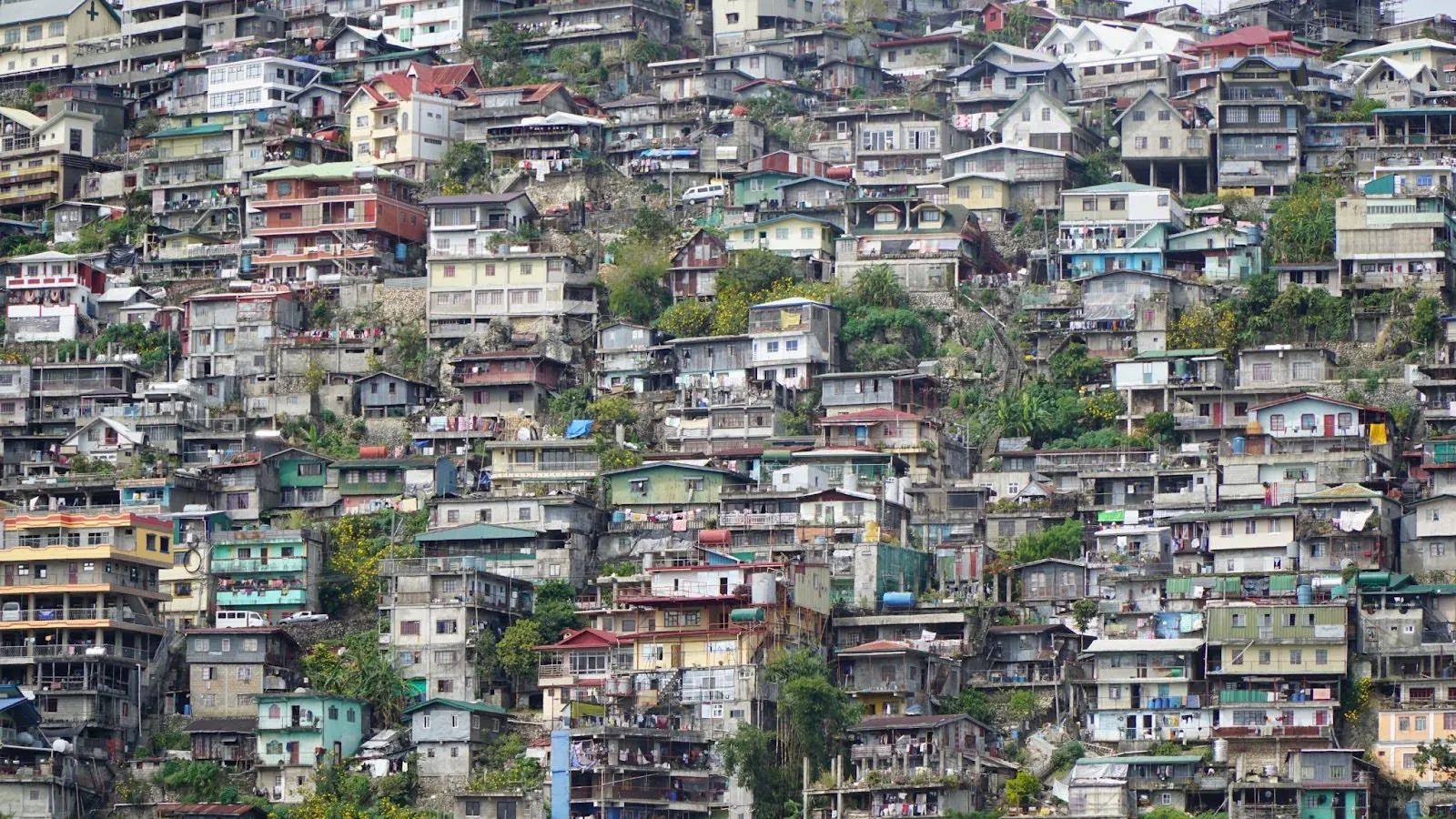
However, this is easier said than done with the staggering number of structures without the necessary permits. Beyond residents’ financial concerns, the city’s building permitting process faces challenges, including inefficiency, complex requirements, corruption allegations, and land ownership and occupancy issues.
NEIGHBORHOOD. Around 80% of Baguio’s buildings have no building permit, as per CBAO. (Pilar Toribio)
City Environment and Parks Management Office (CEPMO) engineer Jhomer Samoranos said pending applications are increasing.
“The [City Buildings and Architecture Office (CBAO)] has a lot of pending applications and tomorrow that number will grow because once an LGU approves a certain document of the applicant, it gets passed to the next office and so [the applications] continue to pile up,” he said in mixed English and Filipino.
He added that no fixed number of applications are approved daily, further slowing down the process.
Councilor Mylen Yaranon earlier noted that longtime residents now prefer buildings in nearby towns like Tuba, Itogon, and La Union due to their faster processes. She cited her experience processing permits in Itogon, which takes only a day.
According to CBAO architect Odaney Baguiwan, reviewing applications with heavily technical documents should only take 21 days to process. She said 20 applications can be accommodated in a single day.
Demolition overreach?
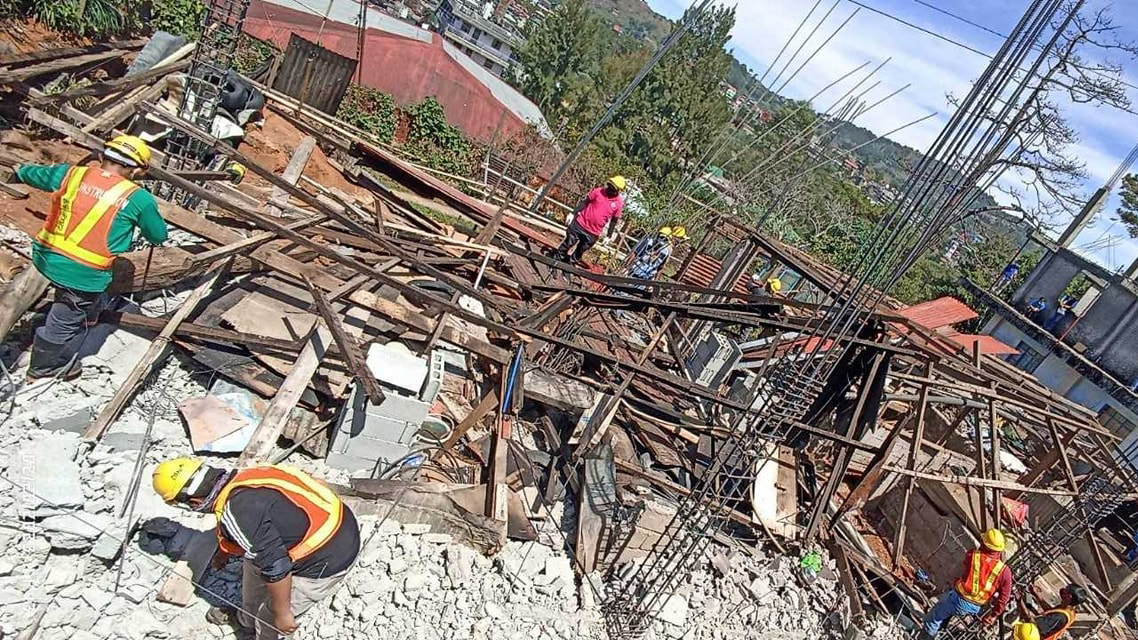
Under Mayor Benjamin Magalong, the city government has strengthened its campaign against informal settlers and illegal structures. The demolition of structures in several areas in the city has raised concerns for residents like the Balayog couple, who are struggling to acquire the necessary permit.
Baguiwan assured that the city observes due process, “We do not just issue demolition [notices] to buildings without permits unless somebody files a case.” She also clarified that the mayor’s office, not theirs, gives demolition orders.
POLICING BUSOL. The demolition of structures in Busol Watershed to protect the forest reservation has received support from some quarters in the city. (Baguio PIO)
However, lawyer and Baguio resident Francis Camtugan disagrees. Citing a recent case involving a demolition order issued by Magalong in March 2024, which his firm is handling, he argues that under the NBC, the mayor has no authority to order the demolition or removal of structures without a building permit.
“[According to the NBC,] the building official should be appointed by the Ministry of Public Works — so that’s the Department of Public Works and Highways. [Here in Baguio, it’s the mayor that appoints,” he said.
Sections 212 and 213 of the NBC state that violating the law, which includes structures without building permits, warrants a penalty of fine, imprisonment, or both. This does not include demolition unless the building is deemed dangerous or ruinous, as provided under Sections 214 and 215.
In two cases involving the demolition order issued by then-Mayor Mauricio Domogan (CA-G.R. SP Nos. 158185 and 156783), handled by Camtugan’s law firm, the Court of Appeals affirmed that demolishing structures built without the required permit is an overreach.
“Domogan was wrong; Magalong is continuing it, and it is still wrong,” Camtugan said.
However, the same decisions noted that the mayor can order the demolition or removal of a structure if there is a law or ordinance related to the issue, and only within a certain period.
“The Local Government Code grants him the power to do so, but he must ensure that all the requisites of the law have been complied with when he issues a demolition order. Otherwise, he issues it in excess of his jurisdiction,” said the ruling.
As of this writing, the city has yet to enact an ordinance setting the prescriptive period for operationalizing this authority.
Slow, complicated processes
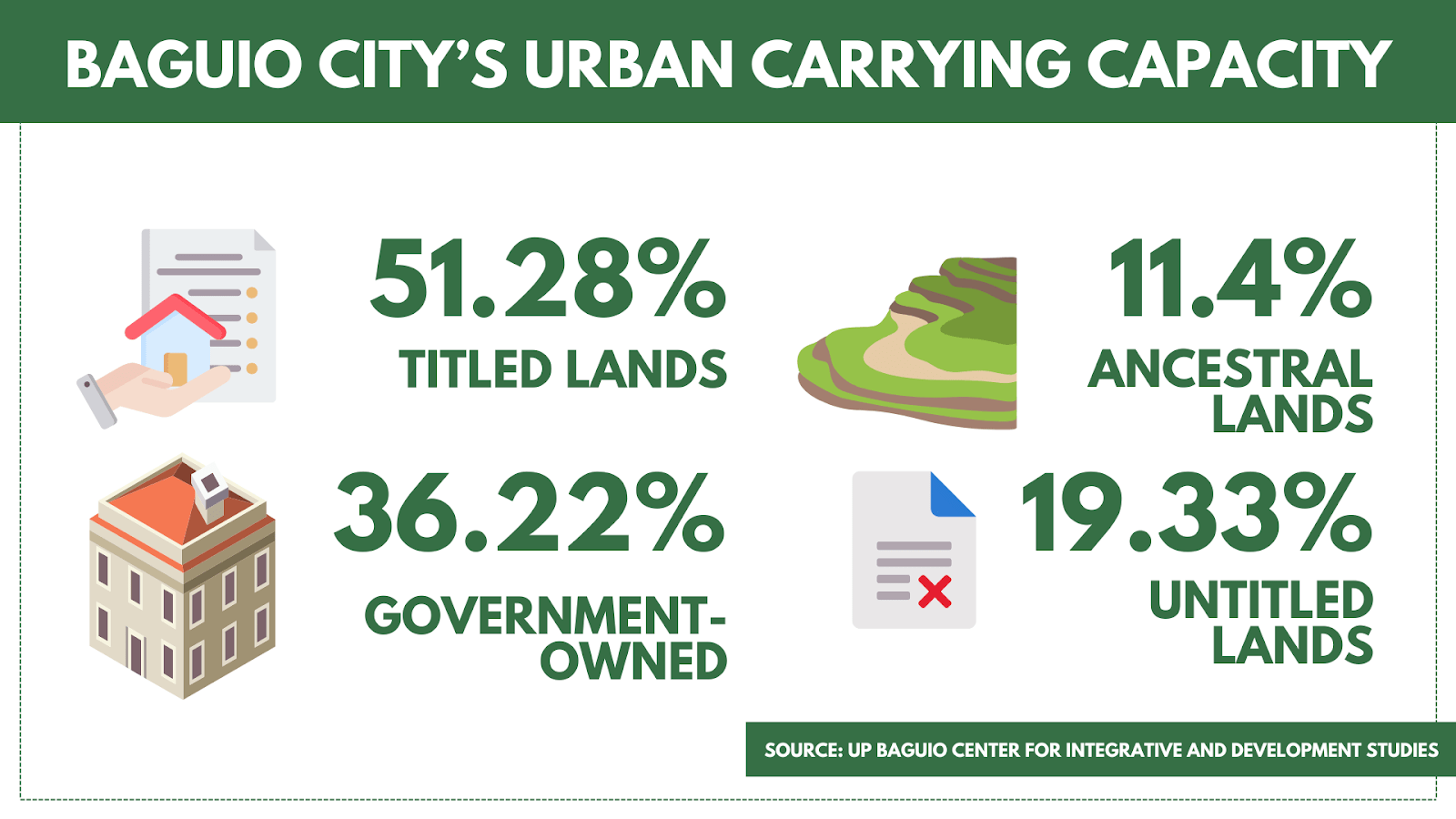
In September 2024, during UP Baguio’s public forum on the city’s carrying capacity, the City Planning, Development, and Sustainability Office (CPDSO) noted that only 51.28% of the lots are titled, 36.22% are government-owned, 11.4% are ancestral lands, and 19.33% are untitled. This totals around 118% of the titled lots, indicating overlapping land ownership.
This further complicates the already “bureaucratic and slow” titling process, which the city council acknowledged in one of its sessions. There is also the matter of unvalidated titles, land reserves, and those occupied by residential and commercial structures that are classified as forest areas.
Unfortunately, families cannot wait forever.
As Yaranon pointed out, the process does not speed up regardless of how complete an applicant’s documents are or the fees one may pay in advance. Former shanties then evolve into bigger, more permanent structures without the required documents.
“Because the land titling process takes so long, the families grew bigger, and structures become permanent yet untitled,” she said in mixed English and Filipino.
However, even those with ancestral land titles find it difficult to process their building permits, a concern raised by Indigenous Peoples Mandatory Representative Maximo Edwin, Jr., in the city council. He cited the criminal charges filed against an Ibaloi elder despite having an ancestral land title, prompting him to propose suspending the permitting process pending the resolution of the matter.
Holders of a Certificate of Ancestral Land Title (CALT), issued by the National Commission on Indigenous Peoples (NCIP), are recognized owners of ancestral home lots. A 2022 Department of Justice legal opinion affirmed that uncontested CALTs in Baguio City are as valid as modern land titles and can be used in government transactions.
Parking spaces are also required, which the CPDSO ensures when reviewing the building placement and overall structure. For instance, under Section 707 of the NBC’s Implementing Rules and Regulations (IRR), at least one off-street parking slot is required for every six “single and multi-family” dwelling units with a lot measuring 32 to 72 square meters and a floor area from 18 to 22 square meters.
BEYOND THE LIMITS. Burnham Park remains a refuge for locals and tourists. While the city has yet to breach its tourism carrying capacity, the Watershed and Water Resources Research Development Extension Center said that based on 2020 data, Baguio has exceeded its population, structures, and roads carrying capacities. (Neil Ongchangco/Baguio PIO)
More challenges
While several individuals view the city’s online application platform as a means to expedite the application process, some believe it is still tainted with corruption and other issues.
Samoranos highlighted some drawbacks of BuildPASS, including the unfamiliarity of older applicants with the technology.
According to him, some CEPMO employees have difficulty accessing the system. Constant turnovers and personnel changes also create a repeated problem for the office, which always needs to reorient employees on operating the website. Additionally, technical errors on the site and an unstable internet connection in their office further delay the approval processes.
“[There are] unavoidable technical issues. Sometimes you cannot open the attachment. Or sometimes things just load without anything ever popping up. So the site still has room for improvement, more so the [city government’s] internet,” he said.
Meanwhile, fraudulent transactions like the one experienced by Ernesto Moreno, a 59-year-old overseas worker, continue to fuel corruption allegations.
A former CBAO architect he entrusted to handle his permit while working overseas defrauded him of P120,000. CBAO issued a certification on July 22 that the individual was a former employee but had not been connected with the office since October 16, 2022.
“Pinalakad ko na naman sa iba yung building permit ko, panibagong gastos…pero matagal pa rin proseso. Inaantay namin ‘yung inspection mula sa zoning pero hanggang ngayon, wala pa pumunta,” Moreno said.
(I had someone else handle my building permit again, which meant additional expenses… but the process is still slow. We’re waiting for the zoning inspection, but until now, no one has come.)
He has been waiting for a zoning inspection since 2023.
Moreno’s experience has made it difficult for people like Camtugan to remove the notion that the process has become lucrative for those inside it.
“[They’ve turned it into a] ‘money-making’ scheme. How do they do it? So the routing goes to Engineer 1, Engineer 2, Engineer 3. [That is] 10,000, 10,000, 10,000 [pesos],” Camtugan said.
CBAO and other offices said collected fees go to the local government’s general fund, with 20% of fines allocated to the Department of Public Works and Highways (DPWH). From 2021 to August 2023, the city has collected P4 million from the accumulated building permit violations alone.
The writers called and emailed CBAO about the corruption allegations, but the office has yet to respond as of press time.
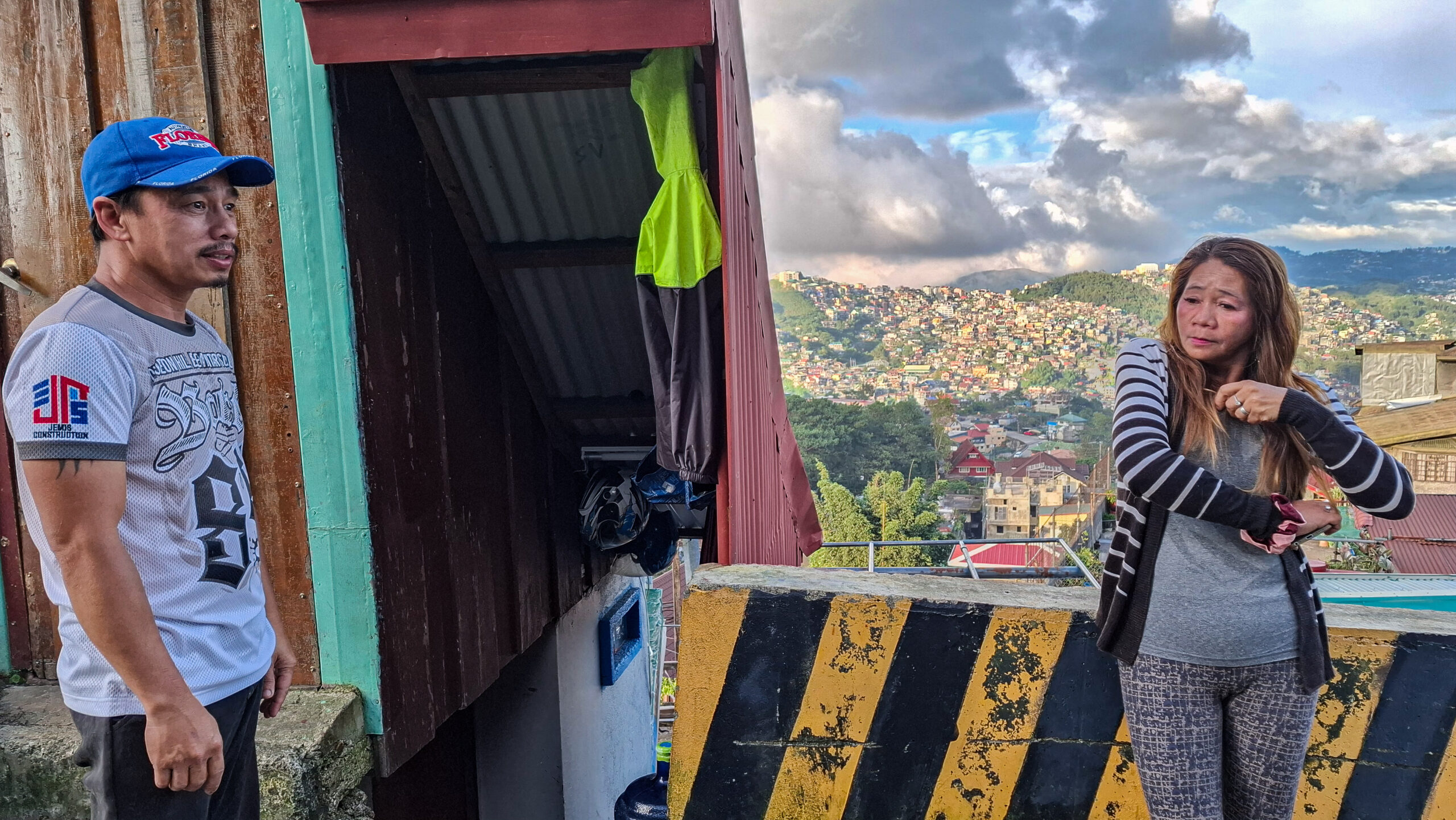
HOPEFUL. Maribel and Mario intend to finish repairs and secure their home. (Rahndal Rico)
What happens next?
Efforts to address “urban decay,” including the strict implementation of the NBC, have gained support, especially in clearing watershed areas in the city. However, this has also generated fear and concern for residents living in untitled lots and undocumented houses.
The Balayogs are just one of the few Baguio residents who received temporary relief.
“Sabi [ng] CBAO ituloy na namin pero wala [pang] budget. Basta daw pag umalis kapitbahay tsaka daw ayusin para di kami ulit masilip,” Maribel said.
(CBAO told us to continue the house repairs, but we do not have the budget yet. They suggested waiting for our neighbors to leave before continuing the repairs to avoid further complaints from them.)
However, their battle is far from over. They still need to acquire other documents before they can secure their home.
Like the couple, thousands still fall through the cracks, struggling to make ends meet and comply with the law to ensure a roof over their heads. While recent developments such as waiving the city’s share of the fines is a glimmer of hope, it may not be enough to ease the burden or ensure compliance for families like the Balayogs.
With the 2025 elections looming ever so closer, residents like Maribel hope that the election can bring their plight into the spotlight, with candidates committing to a more inclusive approach instead of driving them away. # nordis.net
*The authors are BA Communication students at the University of the Philippines Baguio. This article is part of the requirements for JOURN 106: Investigative Reporting.