Distant learning, compounding the woes in Philippine education
FEATURE| September 25, 2020
9MIN READ
By KHIM ABALOS www.nordis.net
Education is one fo the sectors heavily affected by the emergence of the Coronavirus disease 2019 (COVID-2019). As cases continue to rise and with no definite end in sight, learning institutions are forced to shift to distant leaning methods to limit students’ and personnel’s infection risk.
In his 5th State of the Nation Address, President Rodrigo Duterte reiterated that no face-to-face classes would occur until a vaccine is available.
“I will not put at risk the life of our students and teachers,” the president said.
He pointed out that schools can utilize other means of learning, such as television, radio, and modules.
To ensure unhampered learning, the Department of Education (DepEd) launched its distant learning program. The Commission on Higher Education (CHEd) also released its guidelines for the flexible learning scheme.
In general, the guidelines for both laid means to continue the learning process using available technology, the use of modules, in-person and out-of-school teaching sessions, or a combination of these methods.
However, health, particularly the spread of the disease, is not the only concern. Different groups have also raised issues of accessibility and the quality of education under the set-ups.
Despite the compounded and unresolved concerns, many educational institutions in the tertiary and basic education sectors have started their academic year.
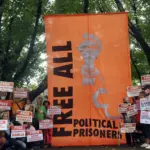
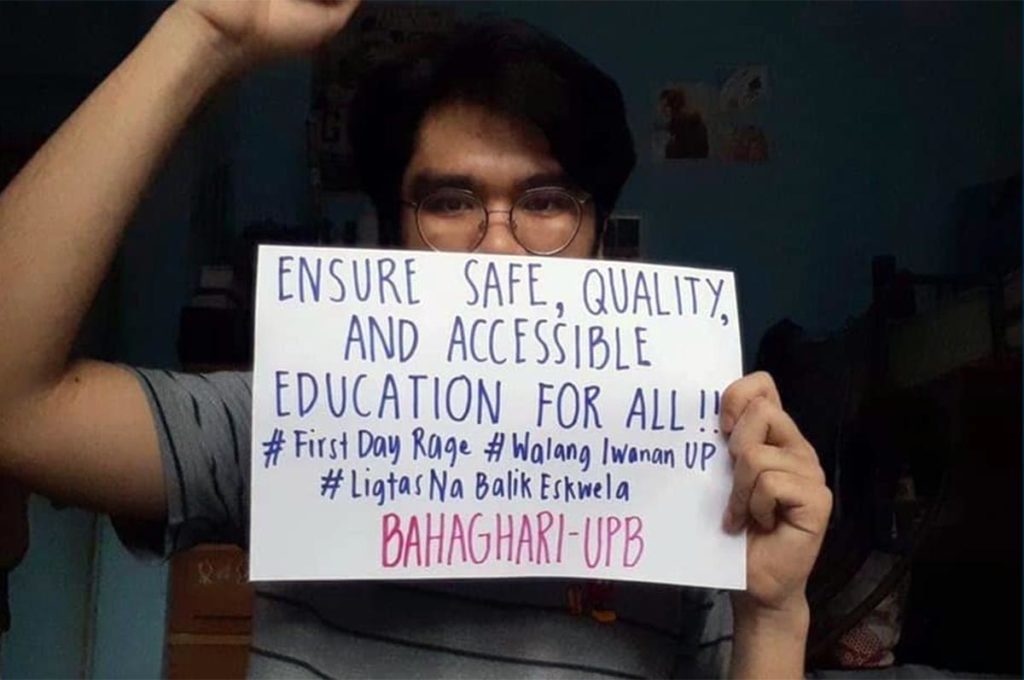
LGBTQ+ UNITED. A member of an LGBTQ+ organization in UP Baguio joins the online action to demand proactive steps from the government to ensure that no students are left behind the learning process during the COVID-19 pandemic. Photo from ACS UP Baguio.
Demands of distant learning
Mother and Baguio City resident Daisy Bagni shared the challenges they experienced with the distant learning scheme.
“Sa mga katulad kong nagtatrabahong mga magulang, kahit na gusto ko mang i-assist ang aking mga anak ay wala akong oras kasi kailangang maghanap-buhay ako para sa aking pamilya para sa paglkain at para sa mga kinakailangang bayaran kaya may limitasyon ito,” she said.
(For working parents like me, even if I want to assist my children, I still don’t have time because I have to earn for my family’s food and necessary expenses.)
Bagni, a leader of the urban poor group from Organisasyon dagiti Nakurapay nga Umili iti Siyudad (ORNUS), said parents are forced to buy gadgets and other needs for the blended learning of their children.
Despite the government’s postponement of class opening, their concerns for adapting to the distant learning and blended method remains.
She said those without regular jobs or low-wage earners would have difficulty providing all the materials needed for the system.
According to Act Teachers Union Region 1 secretary-general and school principal Florante Lachica, the modalities presented by CHEd and DepEd are not new. However, he said that implementation and practice in the country had not been that systematic and extensive.
“Internet, television and radio signals in many places are difficult. Besides the problem of ensuring an efficient delivery and retrieval system for self-learning modules, there is also the matter of attention span and monitoring for students,” he said.
The school principal explained that the sudden shift, and the absence of needed services, equipment, and facilities, made the transition chaotic and difficult for teachers and students. He said funding for school equipment, facilities, and teachers’ training to suit the present need is also a problem.
“For years, the call for higher state subsidy for education have echoed in the streets and the halls of Congress. The COVID-19 pandemic made this demand more urgent,” Lachica said.
Increase budget to address gaps
Last September 18, the Makabayan Bloc filed House Resolution No. 1217, urging the Committee on Appropriations to support the demand higher education budget. The motion intends to ensure “safe school opening” and “delivery of quality and inclusive distant education.”
The resolution said that state funding for education should receive a substantial increase “to address the gaps and challenges” under the pandemic. These include policy issues, funding for learning continuity, research and development, and academic support for specific needs in dealing with school closures and abrupt shift to digital and distant learning.
Rep. Sarah Elago of the Kabataan Party-list pointed out that the increase must match schools’ actual needs to ensure the safety, health, and welfare of students and school personnel.
“Additionally, this resolution echoes the unity statement signed by public servants, university presidents and officials, students, teachers and members of different sectors reaffirms the need to support our SUCs, and protect the right to education at all levels during these difficult times and beyond,” the youth solon added.
The resolution underscored the necessity to restore the cuts made in the 2021 budgets of SUCs to ensure quality and safe learning. Among the items that suffered a decrease are the Maintenance and Other Operating Expenses (MOOE), Student Financial Assistance Programs, and the subsidy for Medical Students.
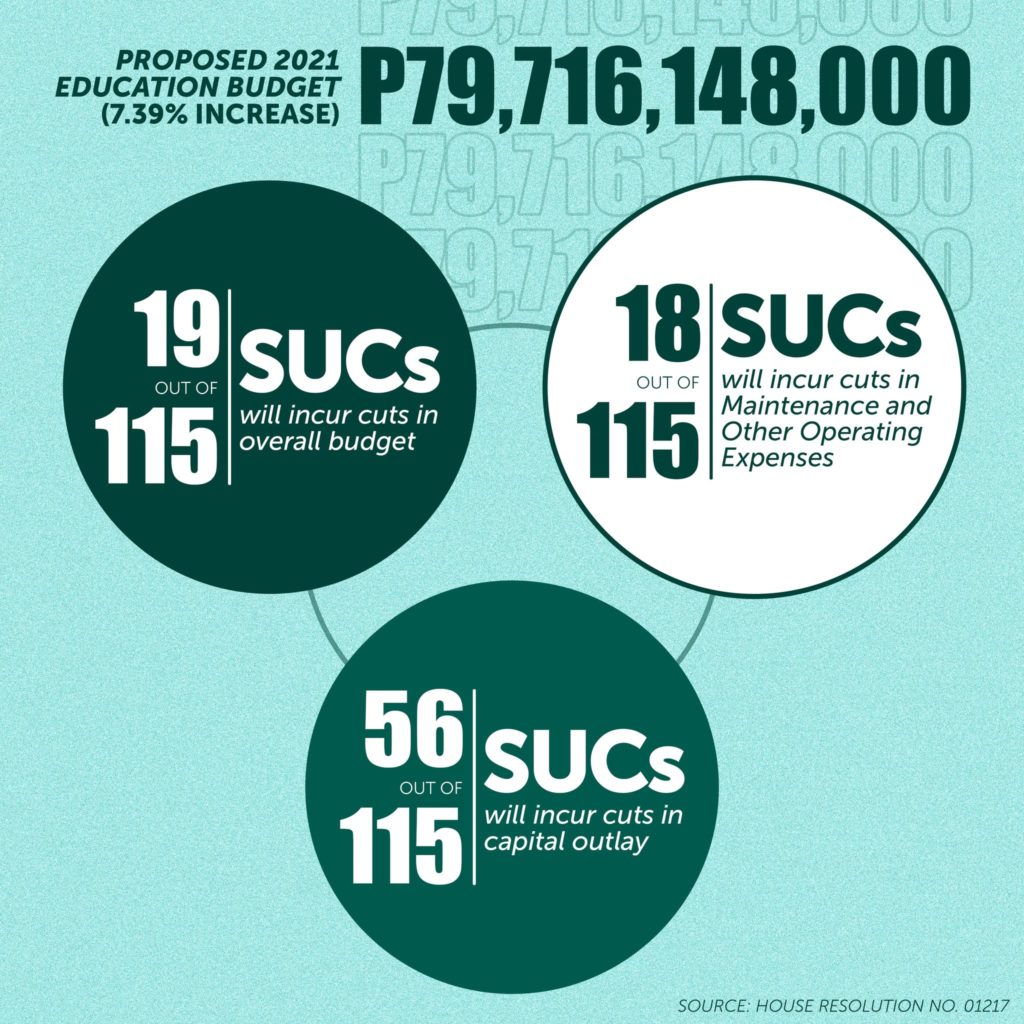
According to the document, the proposed 2021 budget for SUCs increased from the current P73.72 billion to P79.16, a 7.39% increase. However, looking closely at the proposed funds, massive cuts are expected in the MOOE of SUCs.
Nineteen out of 115 SUCs will sustain cuts in their overall budget, while 18 more will get their operating funds slashed. Meanwhile, 56 SUCs will suffer a total of P9.42 billion in their capital outlay.
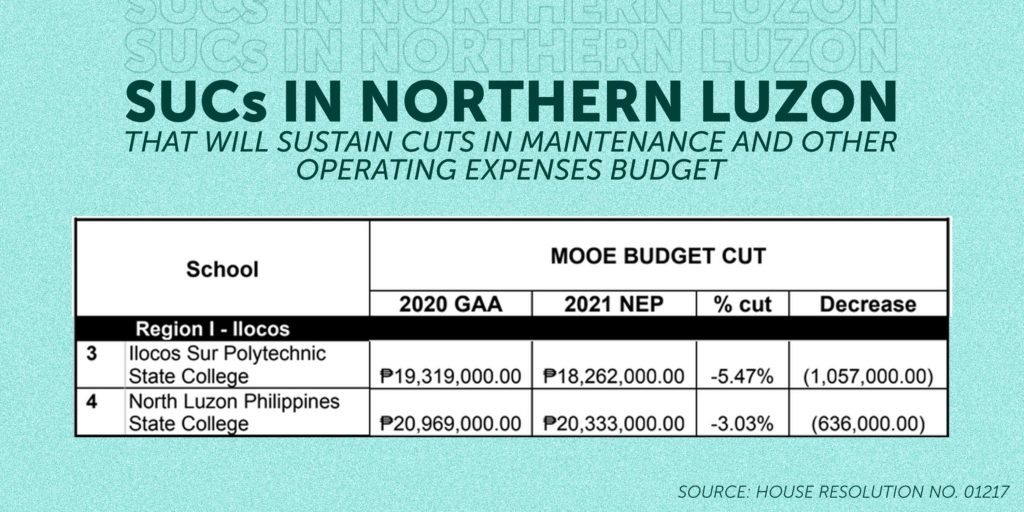
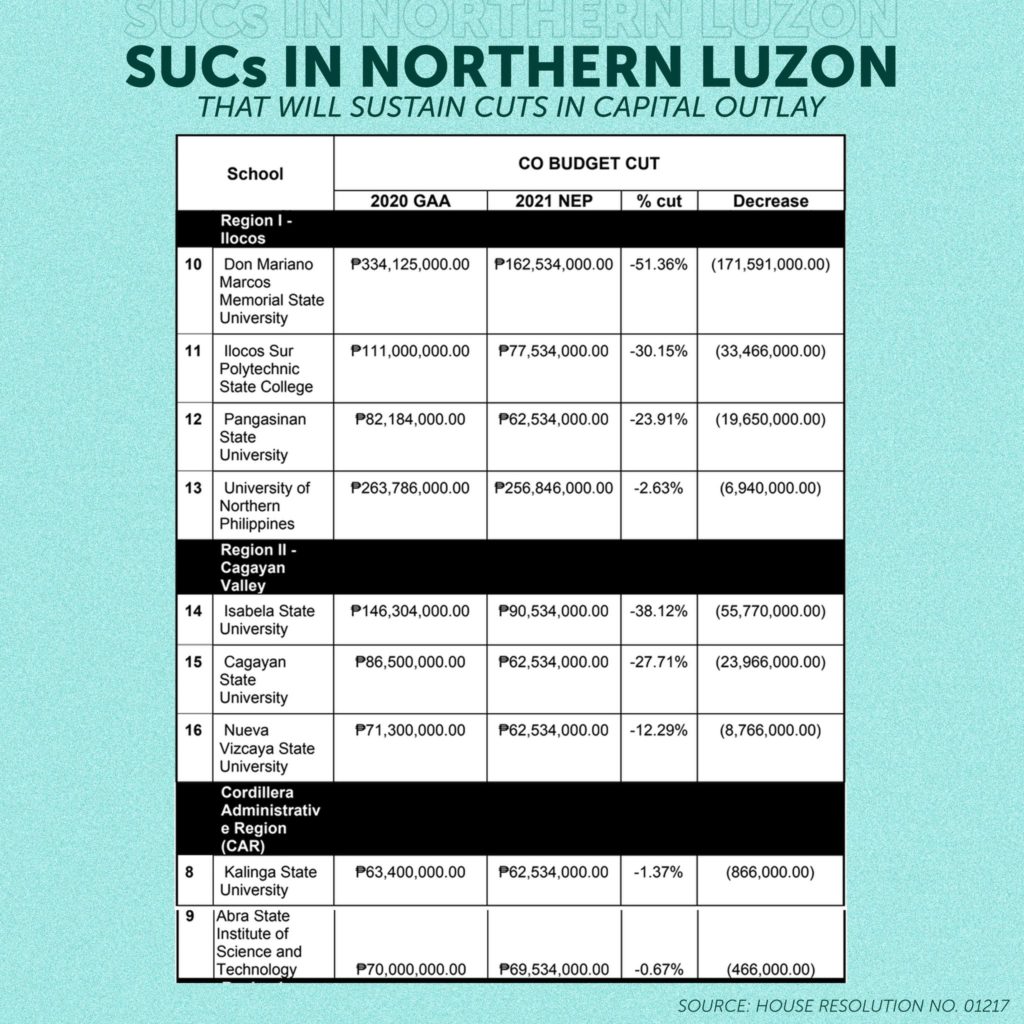
Below are the SUCs in Northern Luzon affected by the budget cut:
The Ilocos Sur Polytechnic State College (ISPSC) and North Luzon Philippines State College (NLPSC) in the Ilocos Region. The two SUCs will sustain a P1.06 million and P636,000 decrease in their MOOE, respectively.
In the Cordillera Administrative Region, Kalinga State University (KSU) will get a P866,000 decrease in its capital outlay. The current budget of the Abra State Institute of Science and Technology (ASIST) will decrease by P466,000.
ISPSC, Don Mariano Marcos Memorial State University (DMMMSU), Pangasinan State University (PSU), and the University of Northern Philippines (UNP) are set to experience a P33.46 million, P171.59 million, P19.65 million, and P6.94 capital outlay decrease, respectively.
On the Other hand, Isabela State University (ISU), Cagayan State University (CSU), and Nueva Vizcaya State University (NVSU) in Region II are also set to incur a capital outlay decrease of P55.77 million, P23.96 million, and P8.76 million, respectively.
Meanwhile, the Alliance of Concerned Teachers (ACT) Philippines reported that the lack of funding for the country’s remote learning system for basic education forced learners to share modules. The group said the situation resulted from the government’s wrong prioritization than the scarcity of resources.
“After two postponements of classes, the Duterte administration still has not addressed the most basic needs of its learning continuity plan (LCP) amid the pandemic. This is completely unacceptable, and is a violation of their constitutional mandate to guarantee accessible quality education,” ACT Philippines secretary-general Raymond Basilio said.
They are urging Congress to increase DepEd’s budget to P51.50 billion to meet the ideal allocation for module printing, translating to about P3,264 per student for the entire school year. The amount can provide a set of weekly modules for 34 weeks to 71 percent of the more than 22 million public school students. The group based its computation from the target module recipient DepEds’ survey for learning modality preference during the enrollment.
During the hearing for the 2021 national budget, members of the appropriations committee pushed for an additional P10 billion funds for module printing.
According to Finance Undersecretary Anne Sevilla, DepEd only received a stingy P15 billion provision in the 2021 National Expenditure Program (NEP). Meanwhile, P74.6 billion is the estimated budget to print modules for a year. Conservative computation puts the value at P50.4 billion.
Local initiatives pushed
With the national government’s hesitancy to provide appropriate measures and sufficient funds, sectoral groups have taken local initiatives to make recommendations to LGUs to address the matter.
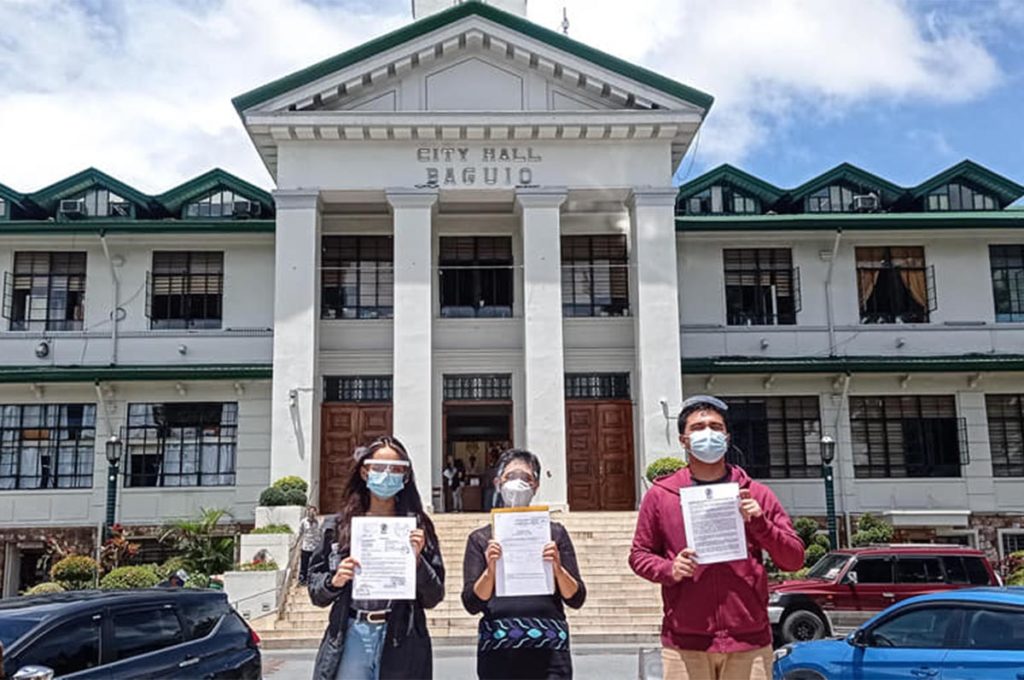
Students, teachers, and parents in Baguio City submitted a position paper on September 15, outlining their recommendations for the resumption of classes in the city.
The group, led by the R4E Metro Baguio, urged the officials to provide mandatory mass testing of education personnel, government’s full financial support for COVID-19-infected employees of public educational institutions, and improvement of the internet connection.
#LIGTASNABALIKESKWELA. Conveners Rise for Education Metro Baguio regularly engage Baguio City officials to raise concerns regarding school fees, requirements, consultations, and assistance were indicated in the position paper. Photo from NUSP Cordillera.
Signed by 45 organizations, the petition is also requesting the review of school guidelines, learning modules, and curriculum, and a multi-stakeholder consultation regarding fees.
R4E Metro Baguio also urged the city council to review the modules and curriculum. According to them, the curriculum should be “learning-based rather than output-based and is adaptive and responsive to the pandemic situation.”
The CHED guideline for the “flexible learning” provides for the review all their curriculum to make the necessary adjustments based on students and learning institutions’ available resources.
In a media briefing, ACT Cordillera coordinator Jeanette Ribaya-Cawiding raised the risk for teachers preparing and delivering modules to the students.
“Kung magkakaroon ng COVID-19 ang isang teacher, lalo na sa public education, wala siyang makukuhang assistance kagaya ng pagkakaroon ng sick leave, hazard pay, at full government financial support. Nakalulungkot dahil sila ay employees of the state pero walang assistance na maibibigay,” she said.
(If a teacher gets infected with COVID-19, especially those from public schools, they will not receive assistance, such as sick leave, hazard pay, and full government financial support. It is unfortunate because they are state employees yet no help from the government.)
According to her, teachers do not have sufficient protective equipment and health supplies to transport learning materials, posing a greater risk.
“Sa pag-iikot nila, wala silang PPEs. Kung mayroon man, it is from their own pockets tapos hindi naman ito sapat dahil kailangang araw-araw kang nagpapalit ng mask at iba pa,” Cawiding explained.
(During the delivery, they don’t have PPEs. If there are PPEs, the money spent on those came from their own pockets, and the equipment is not sufficient since you have to change them every day.)
Meanwhile, Abel Muñoz, R4E convener, said that “there is not much difference in terms of fees collection between the fees for physical classes and the fees for online learning.”
“They paid the same amount of fees, including payment for amenities, which cannot accommodate students because of the online mode of learning,” Muñoz stated.
He added that students pay a certain amount apart from their tuition to access the necessary modules for their classes. He cited the case in Saint Louis University, where students spent P1,500 to P3,000 for their online materials.
Crisis amplified by pandemic
College Instructor and R4E Ilocos spokesperson Joey Dominique Ducusin said that even before COVID-19, the country’s education system is already problematic. According to her, the pandemic only amplified the existing issues, such as lack of facilities, exorbitant fees, and unsuitable curriculums to the country’s needs.
“The economic distinction between families and the exclusivity of education became more visible under the pandemic. Maraming magulang ang pinipilit na matugunan ang pangangailangan [ng kanilang mga anak] pero meron talagang hindi makakaya,” she said.
(Parents are trying their best to provide the needs [of their children] but many find it really difficult).
She added distant learning brought not only economic challenges to parents, “maipapasa din sa mga magulang ang pagtuturo kasabay ng paghahanapbuhay nila para sa iba pang pangangailangan ng pamilya.”
(Parents bear the burden of teaching while earning for the needs of the family.)
Meanwhile, ACT Philippines pointed out that students and educators will bear the brunt of the unprepared and underfund education under the remote learning scheme.
The organization said they received reports of teachers burning out and getting physically and mentally unwell. According to the group, the extreme exhaustion is due to a heavier workload and more extended hours under the new set-up.
“As education frontliners, teachers naturally bore the brunt of the shift to remote learning—figuring out the modalities, coming up with new materials, teaching both students and parents of the ‘new normal’,” Basilio explained.
ACT Philippines underscored that teachers, who are overworked and underpaid, now have to “handle twice the number of learners than before.”
Beyond the health concerns, they noted that the government should ensure that tasks are within the legally sanctioned work schedule and with adequate compensation. They stressed that addressing the need for continuing education under the “new normal” should include measures that protect educators’ welfare and labor rights.
For Kabataan Party-list, the Duterte government will fail to address the problems if it continues to reject calls for a higher state subsidy to education. The group’s deputy secretary-general, Jim Bagano, said the menial budget allocation for education could not go on, especially under the “new normal.”
“Kailangang makita ng CHED lalo na ng buong administrasyong Duterte ang matagal ng ugat kung bakit tayo may kahirapan sa pagtugon sa continuing education sa panahon ng pandemya bago ulit humarap sa panibagong hamon ng remote learning, at isa dito ay ang hindi sapat na alokasyon dito,” he said.
(CHED and the Duterte administration need to realize the root cause of our difficulty in addressing continuing education during this pandemic before facing the new challenge of remote learning, and this is the inadequate fund allocation for education.)
Bagano said that instead of continuously bloating the confidential intelligence and presidential funds, the Duterte administration should allocate resources for adequate health facilities and services in the schools. # nordis.net