4 MIN READBy MARIA THERESA BASIA / MRDC
SAGADA, Mountain Province — On April 12-14, 2015 the Montanosa Research and Development Center conducted a muscovado orientation and processing seminar in Barangay Poswoy in the municipality of Balbalan.
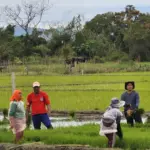
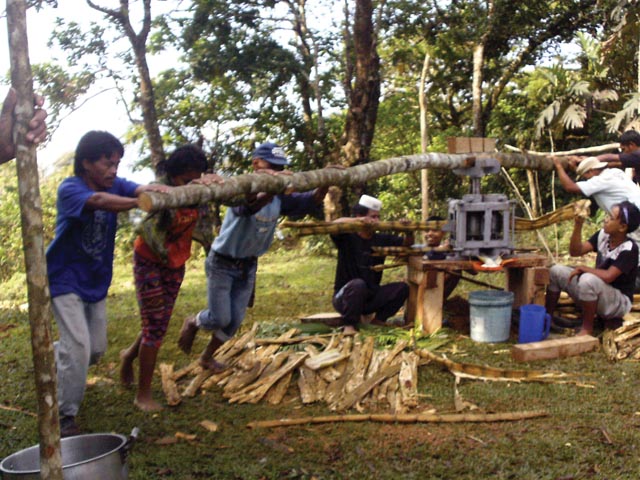
DAPIL. Poswoy folk squeezing the sugar cane juice, the main ingredient of muscovado. Photo courtesy of MRDC
The said activity was the result of the Poswoy Farmers Association for Development (PFAD) request to MRDC for Sugar cane crusher project last year 2014. As a package for the sugar cane crusher project the center delivered the Sugar cane crusher on April 11, 2015 and at the same time conducted the muscovado orientation and processing for the members of PFAD and some barangay officials that attended the activity.
Barangay Poswoy is one among the barangays that comprises the municipality of Balbalan. Based on the community profile, a household of 6 family members consume 8 kilos of commercial sugar a month equivalent to P400 or P4,800/year. The barangay with 196 households consumes about P940,800 a year. If we take the average of 6 kgs a month the whole community still spends some P705,600/year.
In connection to house holds expenditure for sugar it can go up to 10 kilos during the peak of agricultural activity because of the “pappango/alluyon which the community people are used to do. This is one of the problems confronted by the community people secondary to scarcity of rice during lean months which was the main reason why the officers and members of the PFAD came-up with a decision to seek help from the center for a sugar cane crusher and muscovado processing seminar and training to help lessen their increasing expenditure on commercial sugar through production of muscovado for house holds consumption and to minimize dependency on commercial sugar which is controlled by the big capitalist companies.
The center’s objectives to conduct muscovado in partnership with the farmers organization in the barangay was to train village leaders and members to become future trainors to their neighboring barangays. To produce muscuvado for their house holds consumption not to depend on expensive commercial sugar outside, and as a source of cash income for the house holds if they produce more for market purposes. Since muscuvado is an organic product which is good for our health there is no problem in marketing and the center is willing to help find market outlet for their muscovado products.
The training was attended by 33 members and officers of the PFAD and other individuals like the two barangay councilors composing 17 men and 16 women. The first day of the seminar was orientation on cane production where discussion focused on different variety of sugar cane based on its characteristics and differences, Maturity before harvesting and planting seasons to avoid early flowering of the sugar cane.
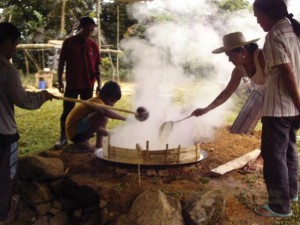
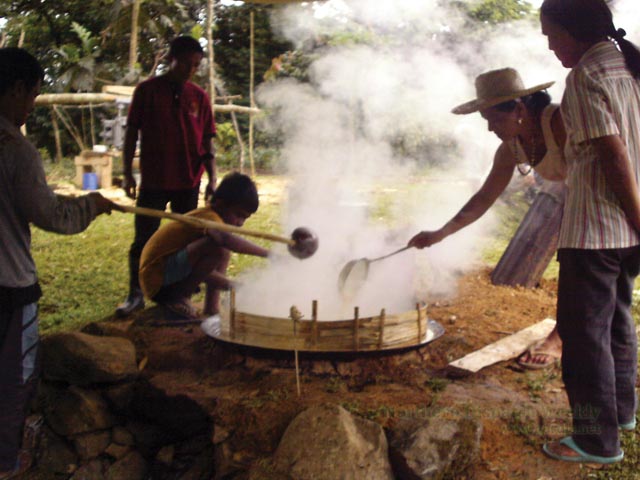
ON THE PROCESS. Cooking the enampetak to be powderized as it cools down. Photo courtesy of MRDC
According to the participants, the months of May and June are the best time for planting for sugar cane. As an opener for discussion on muscuvado processing we asked the participants to share how many kilos of commercial sugar they consumed a week and months and there were house holds that consumed 8 kilos a month and other participants said 6 kilos similar to the data we gathered. The computation and knowledge of the cost of the community sugar consumption surprised them. They realized they are spending millions of pesos on commercial sugar enriching companies like CASUCO, Asucarera de Tarlac, Victoria milling company and others.
The second day of the seminar was the practicum for muscovado processing where we cooked 5 cans of sugar cane juice and the second practicum was the cooking of enampetak. The enampetak product can be preserve for a year which the people also sold at the price of PhP100.00/tubong. However, the first trial for muscuvado processing was not mixed well and did not powderize well. The second batch was however excellent.
So that after, we proceeded to the school grounds to celebrate the success of the training and for a solidarity night program where they prepared a native pig for our dinner. The rest of the umili were invited to join the solidarity night. During this occasion the participants, particularly the women expressed their thanks to MRDC through native songs and salidummay.
MRDC also informed the participants to attend the next or trial for muscovado processing on the third day which was successful and convinced the participants to signify their interest to mobilize for sugar cane and muscuvado production as a source of income.
As a result of the seminar training many of the participants signified interest to plant sugar cane for muscuvado and basi production to maximize the use of their dapilan. We also discussed with the PFAD officers and members to pass resolutions to requesting request for additional sugar cane crushers and submit these to the Department of Agriculture in their municipality or in the province for the needs of other sitios who also have programs for muscovado production. # nordis.net