6 MIN READBy KYLE EDWARD FRANCISCO
Vigan City is a known tourist destination nine hours north of Manila and a recognized World Heritage Site by the United Nations Environment, Scientific, and Cultural Organization (UNESCO) for its well preserved Spanish houses. Anybody who visits Vigan will surely be captivated and amazed by the beauty of Calle Crisologo, especially at dusk and dawn, by the mouthwatering foods like empanada, okoy, bagnet, longanisa and bibingka, by the calesa ride and above all, the hospitality of the people.
Vulnerable to climate change
However, the fame and media coverage being received by this idyllic place goes beyond its famous Heritage Village, the food and the people. Vigan has been repeatedly mentioned as among the most disaster-prone cities in the country. In fact, the University of the Philippines-National Institute for Geological Sciences (UP-NIGS) cited Vigan as one of the major cities prone to flooding and event similar to what occurred in Cagayan de Oro and Iligan City last year because of its location, lying at the mouth of the Abra River. Furthermore, it sits astride the country’s typhoon path traversed by an average of 27 typhoons annually. Vigan is also one of the major cities that will be affected by a one-meter rise of sea level and by extreme weather condition.
Based on Philvoc’s liquefaction susceptibility map, the city is highly vulnerable to liquefaction, especially the coastal communities. In fact, more than one kilometer of shoreline of the city has been lost in the past few years. It is also in close proximity to major faults in Northern Luzon such as the Abra Fault making it highly vulnerable to strong earthquakes and tsunami. A 2007 Tsunami Hazard Map of Philvocs indicates that almost all parts of Vigan will be affected by a three meter high wave and may also experience a wave towering up to 10 meters.
A heritage threatened by mining
Vigan City, the only Heritage City in the country and one of the candidates for the Seven New Wonder Cities has been very conscious of the risks posed by the geological and climate hazards. Learning from the sad experience left by Typhoon Feria, which submerged a great part of the city, the City Government of Vigan designed and provided the necessary financial and material needs for a comprehensive disaster preparedness plan to ensure public safety. The multitude of awards received by the city is a testament to its effort not only to keep its title as a Heritage City but a place that could provide a safety and security for its people. Nevertheless, all this effort could go in vain as scores of mining applications being filed and approved, and a major operation to extract magnetite from the shores and offshore of the city is about to take place.
Vigan City has been identified by the Mines & Geosciences Bureau (MGB) along with Caoayan, Sta. Catalina, San Vicente and Sto. Domingo as areas rich in magnetite not only offshore but also along its beaches. However, the City of Vigan, being aware of the ill effects if mining has consistently opposed all applications to conduct the said activity along its coast and officially sent their message of disapproval by filing a Verified Omnibus Opposition to the MGB against Altamina Exploration and Resources, Global Titan and Colossal Mining Corporation.
However, the city’s opposition fell on deaf ears as the government ensured that mining companies go about their business unhampered. In June 29, 2010, Gloria Macapagal Arroyo approved through the former Executive Secretary Eduardo Ermita the Financial and Technical Assistance Agreement (FTAA) of Altamina Exploration & Resources covering a total area of 5,610.49 hectares including the coastal areas of Vigan City for onshore and offshore magnetite mining. An Exploration Permit (EP) was, likewise, awarded to Colossal Mining Corporation covering almost the entire coast of Ilocos Sur. Another application for an EP by the Grand Total Mining Corporation is still pending for final evaluation at the Mines & Geosciences Bureau.
According to Defend Ilocos Against Mining Plunder (Defend Ilocos), recent monitoring of mining activities revealed that equipment and structures for magnetite extraction have been installed at the adjacent town of Sta. Catalina, San Vicente and another operation is taking place at the boundary of Vigan City and Caoayan. Blacksand extraction in the coastal areas of San Vicente have drastically increased the erosion of its own beach and Sta. Catalina’s shoreline. While the operation in Caoayan, which covers around 20 hectares of beach threatens to level sand dunes which act as natural barriers against tidal surges and tsunami, and may cause siltation and increased water turbidity on the foreshore and fishpond in the area.
Aside from the threats posed by black sand extraction, the continuing mining pollution and sedimentation caused by extractive industries upstream of the river is foreboding danger to the city. Save the Abra River Movement (STARM) pointed that the presence of Lepanto Mining Corporation’s tailings dam is a clear and present threat to the communities along the Abra River, including Vigan City. The group is pertaining to Tailings Dam 5A of Lepanto, which is located in one of the head waters of the Abra River, holding thousands of tons of mining waste that may cause massive river siltation and flash flood that may cascade and reach downstream communities in case of a major dam breach citing the history of dam failures and leakages of Lepanto.
Influential people behind mining
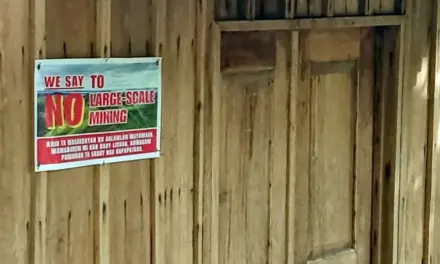
In a community visit made by Defend Ilocos in Barangays Mindoro and San Pedro in Vigan City, local folks reiterated their strong opposition to black sand extraction. However, some were very careful in expressing their views since according to them, influential individuals are behind the said mining plans and operation. Some officials even refused to participate in a group discussion due to fear of being singled-out and receiving the wrath of those behind the move to install mining equipment in between Caoayan and Vigan City.
The group further claimed that the aggressive expansion of operation of black sand extraction in the adjacent towns despite the opposition of the communities is indeed an expression that powerful individuals who include politicians are behind and are greatly benefiting from these operations in expense of the people’s safety and the environment.
Some of the local government units have expressed support and condoned black sand extraction even along its beaches by pointing the supposed economic benefits that they would receive from the companies such as roads, schools, etc. While others just kept their silence as mining equipment and structures were installed in their territory.
Even local maritime police that are supposed to guard the coastlines have been reluctant to hinder such activities despite a standing ban of Vigan City on marine mining and Batas Pambansa 265, which prohibits the extraction of gravel and sand from the beaches. Mining companies have all the liberty to seek shelter in municipalities friendly to them, placing their equipment in boundaries and getting away by imploring that they are not with the territory and/or jurisdiction of local government that resist their presence.
Disaster vulnerability compounded
One of the grounds articulated in the Petition for the Writ of Kalikasan filed by Defend Ilocos and concerned local government units; church groups and individuals in Ilocos relate to the amplified impact of climate change and geological hazards caused by mining. Vigan City is among the areas mentioned in the Writ that might suffer from accelerated coastline erosion and eventual flooding from typhoons and tidal surges if large-scale magnetite extraction pushes through.
The peasant group Solidarity of Peasants Against Exploitation (Stop Exploitation) and the fisher folk organization Timek ken Namnama ti Mangalap iti Ilocos (Timek), stressed that poor farmers and fisher folks are the immediate victims of magnetite mining both from the aggravating effect of the operation to climate change and its direct impact to their livelihood. According to Timek, the recent fish kill experienced in Lake Bito that affected hundreds of fishermen, and peasants was caused by magnetite mining operation in the area.
The group further explained that it was an illustration of the dangers brought about by the surface and bottom plume; and sediment pollution from dredging operation to extract the mineral which reduces the dissolve oxygen in the water and damage the breathing mechanism of aquatic organisms.
For its part, Stop Exploitation mentioned that the continuing damages brought about by previous magnetite mining in some towns in La Union and the second district of Ilocos Sur, in Buguey and Gonzaga, Cagayan and in Lingayen, Pangasinan would surely be repeated in Vigan City, and its adjacent municipalities once magnetite mining commence into full operation.
In the end, everything is interconnected
The issue here is not just about boundary and jurisdiction over mining operation of local government units. It is not a question, whether or not mining companies are placing their equipment and extracting minerals in areas or territory of local governments that are in favor with their operation.
The fact that the primary principle in ecology is everything is interconnected – any disturbance in the sediment transport, wave movement and shoreline topography in adjacent towns will definitely affect the coastal communities of Vigan City.
Thus, as stressed by Defend Ilocos, local governments adjacent and near Vigan, which allows the operation of magnetite mining are participants to the triggers and equally responsible to whatever hazards and disaster that may happen and destroy the pristine beauty of the Heritage Village as a direct or indirect result of the said action. # nordis.net