7 MIN READBy KIMBERLIE OLMAYA NGABIT-QUITASOL
www.nordis.net
Have you heard the story of King Midas, the king who because of his greed wished that everything he would touch turn into gold?
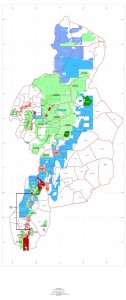
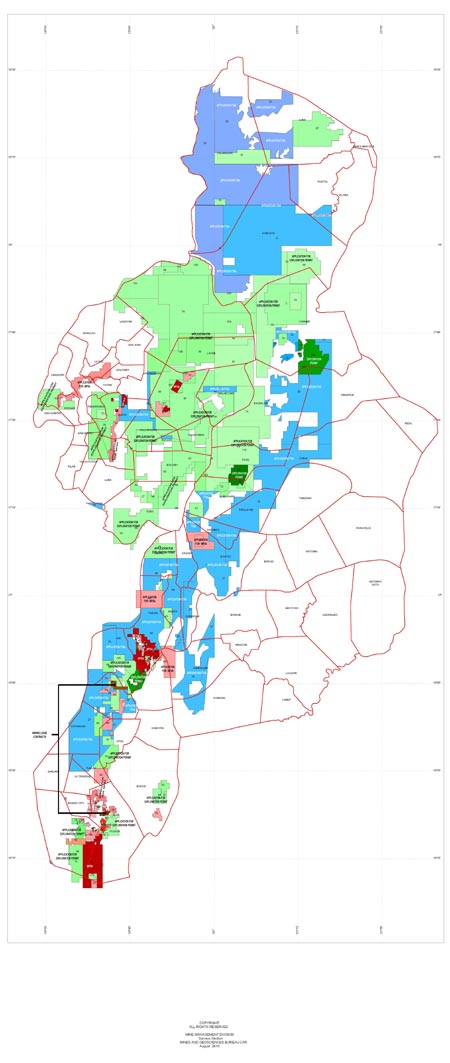
Map source: MINC MANAGEMENT DIVISION, SURVEYS SECTIONS, MINES ANG GEOSCIENCES BUREAU-CAR, AUGUST 2010
In the beginning King Midas was so happy he could turn everything in his castle into gold. But when he could not drink or eat because the moment he touched the glass of water and food all turned into gold. He was even more devastated when he turned his beloved daughter into a golden statue. Luckily when the fairy saw that King Midas has truly learned his lesson she gave him a magic pitcher and told him to fetch water from the spring to sprinkle on those that he touched and turned into gold.
Just like in King Midas, many are bedazzled by the radiant yellow glow of gold. Unfortunately not many have realized that there are things far more precious than gold. So the influx of large mining companies in Benguet lured by the high grade gold ore locked in its mountains. In their want to extract more gold they have overmined and unearthed the ill effects of their operations to only destroy sources of the most basic needs for people to sustain life.
The experience of the Benguet people proves that commercial and large scale mining operations adversely affect the environment, the water, earth and air and ultimately threatening the very existence of people.
The Ibalois of Loakan, Baguio City have learned this from the stories of their ancestors.
According to Vicky Macay, an elder and member of ASPULAN, an Ibaloi organization in Baguio, there used to be a river flowing from the present export processing zone that splits at the present airport area. One tributary falls where the Kennon Road is and the other goes towards Kias.
Macay said that due to mining explorations in the early 1900s the river dried up and the community could no longer plant rice because the source of irrigation was gone.
She added that there used to be ricefields where the Baguio airport is right now. She explained that the ricefields were their primary source of food and that cattle raising was their main source of meat and cash back then.
Some decades ago the colonial government then approved a resolution banning mining with in the boundaries of the city but by then the Demonstration mines, Black Mountain and Benguet Exploration was operational in the fringes of Loakan. The Airport and the Philippine Military Academy was also built. The river was diverted, their lands were expropriated without due process. The Ibalois were pushed to the edge. .
Itogon and Mankayan
Indigenous people (IP) of Itogon and Mankayan continue to suffer from the irreversible effects of large scale mining. The Benguet Corporation Incorporated (BCI), Atok Bigwedge (AB) and Itogon-Suyoc Mines (ISM) are all in the town of Itogon and BCInc. has operated since 1903 as a mining company.
According to Vergel Aniceto of the Itogon Inter Barangay Alliance (IIBA), the conventional tunneling method of the operating mining companies hit the water table causing it to subside. He explained that because of mine tunneling the water table drops deeper and finds other outlets depleting the host community’s water supply.
Earlier interviews with mine workers revealed that mine tunnels could be as big as a regular bedroom or a church.
“We are in constant fear of subsidence as our community has been mined out yet mining activities disguised as small scale continue. But we have no where else to go,” he stressed.
At present, small scale mining (SSM) activities exists within the mining claims of the said companies. Most of the SSMs are under contracts with the mining companies. Despite closing down in the late 1990s, the mining claims of these multi national companies remain.
Aniceto revealed that the contract lease scheme started in 2008. He said SSMs sign the contract as mining companies insist that they still own the areas. He added that most of the SSM in the area are commercialized and employ harmful chemicals such as cyanide.
He stressed that Itogon residents are forced to engage in SSM to sustain their family because the soil is no longer fit for agriculture and due to the scarce water supply brought about by destructive mining operations.
He also pointed out that Itogon’s river systems has become acidic due to mine wastes dumped by the mines. He added that the ill effects of mine wastes dumped since the 1900’s in Itogon’s river systems continue to haunt the community even after the BCI, AB and ISM closed down over a decade ago.
He further said conventional underground mine operations also require the cutting down of timber as these are used as posts for the tunnels. He stressed that for over a century of operations these large mining companies have denuded majority of the forest cover of Benguet. He added that by the time these mining companies closed down the forest cover of the province was already devastated.
In the 1980s, after employing the aged timbering mining method, BC employed the open pit mining method at their Antamok Gold Mine Concession that removed whole mountains and entire villages from the land surface to recover the minutest gold content of the land. At present the open pit area is abandoned.
The Balatoc and Acupan Mine Concession had to close shop due to unviable continuation of underground mining for deeper levels reaching below the sea level and due to the drastic fall of gold prices. While holding on to their mining claim over the Ibaloi lands, BC converted their profitable ventures into tourism enclaves, real estate development and contractual SSM activities where the mined ore is solely bought by the company at a low price and the sharing of the produce is favored for BCI.
IIB-A continues to call on all Benguet folk to move as one in addressing the problem on mining. The group calls on all concerned to revert back to the traditional way of extracting and processing gold. At the same time they demand that the mining claims of the three large scale mining companies in Itogon be revoked and that the government return the ownership and management of these land areas back to the IPs.
The said three mining companies including the Lepanto Consolidated Mining Company (LCMCo) in Mankayan, Benguet were established by the Americans when they took over the country and eventually the mining claims of the Spanish conquistadores in the 1900s. Unlike the other three, LCMCo’s large scale operations continues and it is even expanding.
Mankayan residents and other affected communities downstream the Abra River have reported alarming environmental impacts of the more than 70 years of LCMCo operations. They complained of agricultural and fishing yield, loss of plant life, death of wild domestic animals and various health complaints.
An environmental investigatory mission (EIM) conducted by the Save the Abra River Movement (STARM) in 2002 revealed that the mine waste of LCMCo in its tailings dam 5A contain high levels of cyanide and acids. This was contrary to the company’s claim that they are discharging clean water.
STARM findings also explained a phenomenon affecting all mines whether underground tunneling or open pit mines, the acid mine drainage (AMD). AMD happens when large amount of soil is dug up and exposed to the surface prompting chemical reactions and produce acids. These acids eventually wash into the rivers. The acids then melt chemical in the rocks. These acids kill off plants and fishes in the river.
The group also noted that silt have destroyed ricefields downstream the Abra River. It also found high amounts of total suspended solids (TSS) and total dissolved solids (TDS) at the mine’s carbon in pulp (CIP) mill outlet and tailings dam 5A.
According to Cordillera Peoples Alliance (CPA) data, along the 25 kilometer stretch of the Abra River, some 465 hectares of riceland has been washed out. It further pointed out that the high level of TSS and TSD from the CIP mill and dam 5A indicates that the silt in the river comes from LCMCo’s operation.
Water pollution and siltation largely contributed to the deteriorating agricultural yield in downstream communities. Rice farmers in Cervantes, Quirino, Ilocos Sur complained that their ricefields along the riverbank were cemented by silt while their animals get sick and die from drinking from the river.
Aside from polluting the Abra River, LCMCo’s operations also endangers Mankayan folk from massive land movement such as sinking and subsidence.
In August 1998, several houses were destroyed along Aurora St., after the area sunk by more than three meters. Parts of the Mankayan Central School (MCS) collapsed and was buried then.
The same year, five houses, many farms and portions of the Mankayan-Cervantes Road was washed-out after the sinking of about 14 hectares near the catchment basin of Lepanto’s mine tailings dam 5A, CPA records showed.
The next year, the MCS two-storey building collapsed entirely and 50 more houses were destroyed. In the year 2000, ground subsidence which affected more communities including Tupdak, Bulalacao and Sapid. Large ground cracks formed continuously on the Mankayan-Cervantes Road.
Last 2008, a portion of the slaughter house in Barangay Poblacion sunk after a large crack on the ground occurred.
On June 5, 2009, at least 10 meters of land sunk near the premises of St. Joseph Parish and the main grounds of the Mankayan National High School affecting at least 10 houses. The Mines and Geo-sciences Bureau of the Department of Environment and Natural Resources (DENR-MGB) later declared the sinking area in Mankayan a “danger zone”.
The air is not spared from the LCMCo operations. In the 1980s, residents complained of withering of plants, death of animals and high incidence of respiratory illness due to the copper ore drier exhaust. In 2000 the residents again complained of the same problems due to the Tohking exhaust.
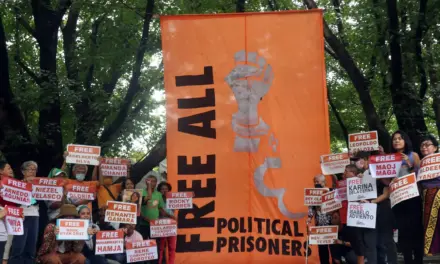
These affected communities have staged protest actions, signed petition papers and lobbied to concerned government agencies and local government units (LGUs) for the stoppage of LCMCo operations but to no avail.
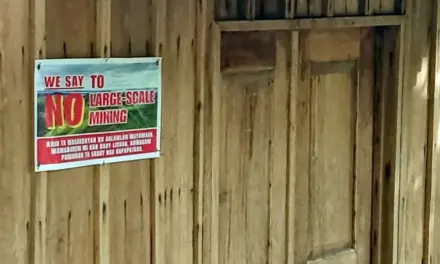
The national government is bent on pursuing its mining revitalization plan despite of the strong opposition of various IP groups and supporters. In line with the government policy of export oriented and import dependent economic strategy, it has again opened up the countries natural resources for extraction and gargantuan profit earning for joint big comprador and multi-national mining corporations at the expense of the IPs.
Unfortunately, in the real world there is no fairy godmother to would provide a magic pitcher to reverse the environmental degradation brought about by the incessant hunger for gold and other minerals. King Midas learned his lesson only after he was famished and lost his daughter.
Aniceto asked, “must we wait for the day when there is no water to drink, no fertile soil to plant on? What kind of environment would the next generation inherit? …There is still hope, all it takes is a unified and concerted action to reclaim the people’s sovereignty over gold.” # nordis.net