4 MIN READBy ALDWIN QUITASOL
www.nordis.net

Tree planting as one of the highlights of the first Ibaloi Day. Photo by Aldwin Quitasol
BAGUIO CITY — After many decades of discrimination as the original builders of Baguio, the Ibaloi clans of Baguio – Benguet flocked to Burnham Park to celebrate the first ever Ibaloi Day.
Last November 2009, the city council passed a resolution declaring every February 23 as Ibaloi Day. The resolution was in recognition of the original indigenous inhabitants of Baguio and also of the struggle of national hero, Mateo Cariño for the recognition of ownership or native title to his ancestral land.
Cariño filed a land registration case with the US Supreme Court in 1901 over his pasture lands which were originally known as Ypit and Lubas. Cariño’s lands were grabbed by the American colonizers for which the Camp John Hay was established as base for the American soldiers. The legal proceedings of Cariño’s case lasted for six years. It was a year after Cariño died when his ownership over the land was affirmed through native title by the US Supreme Court on February 23, 1909.
The native title, because of the struggle of Cariño for respect and recognition, was integrated into the Law of the land and recognized even in international laws. It has given indigenous communities all over the world a means to redress land grabbing of their domain by outsiders mostly by deceit, bribery and military might. Thus, the first Ibaloi Day is significant in the fight of the Ibalois for their lands which was taken away from them for over a century ago.
At present, the descendants of Cariño are still demanding for justice as the lands fought for by their ancestors continue to be taken away by government agencies or improperly processed in favor of fraudulent individuals or groups.

Bendian dance. Photo by Aldqin Quitasol
The first Ibaloi Day hosted by descendants of the original settlers or Ibaloi clans in the general area of the city. It was held at the space between the Burnham park Orchidarium and the Children’s Park. It is said to be the location of Cariño’s pasture land in Kisad.
The festivity for Ibaloi Day started with the traditional Uwik or the sacrificing of a pig to open the occasion and to gather the people. A Mambunong or native priest officiated in the ritual with recitation of traditional Ibaloi prayers with the reading of a pig’s bile and liver for good luck. Ecumenical prayers were also offered with Bishop Carlito Cenzon and some minister descendants of the original clans.
The program then proceeded with the beating of the kalsa (gong) and solibao (indigenous drum) and dancing the Tayaw (indigenous dance) followed by the uu-way-adivay (indigenous cheer). A group of elderly women presented the Bendian dance (Ibaloi victory dance) symbolizing one of their triumphs in defending the Ibaloi identity.
Some Ibaloi youth also presented a colorful dance to symbolize unity. The old women opened the tapey (rice wine) and served it with camote and kahoy (sweet potato and sago).
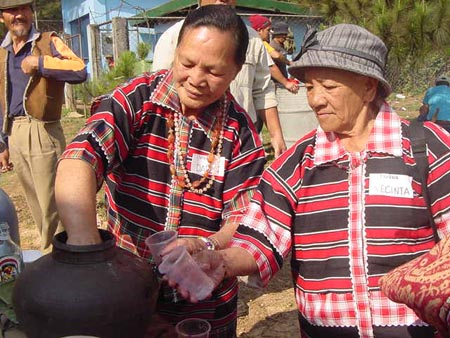
Ibaloi elders preparing to serve the Tapuey. Photo by Aldwin Quitasol
The program included speeches and stories of old from some of the representatives of the clans. They traced their lineage and retold stories that their forefathers narrated to them.
They spoke of their pride in keeping the Spanish colonizers at bay and how they were nearly wiped out as a people. They spoke of their sharing the land with outsiders since they could not possibly use all the mountains and now ironically, they are the ones who are treated as squatters.
Messages of unity from the city officials were heard. Mayor Reinaldo Bautista said it was fitting that this part of Burnham Park be declared Ibaloi Park or Mateo Cariño Park to honor a revered national hero and his contribution to the recognition of indigenous peoples rights. One of the Ibaloi speakers said that February 23 made every Ibaloi proud leaving a challenge that they should continue the struggle to defend what their forefathers started.
Councilor Isabelo Cosalan Jr., an Ibaloi called for his fellow Ibalois to mensaksakhey or unite to further strengthen the Ibaloi identity. Engr. Virgilio Aniceto, 5th nominee of Katribu partylist and an Ibaloi himself, joined the Ibalois to be with other indigenous peoples in protecting their environmennt, their cultural heritage and ancestral lands.
With the assistance of Aniceto, the clans were called to plant a tree each and invited to take care of the tree as the stewards of the Baguio and Benguet environment from which the future generation shall benefit from.
The activity was also highlighted with the burying of a time capsule. Various documents of the Ibaloi struggle and significant papers were among the items placed in the time capsule. It was spearheaded by distinguished Ibaloi grand matriarch, Cecille C. Afable and city officials and local leaders.
A first in the tradition of the tayaw, the young members of the Shiva ni Duakan performed the whole day long with their Ibaloi elders who invited the guest and city leadership to join in the dancing.
In the afternoon, the Handy Guidebook to the Ibaloi Language written by Ibaloi Sofia Anton was launched. The said book is not only for the Ibaloi language enthusiasts but for the Ibaloi youth who seemingly do not know how to speak their native tongue as they speak much of English, Ilocano or Filipino.
The occasion was very well attended and the City Officials pledged their support as the Ibaloi elders promised a yearly celebration of the Ibaloy Day. # nordis.net