








Not a question of who, but what — Tuazon
3 MIN READ
BAGUIO CITY (Mar. 12) — It is not just a question of who, but also what will replace a rotten government, according to a corruption analyst.
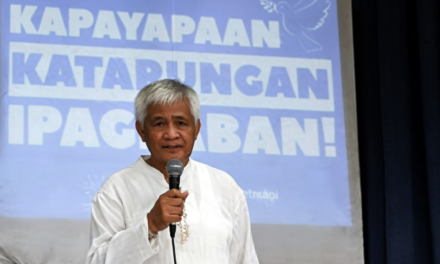
After being asked what comes next after the Arroyo ouster, Prof. Bobby Tuazon, Center for People Empowerment and Governance (CenPEG) director of Policy Study, Publication and Advocacy program, raised the possibility that the answer may lie in asking what should replace, instead of merely asking who will replace Arroyo’s seat of power, during the recently held Kilos Kabataan Kurapsyon ay Labanan forum, here Tuesday.
“I was often asked who will replace, now I say what should replace,” Tuazon asserts, earlier establishing that constitutional succession does not guarantee a long-term solution against corruption nor mal-governance.
He then proposes an extra-constitutional approach that may possibly bring out the needed reforms – a citizen’s transition council, backed by a critical mass.
Tuazon contends that “since we are entrusting temporarily our ‘sovereign power’ to the corrupt officials – at any time they exhaustively abuse it – we have the right to take it back. And if it is through extra-constitutional means then the people should have to decide on that.”
According to the CenPEG director, any people power undertaking essentially leads to an extra-constitutional solution, but to be able to bring about true reforms by means of a people power, you need a critical mass.
“In our reading (of the situation), we will only be able to reach a critical mass when the leading elements of organization have already united on what should be the form of transition government)and it will be a head on collision with the most despicable ruler, most corrupt president we ever had in the Philippines,” Tuazon surmised.
Presenting other possible scenarios, he assures the backfire of constitutional succession in ushering real reforms and in the pursuit of a clean government.
“Constitutional succession, under Noli de Castro will not work. Will he charge Arroyo for extra-judicial killings, for cheating in the election? Hindi – ang pagkakaabalahan niya, yung 2010, to make sure he will be elected,” (No. He will be more preoccupied in making sure he will be elected in 2010) he stressed.
On the other end of the spectrum, he claims that if we allowed the president to stay in power up to the end of her term we are bound for “a major political convulsion” which will eventually ensue in a real people power scenario in the future.
“Why? Because corruption is not solved; NBN is not solved; the constitutionality of Arroyo is not solved. The people have already grown impatient,” he added.
Early on Tuazon pointed out how endemic and systemic corruption had become, afflicting even the attitude of the people towards governance. As one of the audience in the forum puts it, “people (generally) think that we can’t do anything about corruption.”
Accordingly, in a Political and Economic Risk Consultancy (PERC) latest study, the Philippines now ranked as no. 1 most corrupt country in Asia, garnering a score of 9.40 out of the possible 10 and an average of 9 in the scale of the seriousness of the problem of corruption in the public sector. The Hong Kong-based corruption watchdog recognized that the Filipino people have grown tired of the failure of the government in fighting off corruption.
According to Tuazon at the back of it all is a call for genuine reforms. “Ito yung hinanahanap sa mga rallies, sa mga forum. Palaging nandyan yung panawagan sa solusyon. (This is what they are constantly seeking for in rallies, in fora; there have always been a call for a solution) The people are just waiting for reforms,” Tuazon added.
The forum embarked not only on current situation of corruption in the Philippines and the role governance in the aid of corruption but also revealed the unequal power equation that has always favored what he called the ruling elites.
As Tuazon puts it at the beginning of the forum, “There is an end to corruption. Only the people can decisively solve it by making it as part of their protective struggle.” # Danica Sophia Oliveros for NORDIS