





UN rep hears cases of political killings in northern Luzon
3 MIN READ
Victims’ kin long for justice
BAGUIO CITY (Feb. 17) — Believing that justice is not elusive, survivors of the victims of extra-judicial killings in the Cordillera, Ilocos, Cagayan and Central Luzon regions presented cases involving their kin to the United Nations Special Rapporteur on extra-judicial, summary or arbitrary executions who is on an official visit in the country upon invitation of the Philippine government.
UN Special Rapporteur Prof. Philip Alston heard the testimonies of the families, survivors and witnesses of at least 14 cases of extra-judicial killings from four regions north of Manila. The hearing is part of Alston’s February 10 to 21 visit to the Philippines to hear cases in various parts of the country.
In his sharing yesterday evening with the victims’ families and civil society organizations, Prof Alston elaborated that his mission is under the mandate of the UN Human Rights Commission where he will hear the testimonies of victims and witnesses, to come up with a report, and recommendations – including policies – to the government on how to address the issue on killings.
Cases presented
Considered unsolved by relatives, most of the cases of extra-judicial killings have shown involvements by state agents particularly from the Armed Forces of the Philippines (AFP). The cases included: Albert Terredaño, a government employees leader in Abra; Kalinga tribal leader Rafael Marcus Bangit; Alyce Omengan-Claver, wife of ambush survivor Dr. Constancio “Chandu” Claver; Kalinga hunter Victor Balais and Francisco Tangbaoan according to the Cordillera Human Rights Alliance (CHRA), one of the sponsors of the visit.
Cases where killers were identified but mostly un-arrested include: Jose “Pepe” Manegedeg III, killed in Ilocos; Romeo Sanchez, a Bayan Muna leader and journalist killed in broad day light in Kayang Street of this city; Baby Mendiola and husband Ricardo Balauag, killed in Isabela; Jose Javier and Antonio Licyayo, both peasant leaders in Cagayan killed by alleged military. Alston also heard the case of United Church of Christ in the Philippines (UCCP) Pastor Billy Austin who survived an assassination attempt in Vigan, Ilocos Sur. In the case of Jose Doton, a Pangasinan peasant leader, one of the suspected killers was arrested but the other is still unidentified
The cases presented are part of the 833 extra-judicial killings and 193 cases of forced disappearances documented since January 2001 to the present by Karapatan, a national human rights alliance, CHRA claimed. CHRA report last year showed that the most violated right in the Cordillera is the right to life with 26 cases of politically motivated extra-judicial killings.
Deeper root of killings
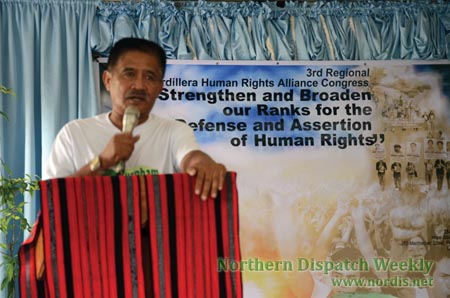
“I am glad that the investigation of the political killings were brought to the higher level,” says Bishop Carlito Cenzon, who delivered the welcome remarks, adding that these killings did not keep us silent as manifested by the growth of the alliance to keep watch the threat on life and liberties.
“I continue to call upon your visit to look into the consequences of the root problems and help build the picture on what is happening with us,” Cenzon added.
CHRA and civil society organizations in the northern regions claimed that the killings were due to Pres. Gloria Arroyo’s policy called Oplan Bantay Laya which make the government accountable for violations.
Visit
Alston’s visit in the Philippines resulted from numerous complaints filed by Karapatan, a human rights organization and the Cordillera Peoples Alliance to the UN to look into the unabated political killings in the country.
Alston is the second UN Special Rapporteur to come to investigate human rights violations this year.
From February 2 to 3 Dr. Rodolfo Stavenhagen, UN Special Rapporteur on the Situation of Human Rights and Fundamental Freedoms of Indigenous Peoples, returned to the country to follow up on his 2002 recommendations. Stavenhagen reacted that the same issues were not addressed.
Alston’s itinerary also includes calls on related government offices, among which are the Commission on Human Rights, the Melo Commission, the offices of the interior and local government, defense, justice police, the armed forces and the investigation bureau. He is also expected to talk with civil society groups in Mindanao when he stops in Davao City. He will also talk to the joint secretariat of the Joint Monitoring Committee (JMC) of the National Democratic Front of the Philippines (NDFP) Nominated Section. He will also talk with other formations that include the Moro Islamic Liberation Front (MILF) and the Moro National Liberation Front (MNLF).
Alston’s UN office has the mandate to undertake fact-finding country visits upon invitation by host governments. Its findings and recommendations may be forwarded to the UN Commission on Human Rights as basis for its dialog with concerned government and follow up its recommendations.
Alston is also the Special Adviser to the UN High Commissioner for Human Rights on the Millennium Development Goals. # Arthur L. Allad-iw for NORDIS