










Looking for idyllic Lubuagan
3 MIN READ
By DENISE O. BANHEH

Tito Sanqui/NORDIS Photo
When I think of the hinterlands of the Cordillera, I think Kalinga. My grandmother who grew up in Mt. Province used to tell me stories of people “who came as far away as Kalinga.” Even for somebody from the Cordillera, Kalinga keeps a promise of mountain living that is still “savage” and “exotic,” authentic. A land of tribal war where men are tall, dark and muscular with tattooed chests, women bare-breasted adorned only with heirloom Chinese beads that crisscross their bodies from shoulder to waist. Just like in a Masferre photograph. The women are strong. They carry as much as ten clay pots piled one after the other on their heads to fetch water. They are a fierce nation, both men and women, that should not be provoked, my grandmother said.
Six hours by bus via Baguio to Bontoc, Mt. Province, and four hours by van from Bontoc to Kalinga traveling a narrow dirt road carved on the side of mountains following the Chico River. Not unlike many roads in the Cordilleras. My destination is a small town center called Lubuagan in the heart of Kalinga Province, where tourism is not a major industry. Quite honestly, I was prepared to see a mountain village so remote it was untouched by the outside world. I did after all spending 10 hours on bus and van to get there. In danger of over romanticizing the Cordillera culture, I was secretly hoping to meet a headhunter or two. But perhaps I should have listened to my grandmother with a little more caution. Not everything grandmothers tell their impressionable grandchildren is reliable. Or even politically correct. She’s in her mid-eighties and lived in a different time.
For one thing, women in Lubuagan are hardly bare breasted in public anymore. The tattoo culture has all but disappeared and I didn’t find anybody admitting to be a headhunter. That would have been fun to see, but I wasn’t too disappointed. Fortunately for me, men still wear the traditional g-string (baag) for ceremony and dance. That was enough. All men, Cordilleran or not, should wear a g-string in public once in their lives. Added fertility points if they danced too.
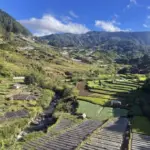
A small village of about 10,000 people, Lubuagan is ideally situated on a leisurely sloping valley between the ‘lowlands’ and the ‘highlands,’ a geographic feature that provides for a unique mix of cultures. The people of Lubuagan enjoy coconuts and Ilocano style homes but they also build rice terraces that the municipal officials boast can rival those of Banaue, Ifugao. The climate is mild, the roads are paved, and the entire village is lined with a multi-million peso irrigation and canal system any developed city in the country can envy.
The town mayor, Johnny Dickpus, doesn’t hesitate to inform visitors that among these series of canals, not far from the town center is a true tried and tested fertility spring. It is not uncommon for families who live by the spring to have at least ten children. An unusually high number of couples bear twins. The mayor swears by odd incidents of infertile couples who come to drink from the spring and shortly after become pregnant, with twins no less. The water source of Lubuagan is located further up the valley. The old men of the village say that enemies have tried many times to poison this water source but failed because the water of Lubuagan is protected and blessed by their tribal god, Tob-ye. Water is life anywhere in the world, but in Lubuagan it is also better than Viagra.
Another thing very special in Lubuagan is their Emilio Aguinaldo Park right in front of the municipal hall. There you will find a very unimpressive concrete statue of General Emilio Aguinaldo in his flaking painted clothes sitting in front of a writing desk. The statue’s head with that famous flat top haircut, is too small for its body. Beside the General, is a concrete horse with a broken tail that children like to climb. The Lubuagan Emilio Aguinaldo Park may be dismal in appearance, but it does not pale in historical significance. Not many small towns can claim to be the capital of the First Philippine Republic. The capital of the First Republic in Asia to be established by Asians which only lasted for two years.
Not long after Aguinaldo was sworn in as the president of the First Philippine Republic in Malolos, Bulacan, the Philippines lost independence to the United States. This made Aguinaldo a fugitive and fugitives can only run to the mountains, which is what Aguinaldo did. He not only went to the mountains, he went to Lubuagan, where he spent most of the year 1900. But then he was betrayed and had to flee again, and was soon after captured by the Americans in Palanan, Isabela. If ever you are interested in tracing the General’s plight from his American captors, Lubuagan is an important stop you cannot miss. #