3 MIN READ
By KIMBERLIE QUITASOL
www.nordis.net
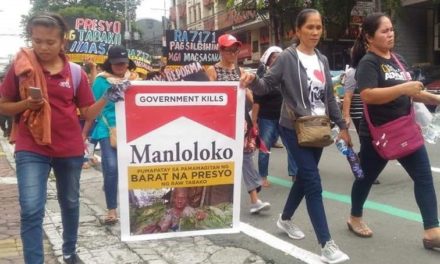
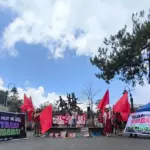
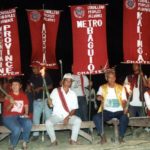
ITOGON, Benguet — More than a hundred indigenous peoples from Itogon, Benguet, joined by their supporters, staged a protest outside the Itogon Training Center during the Environmental Impact Assessment (EIA) public scoping conducted by the Department of Environment and Natural Resources (DENR).
The residents are opposing the mine expansion by Itogon-Suyoc Resources, Inc. (ISRI) in connection with its application for a Mineral Production Sharing Agreement (APSA 103).
Chants and protest messages echoed inside the training center as public scoping was underway, with protesters raising concerns about the possible loss of water sources and environmental threats if the project goes through.
As disclosed during the public scoping, ISRI’s APSA 103 would expand its area from 63.498 to 469.26 hectares, covering portions of barangays Ampucao, Poblacion, and Virac. The company also plans to increase its mill capacity from 500 to 515 tons per day.
Sister Jane Gasilang, a resident of Barangay Ampucao, formally raised their concerns during the public consultation. She criticized the short notice given to affected communities, noting that residents were given only 13 days to review a highly technical scoping document.
“I have graduated from college, but I could not understand the nearly 200 pages of a highly technical document,” she said.
Gasilang also expressed fears over the safety of the mine’s tailings facility, asking: “How safe is the structure? For how long will it be able to stand?”
Rima Mangili of the Itogon Inter-Barangay Alliance (IIB-A) echoed these concerns.
“From the very beginning, the tailings facility has been wrongly located—dangerously sitting above Barangay Poblacion and posing a serious threat to the safety of the community and its environment,” she said in an interview.
Mangili emphasized that a genuinely inclusive public scoping process should be conducted within affected communities to enable wider participation and ensure that residents understand the project’s concrete impact on their lives.
Gerry Cornel, Itogon Municipal Environment and Natural Resources Officer and a resident of Barangay Poblacion, stressed the importance of a hydrology study.
“We do not want toxic materials or siltation to reach our rivers especially the Ambalanga river flowing from Ampucao and exits near the Binga dam,” Cornel said.
He added that the company must include underground water management to ensure that swimming pools in Barangay Poblacion, a main source of residents’ livelihoods, are not affected.
The EIA, Cornel added, should identify alternative sites for a tailings facility once the existing facility reaches maximum capacity, taking into account expected tonnage increases.
Ampucao barangay council member Mylene Sabiano said they oppose the expansion, adding that the company should be content with its current operation.
FPIC questioned
Gasilang argued that affected residents were not genuinely consulted prior to the signing of the Free, Prior, and Informed Consent (FPIC) Memorandum of Agreement and the issuance of the Certification Precondition in 2024.
In their position paper, protesters claimed that the MOA signed in September 2023, between ISRI, the National Commission on Indigenous Peoples, and the Itogon Indigenous Peoples Organization, did not comply with the FPIC Revised Guidelines, the Indigenous Peoples’ Rights Act (IPRA), and the Philippine Mining Act of 1995.
They stated the CP was issued despite opposition and that no consensus-building process was conducted.
Itogon Vice Mayor Dante Alain Xavier Godio said the EIA should reflect that the IIPO’s consent came with conditions, including the upholding of no-mining zones and the protection of water sources. He stressed that these conditions should be “explicitly detailed” in the Environmental Compliance Certificate (ECC).
At the start of the program, Matie Pina Rodas, chief of the Clearance and Permitting Division of the Environmental Management Bureau (EMB), explained that the public scoping aims to consult stakeholders to define the assessment’s focus. She noted that the EIA assesses ecosystem impacts and proposes mitigation measures.
However, she clarified that the public scoping is not the venue to resolve the issues raised regarding the FPIC process.
Rodas declined a media interview, stating she was not authorized to speak. Vergina Briones of the Mines and Geosciences Bureau (MGB) likewise refused to comment on the issues raised, saying they still need clearance from higher officials. #nordis.net