From pulpit to forest: A pastor’s plea for the Sierra Madre
FEATURE| July 9, 2025
6MIN READ
By DANILOVA MOLINTAS www.nordis.net
QUEZON CITY — In a quiet mountain barangay half a day’s drive from the provincial capital of Ilagan City, in Isabela, a local pastor is raising the alarm over ongoing mining operations in the town of Dinapigue.
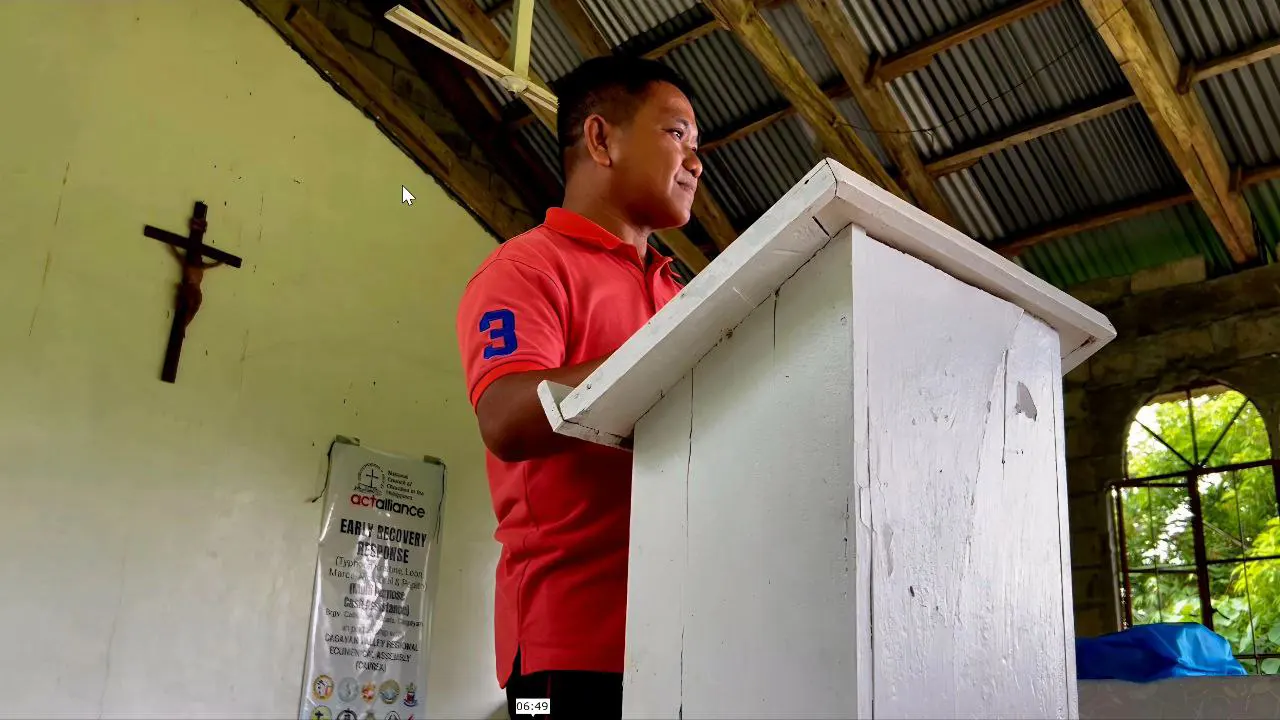
Reverend Allan Manuel of the United Church of Christ in the Philippines (UCCP) ministers from a humble chapel with hollow block walls—some still bare, others patchily painted—and a corrugated tin roof that groans with the wind.
There are no pews, just a few worn plastic chairs and a wooden cross at the altar. From this modest sanctuary, he speaks with conviction, warning about the long-term consequences of mining in forested areas. “God gave us this land—how are we treating it?” he asked in Ilocano, addressing residents and community leaders at an event organized by the ACT Alliance and National Council of Churches in the Philippines (NCCP) on July 4.
Manuel linked the growing climate crisis, flooding, and food insecurity to what he called “man-made calamities,” driven by large-scale extraction and a disregard for ecological balance.
His concerns are centered on the Dinapigue Nickel Project operated by Dinapigue Mining Corporation (DMC), a wholly owned subsidiary of Nickel Asia Corporation (NAC).
Acquired in 2015 for ₱720 million, the site is located in the Northern Sierra Madre and has been developed into a major exporter of saprolite and limonite nickel ore, with reserves valued at over ₱2.9 billion.
The mine is expected to operate until 2054, shipping ore to buyers in China, Japan, and domestic processors.
The pastor’s message is resonating well beyond the small chapel’s walls.
Buffer zones threatened
National environmental groups and even a nascent green party are echoing his calls, describing the project as emblematic of the risks that extractive industries pose to forests, rivers, and coastal ecosystems.
“Mining in buffer zones like Dinapigue strips away the lifeblood of our communities, placing corporate greed above the survival of the poor,” said Jonila Castro, spokesperson of Kalikasan People’s Network for the Environment, a national alliance of community-based environmental groups.
She emphasized the importance of forested buffer zones in protecting biodiversity and maintaining water systems.
“Runoff from mining causes severe siltation, contaminating rivers that serve as lifelines for drinking water, irrigation, and fisheries,” she said. “Along the Palanan coast, polluted runoff decimates fish habitats, depriving fisherfolk of their income and food.”
“The Sierra Madre is our last line of defense against disasters and climate change. Destroying it for short-term gain is a death sentence for marginalized communities,” Castro added.
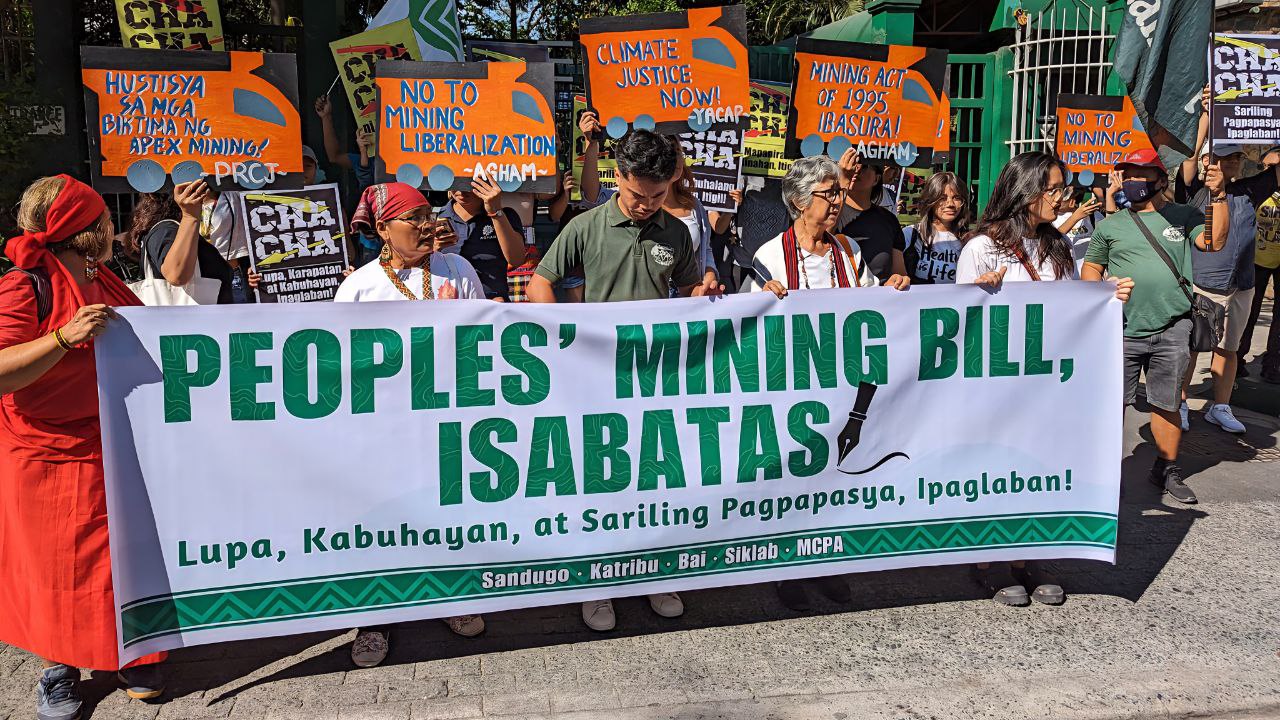
REPEAL. Indigenous peoples and environmental groups continue to call for the repeal of the 1995 Mining Act, which they say has enabled the plunder of Philippine land, forests, and mineral resources and the pollution of water bodies. (Kalikasan PNE)
Alyansa Tigil Mina (ATM) national coordinator Jaybee Garganera likewise underscored the danger of allowing extractive industries into protected-area buffer zones.
“Buffer zones are precisely intended to prevent the degradation of habitats and destruction of ecosystems,” he said. “Mining in these areas causes biodiversity loss, disrupts the migration routes and habitats of wildlife, which are integral to the sustainability of the forest, and causes water and air pollution. For these reasons, mining in buffer zones should be absolutely disallowed.”
Garnagera highlighted the Sierra Madre’s crucial ecological role as a climate shield and carbon sink.
“Government should be protecting the Sierra Madre instead of opening it up to resource extraction,” he said.
David Delano D’Angelo, chairperson of the Green Party of the Philippines, said the government has long failed to respond to warnings from communities.
“This is not the first time a warning has been made,” said D’Angelo, a longtime environmental advocate and former senatorial candidate. “We’ve seen the damage play out in places like Marinduque, where the Marcopper disaster occurred, but the government still refuses to listen.”
He criticized the export-driven nature of the mining industry, arguing that it offers little to Filipinos. D’Angelo called for a nationwide mining moratorium and the passage of the Alternative Minerals Management Act.
“There should be no mining go-zones in critical biodiversity areas like the Sierra Madre. “Nature is interconnected, and protecting it is a moral and survival imperative.”
From ridge to rift
The ACT-NCCP meeting was initially convened to assess the delivery of multi-purpose cash assistance and agricultural recovery efforts for communities hit by four major typhoons in late 2024.
But Rev. Manuel directed the discussion to the deeper, structural root causes of disasters, particularly extractive industries that weaken the environment’s ability to recover and protect itself.
“Large-scale mining weakens the environment’s ability to protect itself,” he said. He pointed to the potential impact of coastal communities in Palanan, where siltation in Dinapigue’s rivers flows into the Philippine Sea.
“Fishers here have been forced to venture farther into the open sea to fish, as siltation from mining affects marine ecosystems,” he said in Ilocano.
Concerns over these environmental changes caused by mining in Dinapigue recently intensified following the release of a viral video circulated by the Municipality of Santa Ana, Cagayan Special Economic Zone & Freeport, on its Facebook page.
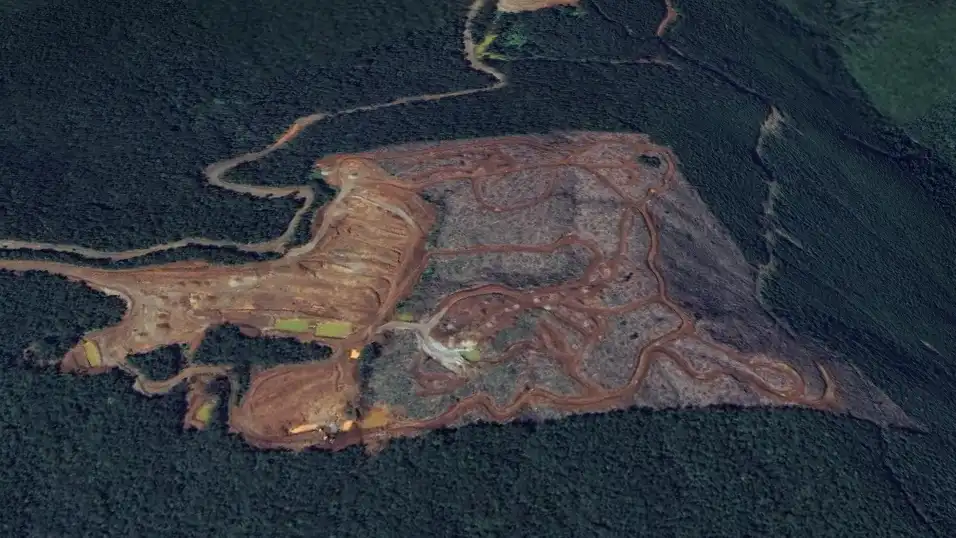
Based on Google Earth imagery, the video shows a dramatic loss of forest cover in what was once a dense forest in the Northern Sierra Madre, and a brown, silt-laden Dinapigue River emptying into the Philippine Sea—a visual sign of mining runoff affecting marine ecosystems.
SCARRED. A section of the Dinapigue nickel mine on the Sierra Madre operated by Dinapigue Mining Corporation in a Google Earth satellite image captured on Oct. 26, 2024.
In 2002, Dinapigue was identified as a Key Biodiversity Area (KBA) under the Philippine Biodiversity Conservation Priority-Setting Program.
However, when the Expanded NIPAS Law was passed in 2018, it was excluded from the final map of the Northern Sierra Madre Natural Park—a decision that remains poorly explained.
For years, environmental advocates and indigenous peoples’ communities have warned of the continuing degradation of the Sierra Madre Range, one of the country’s last intact forest frontiers and a vital carbon sink.
Deforestation, road-building, and watershed disruption threaten biodiversity and undermine its ability to act as a natural climate buffer, increasing the region’s exposure to floods, drought, and long-term ecological collapse.
Bad optics or bad for nature?
In response, DMC defended its operation, stating that the mine operates outside the boundary of the Northern Sierra Madre Natural Park, in a “multi-use zone” that is legally designated for activities such as mining.
“The mine site is not within the protected area and is fully compliant with all legal and regulatory requirements,” the company told BusinessMirror on May 22, 2025.
DMC also emphasized its reforestation programs, including the planting of over 626,000 seedlings and the rehabilitation of mined-out areas.
Nickel Asia responded to the viral imagery by acknowledging the poor optics but defended their record of compliance.
“The footage may look bad, but our operations are legally permitted and environmentally compliant,” a Nickel Asia spokesperson said.
But the Save Cagayan Valley Movement (SCVM) dismissed these statements as greenwashing.
“When rivers run brown and fishers lose their catch, it’s not ‘optics’—it’s ecological collapse,” said Agnes Mesina, SCVM coordinator. “Compliance on paper means little if it destroys real ecosystems. Greenwashing won’t bring back the forests.”
“Let’s be clear: the question isn’t whether Dinapigue mining is technically outside the park. The real issue is why we allow large-scale extraction in forest buffer zones that are critical to community survival and climate stability,” Mesina said.
The Chamber of Mines in the Philippines also issued a statement backing the project and warned that “mischaracterizing it as illegal or destructive undermines responsible mining.”
SCVM responded by asserting that extraction in ecologically sensitive areas should never be normalized. “Such technicalities sidestep the deeper issue of ecological responsibility.
GOD’S STEWARD. Church workers, such as UCCP Pastor Allan Manuel, continue to work with marginalized communities in the Cagayan Valley, promoting social and ecological justice as part of their faith-based advocacy. (CVREA)
Disaster response, nature stewardship
Late last year, Cagayan Valley was battered by four major storms in rapid succession—Typhoon Julian (Krathon) in September, followed by Severe Tropical Storm Kristine (Trami), Super Typhoon Leon (Kong‑rey), and Tropical Storm Marce (Yinxing) through October and November.
The typhoons brought massive floods, submerging farmland, displacing thousands of families across Isabela and neighboring provinces, and causing over ₱1.4 billion in agricultural damage.
ACT Alliance and NCCP organized the Early Recovery and Response project in response to the cascading climate hardship. The program aims to deliver both emergency relief and long-term rehabilitation.
In the Cagayan Valley, this has included cash aid, food, hygiene kits, and the restoration of basic services such as water and shelter.
The initiative places affected families at the center of recovery, emphasizing local leadership, livelihood resilience, and faith-based community rebuilding.
As communities in Cagayan Valley continue rebuilding from back-to-back disasters, his call rings louder than ever. Proper recovery demands more than relief—it requires protecting the land that sustains life. Without urgent action to stop destructive extraction and defend the rights of affected communities, the region will remain vulnerable not only to typhoons but also to the deeper, ongoing storm of ecological collapse. As the pastor reminded in the sermon, the choice is whether we treat this land as something to exploit or something to defend for future generations.#nordis.net