Opposition rises as city veers towards corporate public market development
FEATURE| August 21, 2020
7MIN READ
By SHERWIN DE VERA www.nordis.net
First of two parts
Elected with the promise to bring a “breath of fresh air” in Baguio governance, Mayor Benjamin Magalong started with a 15-point agenda. His plan to revitalize the country’s Summer Capital included the rehabilitation of the city’s public market.
“Baguio City needs a developed, organized and sanitary public market, which should be transformed to become the city’s largest tourist attraction,” read a city council resolution supporting the market’s redevelopment.
The city council said the project is in line with Baguio’s titles as Summer Capital and UNESCO Creative City. The resolution also stated that the city would rebuild the market on its own.
A technical working group presented in late 2019 involved a P6 billion 7-story structure, a sewage treatment plan, open spaces, and the easing back of the congested Magsaysay Avenue.
However, controversies soon ensued when Robinsons Land Corporation (Robinsons) and SM Prime Holdings, Inc. (SM) submitted unsolicited proposals for the market redevelopment in late February.
‘Not another mall’ — remained the general sentiment of Baguio locals, market vendors, and organizations for the long-overdue rehabilitation of the Summer Capital’s Public Market. The social media upheaval on the issue is slowly transforming into a fight against what Baguio residents see as a sellout of an iconic landmark to mall giants.
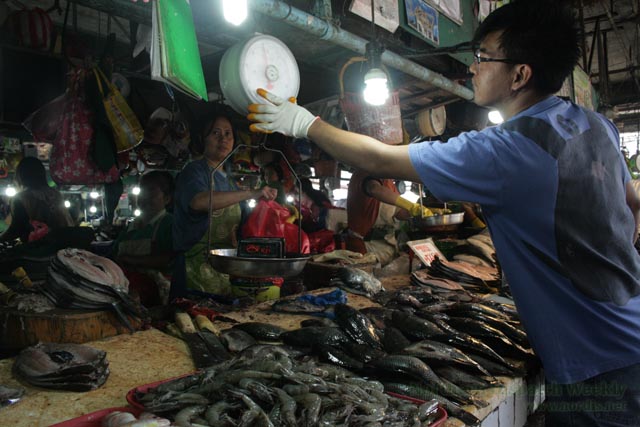
FILE PHOTO. A team from the Department of Trade and Industry checks the accuracy of weighing scales at the Baguio Public Market. The office routinely conducts inspection as part of its consumers’ welfare program. Photo by Delia Bagni
The Uniwide battle
The market redevelopment narrative started with the passage of City Ordinance 38 in 1995. The legislation laid the guidelines for the proposed development of the market. August of the following year, the city government inked a deal with Uniwide Sales Realty and Resources Corp. to modernize the city market.
The deal did not go unopposed.
The Baguio Market Vendors Association (MBVA) filed a lawsuit questioning the constitutionality of the ordinance. They also challenged the validity of the contract between Uniwide and the city.
The dissent and the lawsuit dragged on for two decades until Uniwide fell to losses and all its interests dissolved.
The Organisasyon dagiti Nakurapay nga Umili iti Siyudad (ORNUS), an organization of poor residents in Baguio, worked with vendors in the local market and supported their struggle.
“Opposition was strong then. At noontime, the sound would fill the market from vendors and even marketgoers’ noise barrage,” recalled ORNUS leader Geraldine Cacho.
However, Uniwide did not let up its desire to rebuild the market. In 2015, the company reiterated that it would redevelop the space after the Supreme Court upheld the contract between the company and the city.
This came with renewed opposition.
In a story published by the Baguio Midland Courier in 2015, the consortium of market vendors recalled the displacement of countless vendors because of the Maharlika Livelihood Center and Baguio Centermall.
“Should the project proceed, the public market will disappear and perhaps would exist only in history books and museum articles. (And) in its place, a multi-story mall will rise,” quoting the group in the article.
The Uniwide saga ended when Magalong shut the door on the company’s intent. In an Inquirer 2019 report, the mayor said the city would no longer deal with the company. He underscored that the agreement ended following the dissolution of the company.
Changing tune
Initially, Magalong eyed a P2billion loan from the Development Bank of the Philippines (DBP) and P4 billion allotment from the city to finance the project.
However, the hope that corporations would be out of the project started to fizzle out in February. During the period, SM and Robinsons expressed interest in the public market redevelopment.
TABLE 1. Design for Market Development and Lease Term
SM PRIME HOLDINGS, INC.
ROBINSONS LAND CORPORATION
DESIGN
7-storey structure on the public market’s 3-hectare to accommodate around 5,396 vendors.
Two (2) structures within a 4.5-hectare area.
USE & CONTROL
First two (2), the upper and lower ground floors, will be the public market managed by the city. Two (2) basement floor for parking, three (3) floors for SM’s commercial undertaking and roof deck park for events and activities.
One (1) will be city owned while the other one (1) is for Robinsons mixed use complex (retail/mall/BPOs).
YEARS OF LEASE
50 years, city will pay the developer with the depreciated cost prior to turnover.
50 years with an automatic renewal for another 25 years.
COST
P5.4 Billion
P6.4 Billion
CONSTRUCTION PERIOD
2 years
2.5 years
Source: SM Prime Holdings, Inc. and Robinsons Land Corporation proposals
By June, city officials started to shift their eyes to PPP, explaining that the city cannot finance it.
“First, we weighed if this could be done by the city alone, it turned out we could not. Second, we presented if we could do it through a ‘turnkey basis,’ meaning after so many years when it is done, we have to pay for the expenses. It turned out we could not. And third, we presented proposed loan schemes of two banks, Land Bank and Development Bank of the Philippines… it turned out we could not handle the loan payments,” city administrator Bonifacio Dela Peña explained.
On June 23, the city administrator bared that SM and Robinsons qualified for the bid to undertake the public market development project. Eased out from the bidding process is BMVA due to some legal technicalities.
In March, the BMVA came up with a proposal for the project costing around P3 billion. In a press release, the city information office describes the design as “a modestly-sized building” in contrast to the proposed plans by the city’s technical working group, SM and Robinsons.
The structure includes a pay parking and modern features of the current market. Part of the innovation is the relocation of flower vendors in front of the market as part of the facility’s attraction.
The group’s proposal also projected a lower rental rate, at P50 per square meter per day in the different sections. They said a lower lease is still possible to around P40 to P42 per square meter per day depending on design and scope of the development.
Dela Peña said the city entertained the mall giants’ submissions since the PPP rules mandate the Public-Private Partnership for the People Initiative Selection Committee (P4-SC) to evaluate unsolicited proposals.
At the June 29 council meeting, city accounting and budget officials said allocating P4 billion and the amortization for the P2 billion loan would affect the cities delivery of services and projects. Among the sacrifices the city has to bear is the loss of funding for projects with allotment from the 20 percent development fund to pay its debt obligation for 15 years.
PPP it is
During the July 6 regular council meeting, City Budget Office chief Leticia Clemente presented the options the city can undertake for the project. She made a comparative financial projection based on the design the city council previously approved. According to her presentation, equity financing has the shortest payback year and highest return of investment compared to debt servicing, PPP-lease, and PPP-joint venture.
TABLE 2. Summary of Comparative Results among Market Development Modalities
EQUITY FINANCING
DEBT FINANCING
PPP LEASE
PPP JOINT VENTURE
(Own Fund Source)
(Loan)
REVENUE (Billion peso)
16.027
16.027
8.935
8.704
EXPENSE (Billion peso)
5.726
5.726
2.010
2.794
NET INCOME (Billion peso)
10.300
10.300
P6.926
5.910
ROI (20-year average)
8.58%
6.86%
5.55%
4.92%
PAYBACK (years)
10.91
13.85
17.64
20.24
Source: City Budget Office June 6 presentation for the city council
However, Magalong, who attended the same meeting, asked the legislators to favor PPP-lease. He explained that the PPP proposal is the perspective of the investor.
“Any enterprising proponent would not go for this dahil napakababa. Look at this, 4.92 [percent] lang. Pero ang tanong ko sa inyo, why are these proponents investing despite the fact na mababa?” he said.
According to him, the projected 20.24-year payback period is very conservative, underscoring that the proponent will only recoup their investment after 20 years. He also pointed out that the profit margin, which is 4.92 percent, is unacceptable.
“Pero why are they investing? It is because they want to leave a legacy. They want to help the City of Baguio,” he added.
Magalong reiterated that the city could not undertake equity or debt financing unless it is ready to sacrifice other projects funded under the P200 million development fund.
“If you ask me personally, I am strongly recommending the PPP modality for the public market modernization. The City Government will not spend anything, and also, this public-private partnership will generate revenues for the city,” the mayor said.
On July 13, the city council heeded the mayor’s appeal and voted in favor of the PPP-lease as the modality for the market redevelopment. They also urged prospective contractors to utilize the design that the body endorsed earlier.
Dela Peña confirmed on August 12 that the Public-Private Partnership for the People Initiative Selection Committee (P4-SC) awarded the original proponent status (OPS) to Robinsons.
The city administrator explained the OPS awarding is the first step to evaluate the proposal. The proponent and the city would still negotiate the terms and conditions for the project’s technical and financial aspects. According to him, this process would take about a month and a half. If they come into terms, the city will proceed with the Swiss challenge, where other interested parties can challenge the one presented by the original proponent.
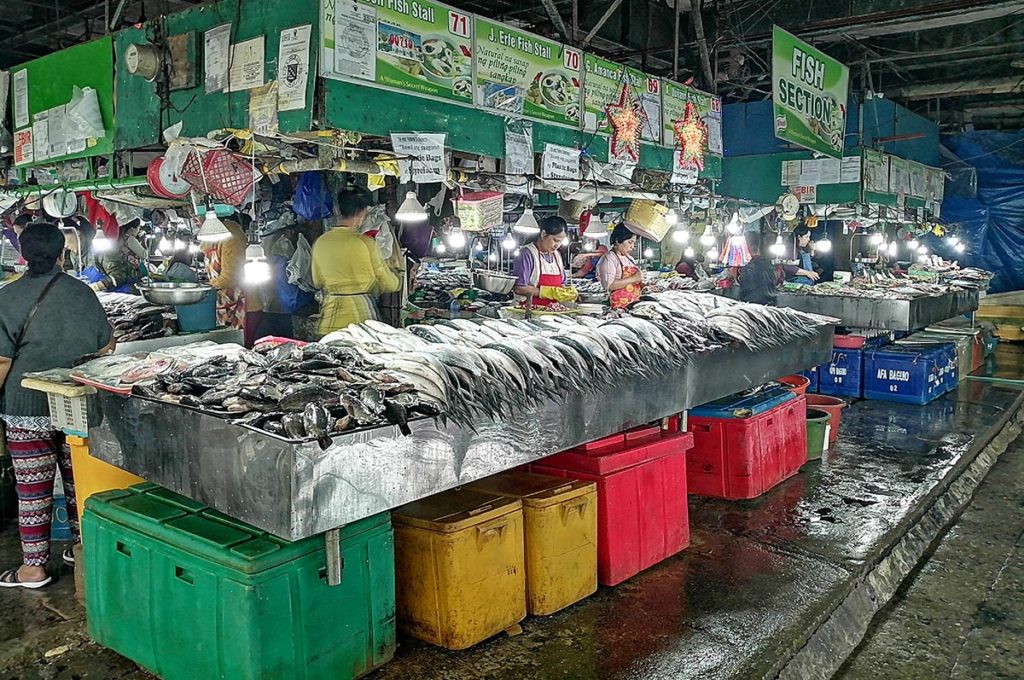
FILE PHOTO. Fish section at the Baguio City Market. Photo by Sherwin De Vera.
Growing opposition
Meanwhile, the opposition to hand the Baguio City Public Market redevelopment project to corporations continues to grow each day. The initial social media uproar has transcended to formal notice of protests from groups and individuals.
The latest to express dissent on awarding the OPS to either Robinsons or SM is Councilor Betty Lourdes Tabanda.
On August 13, the councilor submitted a letter to the Office of the City Administrator asking the administrator if it has taken into account the people’s sentiment. She also inquired if the construction of more malls part of the city’s Comprehensive Development Plan.
According to her, Robinsons also “refused to submit additional documents” to allow them to examine the proposal thoroughly. Meanwhile, she underscored that SM’s plan to integrate the market to its mall would change the character of the facility.
“We will no longer have a Baguio City Public Market. We will be closing the HEART of Baguio,” she said.
On the same day, the Baguio Heritage Foundation, Inc. (BHFI), Rehabilitation action for Baguio. Inc. (RABI) and Council for the Restoration of Filipino Values (CRFV) formally petitioned the city to reject the unsolicited proposals from the mall developers. They also asked the local government to modernize the market in partnership with the market cooperatives.
The content of the petition, which they released on Change.org and social media earlier, urged the mayor to prioritize local investors. As of August 20, 5:00 PM, signatures for the petition have reached 2,216.
Instead of allowing mall developers, they proposed that the city use its “idle funds” or get a loan. The group also said the city could post bonds and let Baguio residents invest in the market.
Earlier, BHFI released a separate statement opposing corporate intervention for the project. They underscored that the city market is “considered a heritage site” established in 1913, a trade center even before Baguio became a city.
“Our Baguio market should prioritize occupancy by Baguio merchants and not be under the monopoly of giant corporations, one of which already displaced many Baguio businesses and family entrepreneurs. Another mall by any other name would be a betrayal to our own Baguio citizens,” the foundation said. # nordis.net