UP FOR GRAB | IP land and resources taken for gov’t and corporate interests
FEATURE| November 18, 2019
8MIN READ
By ACE ALEGRE www.nordis.net
Indigenous peoples’ (IP) culture and survival are connected with their land and resources. Through their knowledge and sustainable practices, they preserved the richness of their vast territories, ensuring the needs of the next generation. However, the past and present administrations have treated the IP’s ancestral domains and lands as resource-based. Laws and policies that favored the government’s development thrust and corporate interests have undermined the IP control over their ancestral domains.
The Philippine Task Force for Indigenous
Peoples Rights (TFIP) provided realities on the ground that fuels the massive
rights violations and continuing resistance of indigenous peoples. The group
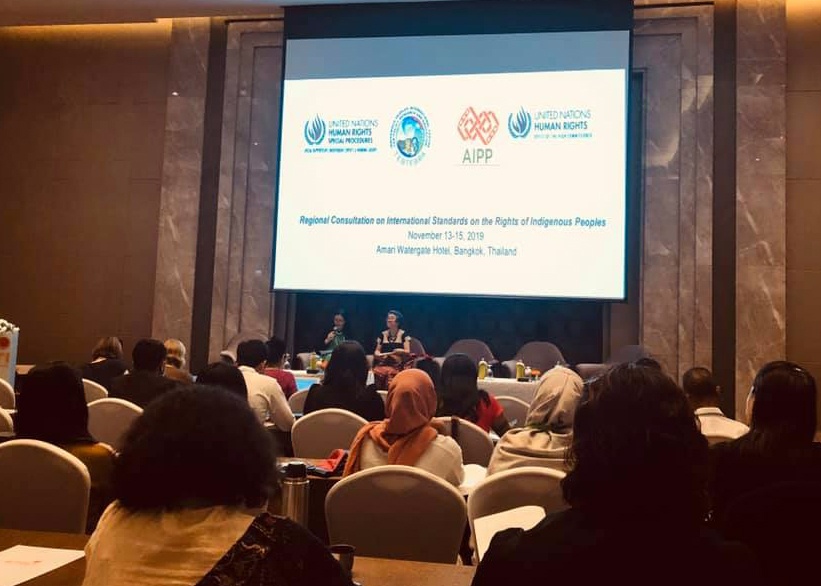
gave a glimpse of the situation in the Philippines in the Regional Consultation on International Standards on the
Rights of Indigenous Peoples held on November 13-15 in Bangkok, Thailand.
TFIP executive director and Ibaloy-Igorot Jacqueline K. Cariño said that state laws and policies regarding land and natural resources disfavor indigenous peoples. Among those she mentioned are the Forestry Code, Philippine Mining Act of 1995, and the National Integrated Protected Areas System Act (NIPAS).
STATE OF IP RIGHTS. Jacqueline Cariño (center) gave a detailed situation on the respect and protection of IP rights in the Philippines from the information she gathered in the meeting with IP organizations in the country on November 6-7 in Quezon City. Photo courtesy of Sarah Dekdeken/CPA
She underscored that the doctrine,
which declares that, “most of the indigenous peoples’ ancestral lands are
considered part of the public domain” is the culprit. These lands may
be disposed of by government agencies for their use or by private corporations
for so-called “national development,” she explained.
The
scion of Ibaloy chieftain Mateo Cariño likened indigenous peoples’ land, territories, and resources to
“a huge mango orchard, laden with ripe fruits” that are up for
picking.
Her great grandfather sued the American for intruding in their native Ibaloy
lands in the old Baguio City at the US Supreme Court and won. The ruling is now
known as the “native title doctrine,” obligates the government to
recognize IP land rights
“After indigenous peoples planted
the seeds, tended and grew the trees since time immemorial, the fruits, the
trees and even the land on which they stand are coveted and now up for grabs by
State and corporate interests,” she said
Problematic state policies
According to Cariño, the current
Philippine administration’s 10-point Economic Agenda and the Philippine
Development Plan for 2017-2022 has set the policy framework for the grabbing of
indigenous peoples’ land, territories, and resources. The policies contained in
the plan, according to her, violates the right to self-determination of
indigenous peoples’ in the country.
“Government policies and
programs in mining, energy development, plantations, forestry, special economic
zones, and infrastructure are marking a clear trend towards widespread
dispossession and displacement of indigenous peoples from their ancestral
territories,” she added.
TFIP chief noted that even with the
Indigenous Peoples’ Rights Act (IPRA), violations of IP rights continue in the
country. She also expressed disappointment with the National Commission on
Indigenous Peoples (NCIP). She said the agency has “fallen far way below
and even violated its own mandate of protecting indigenous peoples’
rights.”
IPRA contains provisions that provide
for the issuance of Certificates of Ancestral Land and Ancestral Domain Titles
(CALT / CADT). It also mandates the conduct of Free Prior and Informed Consent
(FPIC) for projects in IP territories. Passed in 1995, the international
community considers the IPRA as landmark legislation to recognize and protect
IP rights.
The group said that even with the
IPRA, “many mining companies, plantation owners and other private corporations
have gotten away without genuine FPIC process with indigenous communities.”
According to her, this became
possible “through bribes given to leaders and influential members of
communities causing division and internal disunity, coercion through the use of
military, paramilitary and private armed groups, misinformation on supposed
benefits leaving out potential disadvantages and adverse impacts, and
manipulation of the FPIC process by the NCIP.”
She pointed out that energy projects
have gotten away without the FPIC. She attributed this to the loophole in the
Electric Power Industry Reform Act (EPIRA), which does not provide for the
consent of host indigenous communities as a requirement to build and operate.
Rubbing salt to injury, Carino said, even laws on conservation such as the NIPAS “remove the rights of indigenous peoples to undertake economic activities.” Under the law, “farming and gathering of forest products such as medicinal plants, timber, and animals from parts of their territories” are prohibited in NIPAS areas inside IP territories. Meanwhile, the Integrated Forestry Management Agreement (IFMA), Pasture Lease Agreements, Timber Licensing Agreements permitted the large-scale exploitation of Philippine forests and conversion of forests and agricultural lands to plantations, ranches and pasture land by private corporations. These areas, she explained, are mostly in IP ancestral domains. She cited the coffee plantation of Silvicultural Industries, Inc. in Lake Sebu, rubber plantations for the use of giant tire manufacturers such as Goodyear and Yokohama, the oil palm plantations in Mindanao, and Palawan, the Yulo King Ranch in Coron, Palawan, and among others.
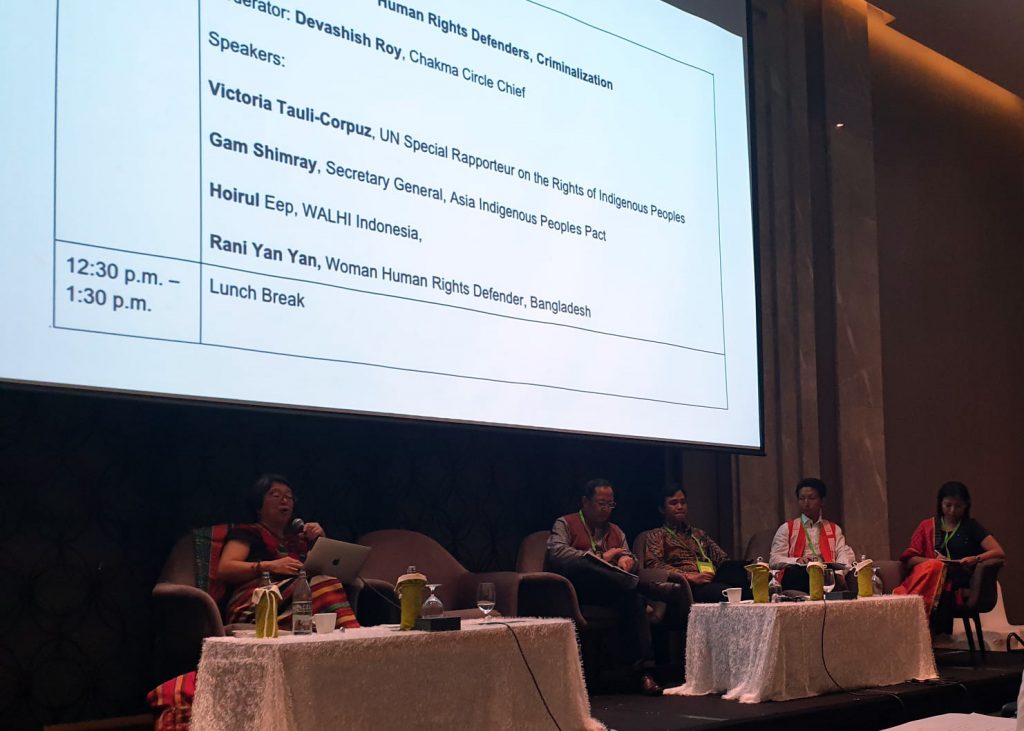
NOT CRIMINALS. The case of Rachel Mariano was cited among the cases of criminalization against indigenous peoples in the Philippines in the panel and plenary on human rights defenders. Photo courtesy of CHRA.
Worse, Cariño said, is the
“criminalization of Indigenous Peoples defending land, territories, and
resources.”
Indigenous peoples’ rights
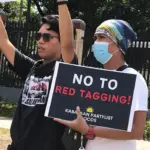
defenders are being targeted and accused of being communist fronts while IP
organizations members are vilified as terrorists, she narrated.
Cariño said that corporate and
government projects like energy facilities, dams, and water supply projects
violated provisions of the IPRA and the UN Declaration on the Rights of
Indigenous Peoples (UNDRIP). She cited the Duterte administration’s priority
projects like the Chico River Pump Irrigation Project in Kalinga and the New
Centennial Water Source-Kaliwa Dam project in Rizal and Quezon provinces.
She said the projects are both
“being built in indigenous communities with detrimental effects” and “funded by
onerous Chinese loan agreements disadvantageous to the interest of the Filipino
people.”
According to her, ongoing and
planned hydropower projects in IP ancestral lands across the country would
displace more than 100,000 individuals from at least 106 villages. Four of the
projects she identified are in Northern Luzon. These are the Ilaguen Dam in
Isabela, Diduyon Dam in Nueva Vizcaya, Alimit Hydro Complex of the SN Aboitiz
in Ifugao, and Karayan dam in Kalinga.
The government and corporate sector
are also exploring the installation of geothermal plants and coal mines inside IP
domains. North of Manila, geothermal energy will be harnessed in the projects
of American firm Chevron and local company Aragorn Power and Energy in Kalinga
province and the PRC Magma in the provinces of Benguet, Mt. Province, and
Ifugao.
Cariño added that mining is still the main threat faced by many indigenous groups in the country. At present, she said that 230 of the 447 approved mining applications are in ancestral territories, “encroaching” in at least 542,245 hectares of ancestral lands. According to her, these comprise 72% of the 748,590 hectares covered by all the approved mining applications. She claimed that the ancestral lands and resources of the Igorot people in Benguet, Mt. Province, Ilocos Sur are endangered by ongoing mining operations. Currently, huge commercial mining firms like Lepanto Consolidated Mining Company and Philex Mining Corporation are in the area. There is also the application of Nickel Asia subsidiary, Cordillera Exploration Company, Inc. covering several provinces in the Cordillera and Ilocos Sur.
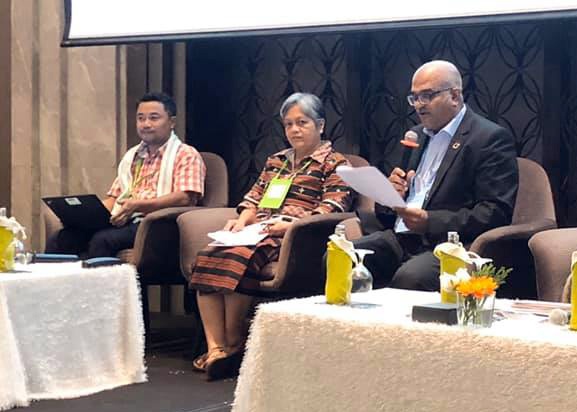
REPORTING. United Nations Special Rapporteur on Indigenous Peoples Rights Vicky Tauli-corpuz received the reports from the delegates during the consultation that tackled key issues on the right to self-determination of indigenous peoples, as well as their collective rights to their territories and resources. Photo courtesy of Sarah Dekdeken/CPA
The TFIP chief also noted that
Australian mining giant OceanaGold Philippines, Inc. applied for another 25
years to operate its mine in Didipio, Kasibu, Nueva Vizcaya. On June 20, the
company’s Financial and Technical Assistance Agreement (FTAA) with the
Philippine government expired. The Ifugao indigenous people in Didipio
protested the entry and operation of OGPI. They continue to oppose the
application for the renewal of its FTAA together with the people and local
government of Nueva Vizcaya.
Meanwhile, local and foreign
agribusiness corporations occupy at least 130,000 hectares of ancestral lands
for their monocrop plantations of banana, pineapple, oil palm, bioethanol,
coffee, and other crops. These plantations have worsened the loss of
livelihood, hunger, and human rights violations suffered by the indigenous
peoples, especially in Mindanao and Palawan, Cariño said.
According to her, monocrop
plantations continue to use banned pesticides such as carbofuran (Furadan) and
glyphosate. This practice has inflicted indigenous peoples living close to
these plantations with respiratory, skin, and gastrointestinal diseases, she
added.
Cariño also noted that agribusiness
corporations implement exploitative wage system to their farmworkers, which
includes indigenous peoples. She cited
the case of the Sumitomo Fruit Corporation (SUMIFRU) that implements the
piece-rate system, described by critics as the “worst exploitative” wage system
The TFIP pointed out that new
agreement of the Philippine government with Malaysian and Indonesian entities
opened up at least 120,000 hectares of land for more oil palm plantations in
Mindanao and Palawan. She also noted the massive land grabbing of David M.
Consunji, Inc. (DMCI) for its logging and Integrated Forestry Management
Agreement (IFMA) covering at least 102,954 hectares of ancestral lands in the
sacred Daguma Mountain Range in the South Cotabato, Sultan Kudarat and
Saranggani provinces. and logging concessions covering
She also cited the New Clark City
(NCC), previously called as Clark Green City, another priority in Pres. Rodrigo
Duterte’s “Build, Build, Build” program yet posing adverse effects to IP
communities. The NCC covers more than 9,400 hectares of land, including Ayta
territories in Tarlac. The project includes the building of geothermal and dam
energy projects that would cover up to 59,000 hectares of ancestral lands. The
government will also maintain its control over the 17,000 hectares Crow Valley
Military Complex for US Military exercises in Pampanga, Tarlac, and Zambales,
she added.
“Alternatives”
Cariño said when it comes to protecting the land and environment, indigenous peoples for centuries have been practicing alternatives. These practices, according to her, are opposed to the “destructive development aggression” by the government and large corporations.
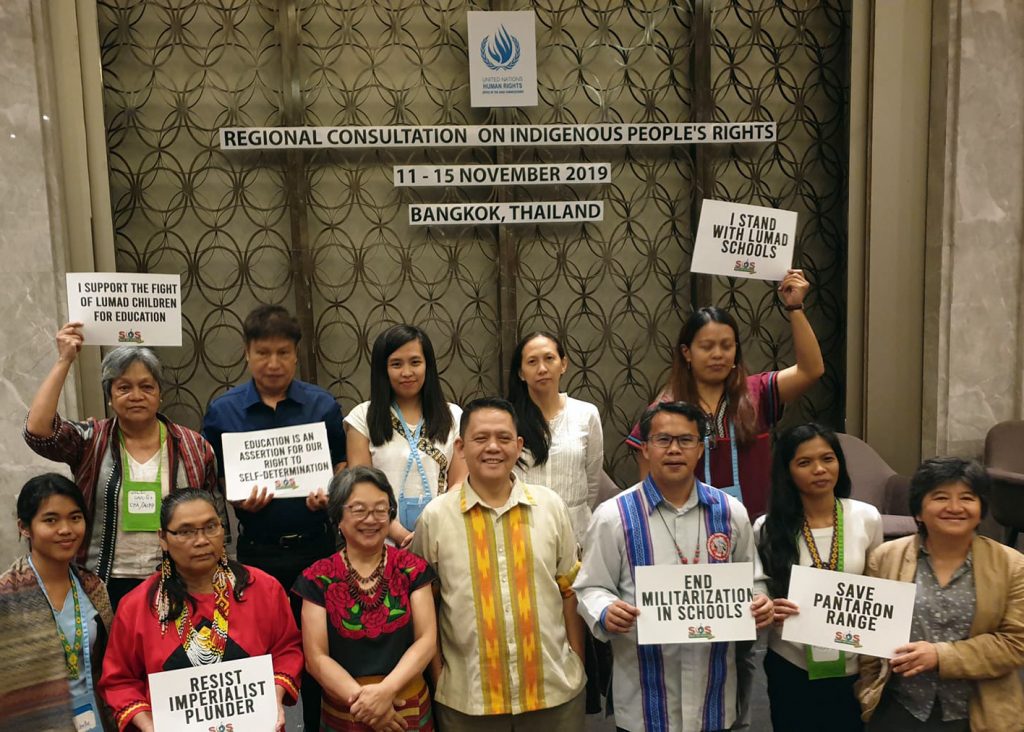
STRUGGLE CONTINUES. Indigenous peoples’ rights activists from the Philippines who attended the consultation vowed to face the challenges head on and continue the struggle for self-determination. Photo courtesy of CHRA
She argued that IPs proved through
the years that traditional knowledge, values, and innovations adapted to the
local culture and environment are viable and sustainable. She noted that these
ensured the survival of present and future generations. The executive director
added, “Innovations in renewable energy, sustainable agriculture, climate
adaptation, and other initiatives have been developed.”
Citing the Cordillera IP practices on
the utilization and management of natural resources within their ancestral
domain, she said the knowledge also benefits modern industry and agriculture.
She identified traditional forms of
forest and watershed management such as lapat,
muyong, and batangan. Also
mentioned were the traditional types of communal irrigation and water
management like the lampisa and sebbeg. Tuping, she said, is an
effective way of stonewall building for land stabilization while panag-usok is environmentally-sound
traditional small-scale mining practices. There is also the Holok system of pest management that
utilizes the various parts of more than 25 plants to produce a pesticide
against worms and other rice pests.
According to Cariño, IP values in
the region such as inayan and lawa that prohibit one from doing what
is taboo or harmful to the community, also contribute to sustainable resource
management. She noted about ayyew or simple,
thrifty and unwasteful living and kasiyana,
a positive view of the future despite many obstacles. Ther is also the different
forms of community cooperation like ub-ubbo
and binnadang are that foster solidarity
and volunteerism.
Underpinning these positive values
is the worldview of Indigenous Peoples that Land is Life that needs to be
nurtured and protected for the sake of the past, present, and future generations,
Cariño explained.
Experts from different international
IP organizations and institutions also provided insights and recommendations. #
nordis.net