Environmental network formed against Nickel Asia subsidiary
NEWS | August 26, 2019
4MIN READ
By SHERWIN DE VERA www.nordis.net
SAGADA, Mountain Province — Community representatives, people’s organizations, and church leaders from the Cordillera region and Ilocos Sur province unanimously approved a resolution to establish an environment and mining network to ensure the implementation of the units formed during the Aywanan Environment and Mining Summit on August 24 in this tourist town.
Heavy rains failed to deter more than 300 individuals from attending the gathering aimed to build the broadest unity against the mining application of Cordillera Exploration Company, Inc. (CEXCI), a subsidiary of Nickel Asia Corporation. Expert speakers gave talks on Nickel Asia Corporation’s past and present record and on technical and legal matters related to mining.
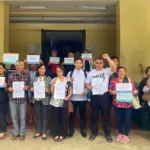
UNITED. Different groups and communities, including officials from local governments and state agencies, joined the summit against the impending entry of mining and other destructive projects into the Cordillera region and parts of Ilocos Sur. Photo by Sherwin De Vera
Participants created a campaign plan that includes an inter-provincial, inter-regional petition against the application of CEXCI. The reasons cited in the document are the destructive impacts of mining on the environment, such as soil and water pollution. They noted that mining would destroy local agriculture and would displace communities and small-scale miners.
Delegates also identified the engagement of local governments to pass resolutions and ordinances against corporate mining as an essential part of the campaign. The group agreed to hold an education and information drive, including forums and community meetings, in the affected villages in the coming months.
The Episcopal Diocese of Northern Luzon of the Anglican Church, the Movement for the Advancement of Inter-tribal Unity and Development, and Binnadang, the women’s organization federation in Mountain Province, organized the activity.
Timely event
“I believe that today’s gathering
will open our minds to the truth about mining. We are fortunate that there are
groups with us today that are willing to speak about the dangers of
mining,” said Tomas Tawagen, the provincial indigenous peoples’ mandatory
representative, in his opening message.
He said the event was appropriate to
prepare the people because if mining companies were to explain their purpose,
“they will surely provide deceiving explanations and sweet promises.”
“Hopefully, this activity will
open the eyes and ears of our townmates who chose to play blind and deaf about
the effect of mining on our land, to our territories,” he added.
BASIC HUMAN COURTESY. Rocky Ngalob, free prior and informed consent (FPIC) focal person of NCI-CAR, likened the process to a stranger asking to enter one’s house. “Before he can enter and do his business, the stranger must first knock on the door, introduce himself and state his purpose and ask permission if he can enter the ask.” Photo by Sherwin De Vera.
Tawagen, who sits as a member of the legislative body of the province, reminded that communities should be watchful of individuals posing as leaders or elders who will readily sell their lands to investors.
Reverend Father Marcial Lloyd
Castañeda of the Kilong Catholic Mission saw the activity as “a big help
for church leaders” to learn more about the integral connection between
human rights and the environment.
He stressed the importance of being
informed about the issue, so the church can “better inform and engaged
parishioners.”
“I believe this [activity] if we
put it in three [words], is what we call formation, transformation, and
information. This is very good, and I appreciate this initiative,” he
added.
Collective responsibility
In his message read by Rev. Leoba
Achawon, Bishop Brent Alawas of the Episcopal Diocese of Northern Philippines
(EDNP) reminded the participants that protecting and preserving nature is a
collective task.
“We do not live to individually
consume the resources of this earth but to contribute and collectively work
together for the protection and preservation of our natural resources so others
can also share in God’s bounty,” he said.
The prelate pointed out humans
“misused their intelligence and power to satisfy their greed,”
resulting in the “destruction and corruption” of the world.
According to him, it has become easy for people to overlook their “responsibilities as caretakers of the earth” in exchange for “monetary success and accumulation. He urged the participants to live simple and humble lives while protecting the environment.
“Collectively, let us all work
together for the common good, putting selfish interests aside and cooperate
with others for a better, peaceful world,” said Alawas.
RELIGIOUS DUTY. Reverend Father Marcial Lloyd Castañeda underscored the church’s duty to protect the environment and be with its members in actions that promote their rights to a healthy and balanced ecology. Photo by Sherwin De Vera.
Pulpit as a medium
“Events like this are important
to teach the people of the happenings in other places, to give us information
about what these companies are doing to our environment,” said Anglican
priest Domingo Mayapit.
He said the best contribution a priest like him could give was “to use the pulpit and teach our constituents to be stewards of the environment.”
According to him, the clergy should take a more significant role “against big mining corporations who intend to destroy our environment.” He said that promoting environmental protection is part of promoting the Christian faith.
“I also urge the pastors, fellow
priest, and church ministers to participate in gatherings like this and be part
of actions to protect the environment,” he added.
Legacy to uphold
“The discussion on the environment
and mining is not new. This is not the first time that communities came
together to talk about the issue. However, there is a certain motivation why we
are here,” said Cordillera Peoples Alliance (CPA) secretary-general Sarah
Dekdeken.
According to her, not a single application for a financial and technical assistance agreement (FTAA) was approved in the Cordillera since the enactment of the Philippine Mining Act in March 1995. She attributed this to the “strong and united opposition of the people.”
“This is our legacy that everyone
must uphold,” she said.
CEXCI has two applications for mineral exploration, labeled EXPA 14 for Kalinga and Abra covering 13,269 hectares, and another 11,170 hectares under EXPA 116 for Benguet and Ilocos Sur. Its largest application is under AFTA 08, covering 43,523 hectares in the adjacent areas of Benguet, Mountain Province, and Ifugao.
FTAA is a contract for large-scale
mineral exploration, development, and utilization between the government and a
mining company. It allows foreign-owned companies to extract and export
minerals from the Philippines. # nordis.net