Sunflower as Symbol of the Fight Against Misogyny
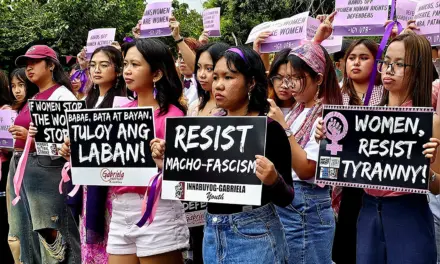
3 MIN READThe Sunflower Parade aims to remind the world that women and children have rights that need protection and deserve it, and to affirm that these Filipino women are not alone.






www.nordis.net
“Walang former former, lalo na sa probinsiya,” Mindanao journalist Cong Corrales, who now works for the Philippine Center for Investigative Journalism, wrote on his Facebook wall.
Corrales knew what he was saying. He is a provincial journalist and almost all the 173 Filipino journalists killed in the Philippines since 1986 came from the provinces. There are indeed no former journalists, especially in the province.
The fact that Mei Magsino was a former journalist does not mean that she was no longer one. We know former journalists who were just biding their time, waiting for the right time or a windfall to regain their stature as a journalist by starting or re-starting their own newspapers or opening a radio station or buying a slot in one station.
Mei was contributing to Vera Files and PCIJ when her own weekly newspaper in Batangas folded up. She was very active in the Facebook, hitting on politicians she was critical about on her paper. A few days before her death, she already warned some of her friends that her life was in danger because of her postings.
The life of a journalist is a vocation. It is very hard to get out of it. The danger is like that of a gang member. You may have transitioned out of the gangs, for example, and are living a “normal” life, but the rival gangs don’t know that. To them, you are still a rival. In the same vein, that is how our enemies perceive us.
This reminds us so much of our former colleague. Rey Pedronio was also considered a former journalist when he was murdered in front of his wife in 1999. Pedronio was a former business writer for a Baguio newsweekly. He was taking up law. He was also technically a journalist at the time of his murder as he had teamed up with a colleague and now editor Thom Picana in a radio talkshow and they were on their third week.
Pedronio was young and promising. He was the only one among his large family to graduate college, and was the breadwinner. The assassin, a member of the CPLA, knew he was a former journalist but that was not a deterrence.
And yet Pedronio’s case was a rarity. It was one of the killings that was able to reach a favorable end. Not only was the case solved in the police parlance but the killer was even put to jail. The masterminds, however, were not even identified even when it was clear that the assassin was but a bodyguard. And yet how many of the cases of the 172 other Filipino journalists killed reached that far?
And now this. Another former journalist killed by a hired killer.
“Mei’s murder not only highlights the fact that leaving journalism is no guarantee for safety from the perils of the profession — especially not from those with long memories and deadly intent — it also underscores the depths to which the culture of impunity has become entrenched in our country and society, courtesy of a government that has shown only the most cursory regard for human rights,” wrote the National Union of Journalists in the Philippines in its statement. “Especially since, as report after report shows, agents of the State have and continue to violate human rights with impunity, with government turning a blind eye or, in some cases, actually justifying, these depredations,” NUJP said.
Being a journalist is a life sentence. Like any Filipino, we do not deserve a death sentence. # nordis.net
This is a pooled editorial by the Baguio Correspondents and Broadcasters Club (BCBC).
3 MIN READThe Sunflower Parade aims to remind the world that women and children have rights that need protection and deserve it, and to affirm that these Filipino women are not alone.
2 MIN READDahil walang tuloy-tuloy at transparent na aksyon ng mga kinauukulan kontra sa mga sugalan, lumalabo na ang linya sa pagitan ng kapabayaan at pakikipagsabwatan.
4 MIN READAs petroleum prices continue to surge, the journey to seek medical care is becoming increasingly difficult for countless Filipino families, particularly those in rural and geographically isolated areas.
3 MIN READDevelopers, researchers, and open communities create a counterweight. That is why support for developers and open communities matters more now.
