2 MIN READBy AMIANAN SALAKNIBAN
www.nordis.net
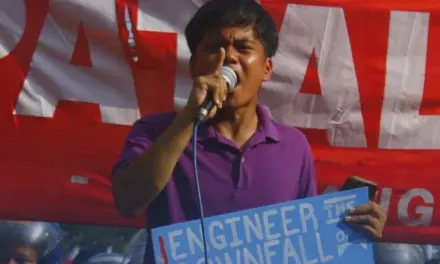
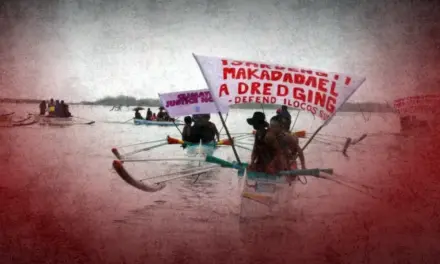
Last week, hundreds of pro-environment and anti-mining advocates joined forces to denounce the birth of Mining Act of 1995 near Malacanang. For 20 years, the people suffering from the effects of large-scale mining are clamoring that the law be repealed and replaced with an alternative, beneficial and environment-friendly mining law – the People’s Mining Bill.
The People’s Mining Bill or House Bill 4315 is the fruit of all the people’s hopes of what a genuine Mining Act should be. According to think-tank Ibon Foundation, in a mineral rich country like ours, the mining industry is an important economic booster that can even “propel us to industrialization”. However, the Mining Act of 1995 hinders this direction because most of its provisions are foreign- and elite-dominated. Our natural resources destroyed and our people displaced in exchange for measly taxes paid to the government.
To resolve this lopsided law, progressive partylists heeded the pleas of the people after conducting actual ocular inspections, and broad and nationwide consultations with workers and indigenous peoples in mining affected communities. They have come up with the People’s Mining Bill composed of 16 chapters with 164 provisions that entail the following features:
1. Nationalizing the Mining Industry
The People’s Mining Bill shall reverse the liberalization of the mining industry that the Mining Act of 1995 enacted. Instead, the Philippine mining industry shall be developed under the perspective of national industrialization and agrarian reform via ecologically sound, economically feasible and democratic methods.
A Philippine Industrialization Program and a National Mining Plan shall be constructed. It aims to work towards achieving self-sufficiency, gaining maximum benefit for the local and national economy, and engaging public participation and representation in mining.
2. Re-orientating Government Responsibilities
The Mines and Geosciences Bureau (MGB) shall be reoriented to become a true scientific research institution that holds exclusive rights to conduct exploration activities and identify strategic mineral resources for the country’s development. All mining explorations, with the preference for non-invasive methods, shall be the MGB’s responsibility.
Multi-Sectoral Mineral Councils composed of representatives from MGB, Department of Environment and Natural Resources (DENR), Local Government Units (LGUs), stakeholder groups, and affected communities shall be created to deliberate mining applications, monitor the conduct of mining operations, and create internal rules of procedure.
3. Revoking lopsided provisions
The questionable Financial and Technical Assistance Agreement (FTAA) that allows 100% foreign ownership and incentives shall be scrapped. Large-scale mining agreements shall be limited only to Mineral Production Sharing Agreements, Co-production Agreements and Joint Venture Agreements.
4. Defending people’s rights
The rights and welfare of the social sectors and stakeholders affected by the mining projects shall be upheld. Worker’s rights and occupational safety shall be prioritized. Affected communities, especially the indigenous peoples shall be consulted through genuine Free, Prior and Informed Consent, their right to say no shall be respected and their lives shall not be threatened by military force.
5. Protecting the environment
The People’s Mining Bill shall be strict at enforcing provisions that guarantee environmental sustainability, access to justice and protection of human rights in affected communities. An Environmental Social Impact Assessment and Mitigation Plan shall be created to regenerate, rehabilitate and restore affected mineral areas; develop and conserve watersheds; relocate and return displaced population; and provide alternative livelihood and socio-economic development. It shall also appropriate areas off-limits to mining such as watersheds, protected areas, and key biodiversity areas. Food security and agricultural modernization shall be prioritized over gold. # nordis.net