4 MIN READBy ARTHUR L. ALLAD-IW
www.nordis.net
BAGUIO CITY — For the indigenous people in the provinces of Rizal and Quezon, they thought their nightmare had ended when the plan of then Pres. Ferdinand Marcos to build the Laiban hydro-electric dams on their river was shelved.

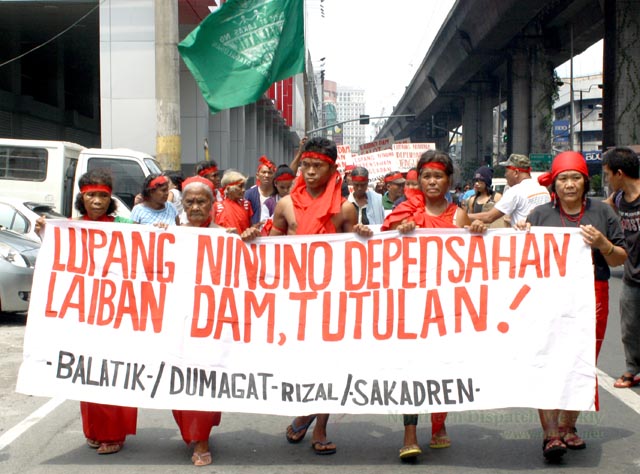
Photo courtesy of TFIP
They were wrong. The same nightmare returned to haunt these indigenous peoples again as the administration of Pres. Noynoy Aquino announced the revival of the Laiban dam as a component of its New Centennial Water Supply Source Project.
For these affected indigenous peoples, the Laiban dam does not only spell displacement from their ancestral territories but it would detach them from the sources of their daily and livelihood needs.
The planned dam
Laiban dam was a project conceptualized by the Marcos administration in the 1970s with the dams along the Chico River in the Cordillera region. At that time, Laiban dam project was composed of the Kaliwa and Kanan dams.
“For easier implementation, what is being revived today is the Kaliwa dam”, explained Piya Malayao of KAMP (Kalipunan ng mga Katutubong Mamamayan ng Pilipinas), a nationwide federation of indigenous peoples community organizations.
It is however referred to as the Laiban dam project as the site of the dam to be constructed is in Laiban, Tanay, Rizal. It threatens to submerge 28,000 hectares including the eight villages in the provinces of Rizal and Quezon where around 21,000 farmers and indigenous Agta, Dumagat, and Remontado will definitely be displaced, added Malayao in an interview.
If pushed through, the Laiban dam can generate 1,830 million liters of water daily and produced 25 MW. And the dam’s water sources will be the Kaliwa and Kanan rivers.
Development aggression
Affected indigenous elders heard Marcos telling them in the 1970s to sacrifice for the interests of the majority. But they doubt it, as it is not the majority Filipinos who will benefit from the said projects.
Kakay Tolentino explained that the Laiban project targets to bring potable water to the Metro Manila area. Though it is smoke-screened for the water needs of people in Metro Manila, the water business would be controlled and monopolized by corporate interests, said Tolentino, national coordinator of BAI, an indigenous women network.
While profits will be raked by corporate interests, the affected indigenous peoples will be uprooted from their economic and ancestral domain, added Tolentino, an Alta Dumagat, in an interview.
Data showed that the project is a part of the public-private partnership of Aquino. Interested parties in the project included Marcos crony and Noynoy’s uncle Danding Conjuangco’s company San Miguel Bulk Water Corporation and the Metropolitan Waterworks and Sewerage System (MWSS).
In a KAMP statement, “Through its (government) Public Private Partnership schemes, supply of utilities such as water and electricity are even more concentrated in the hands of private businesses. Aside from the mega profits projected, these utilities are vital in the government’s other projects with foreign and private investors.”
But the affected IPs say, “that if such is development, development for whom?” They said that indigenous peoples are the sacrificial lambs for state backed corporate interests’ exploitation of the resources located in their ancestral territories.
New generations for Anti-Laiban dam
Interesting to note in the struggle of indigenous peoples against the Laiban dam is the continuity of the struggle by the children of those Agta, Dumagat and Remontado who opposed the Laiban dam project during the Marcos period.
Arnel delos Santos, the spokesperson of the Mascada Indigenous Peoples Organization in Rizal, is among the new generation who oppose the revived project. His father Nicanor was an actively opposed to the Marcos Laiban dam project, who continued the IP struggle for the protection of their ancestral domain. His struggle for indigenous people’s rights caused his life when he was shot dead by soldiers on December 8, 2012 in Antipolo City.
Without the affected villages’ free, prior and informed consent, and on the pretext of protecting the project the IP communities were militarized, creating an atmosphere of fear among the affected indigenous peoples. Despite such situation of threats and harassment directed at his family and his tribe, Arnel resolved to continue the unfinished task of his father.
Why is it hard for the government to understand the importance of the ancestral homeland to them?, asked Arnel, 26 years old, secretary-general of BALATIK or Bigkis at Lakas ng Katutubo sa Timog Katagalugan, an alliance of indigenous organizations in Southern Tagalog.
Arnel said he saw the importance of continuing the struggle as taught by his father, Nicanor. He learned from his father that it was the collective resistance of the indigenous peoples in their area that had shelved Marcos’ Laiban dam. He sees such unity and collective action of the indigenous people would stop this project revived by Pres. Noynoy.
And addresses the president: “If you do not see what we see, you should leave Malacanang because you are only serving your foreign master.”
And the opposition to the Laiban dam broadens.
In a gathering of affected indigenous peoples in Taytay, Rizal last month, they united to oppose the planned project. They invoked the recognition of their cultural practices on any develpment project that will affect their communities, particularly so that this month is observed as indigenous peoples month.
“We do not want our lands stripped off its natural resources just to enrich a few people. If there is a need to put up large dams in our rivers, we demand that the proponents pass through a full process of consultation based on our traditional practices and leadership,” their statement of unity stated, as they urged the people to heighten their opposition against the Laiban dam.
According to KAMP, Laiban is a part of the present administration’s 149 hydropower projects and 16 geothermal projects that have been built, under construction or are in the pipeline.# nordis.net