4 MIN READBy KIMBERLIE NGABIT-QUITASOL
www.nordis.net
BONTOC, Mountain Province — After being slapped with a petition for Writ of Kalikasan in 2012, the municipal government of Bontoc, the capital town of Mountain Province, continues to find ways to manage its garbage problem.
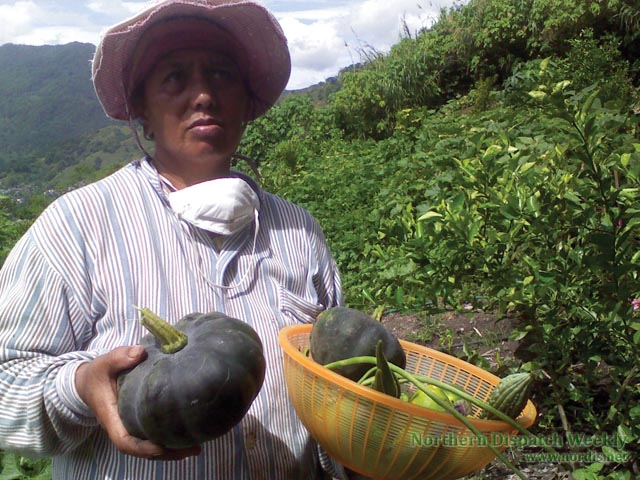
GARBAGE BOUNTIES. These vegetables are organically grown at the Bontoc Ecology Park 1 where the biodegradable waste of this town is dumped. Photo by Kimberlie Ngabit-Quitasol
Bontoc Mayor Frank Odsey, in an interview, shared that local business establishments have been complying with their newly promulgated plastic ban. “The plastic ban has been on for three weeks already and most of the local business establishments are complying,” he reiterated.
The ban on the sale and use of plastic bags is pursuant to Municipal Ordinance No. 212 S. 2013 otherwise known as “An Ordinance Prohibiting the Use of Plastic Bags on Dry Goods and Regulating Its Utilization on Wet Goods and Prohibiting the Use of Styrofoam in the Municipality of Bontoc, Mountain Province and Prescribing Penalties thereof.”
Establishments who are found violating any of the prohibited acts will be fined P200 for the first offense; P500 for the second offense and P1,000 for the third and succeeding offenses or imprisonment at the discretion of the court. Fines are payable to Municipal Treasurer’s Office.
Odsey, however, said that they are having problems with businessmen coming into the town to sell their produce. He shared that most of these businessmen coming from outside Bontoc still use plastic bags and uses ignorance of the law as an excuse. “These business people from outside are using ignorance of the law as their excuse. But we fine them anyway,” he said.
Odsey claimed there was a decrease in the town’s garbage after the implementation of the plastic ban. He, however, could not quantify the decrease in plastics in the garbage being collected in the town.
It can be recalled that Bontoc had been operating an open dump in Calutit village along the bank of Chico River. The said dump was decommissioned in August 2013 after the courts granted the petition for writ of kalikasan.
The Calutit dump was about 100 meters long along the riverbank. A major Cordillera river system, Chico River, starts from Mount Data in Mountain Province and traverses the towns of Bauko, Sabangan and Bontoc, as well as communities in Tinglayan and Pasil towns and Tabuk City, the capital of Kalinga province towards the Pacific.
Odsey said, “The former dump site is now fully rehabilitated and is even vegetated,” he said.
Dump in a garden
The mayor also shared that the municipal government is now developing two ecological parks as part of their waste management program. Eco-park 1 is for biodegradable waste and Eco-park 2 is for the recyclables and residual.
Roger Agcapen, municipal environment and natural resources officer, said Eco 1 is about 500 square meters where the biodegradable wastes of the town is being composted. He said the about 500 kilograms of biodegradable waste is being collected and dumped at Eco 1 every Monday, Wednesday and Friday and about 300 kilograms every Tuesday, Thursday and Saturdays. He added that about 250 to 300 kilograms come from the town’s public market.
Agcapen explained that there are more garbage collected on Mondays, Wednesdays and Fridays because it is the schedule of collection from the villages in the town center that include Poblacion, Bontoc Ili, Samoki and Calutit. He said garbage from the town’s public market is collected daily.
“Biodegradable wastes are mostly vegetable and fruit peelings and most of these peelings end up as animal feeds in many of the town’s villages,” he explained.
Nida Cherwaken, one of the casual employees hired by the local government to tend to the garden and garbage at Eco1, said they have observed a decrease in the plastics and other non-biodegradable wastes being collected. But, like the mayor, she could not quantify the exact decrease. “There are still some plastic cups and other containers that reach Eco1 despite it being biodegradable wastes but it is decreasing,” she said.
Cherwaken shared that they use the plastic cups and containers for their seedling beds. She added that they also got the seeds that they planted from the biodegradable garbage dumped at Eco1.
“We have planted lemon, squash, okra, eggplant, string beans, bitter gourd, cucumber, tomatoes and even several flowers here at Eco1,” she shared. She added that the garbage collectors and those who work at the dump bring home some of their harvest and sell the rest. The money raised from selling the harvest form Eco1 garden is used to buy their snack and other needs at the garden like soap they use to clean themselves after sorting the garbage.
Residual problem
Odsey admitted that at the moment they are having problems with the disposal of residual wastes. “Residual wastes are temporarily dumped at the town’s burned slaughter house pending negotiations for the acquisition of land for the construction of the proper waste facility for residuals,” he said.
He added that funds are available for the construction of the waste facility. “We have funds but the clan (who owns the land identified for the facility) must first resolve among themselves whether they would sell the land to the local government or not,” he explained.
The mayor also shared that Eco2 is under construction where they plan to process bottles and plastics. He added that Eco2 will also be developed into a botanical garden planted with herbs and fruit trees. # nordis.net