4 MIN READBy ARTHUR L. ALLAD-IW
www.nordis.net
If there was a time in history that ignited Cordillera unity, it would be that period when the dictator Marcos planned to build the World Bank-funded Chico River Basin Hydroelectric Dam project. This dam projects along of the Chico River illuminated the people’s consciousness to understand how the enemy was the state and its imperialist masters. Added enlightenment was drawn from the expropriation by a Marcos crony of the forest resources covering 200,000 hectares in Abra-Mountain Province-Kalinga boundaries under the Cellophil Resources Corporation. Unmasking how the state became a machinery of the rich and powerful and both were backed by the dictatorial regime’s armed forces.
And for those affected by this development aggression, they exhausted an indigenous system which became a weapon to stop these imperialist funded-energy projects and resource exploitation by a crony. Interesting to note in their struggle is the role of an indigenous system called the bodong or peace pact.
Bodong is an indigenous practice by the binodngan (bodong-practicing) villages in the Cordillera region, like in the areas of Kalinga, Mountain Province and Abra.
Traditionally, bodong is forged bilaterally or between two tribes only. The peace pact is a result of a consensual agreement between two tribes that are in conflict or actual tribal war arising from individual violation of a person’s dignity.
If a tribe or both tribes are satisfied with their quest for justice, it would usually result into a bodong between them.
A collective violation of a community’s rights like expansion by one tribe over another tribe’s territory or acquisition of resources would also result to bodong as a result. The Binodngan People’s Organizatrion (BPO), an organization of people from the bodong practicing villagers, define bodong as an agreement between two tribes to end tribal war and achieve peace between them by respecting territories, properties, lives and dignity of tribal members.
In the societal development of the Cordillera, the bodong evolved from bilateral to multi-lateral bodong system for the defense of their land, culture and resources. Veterans of the anti-Chico dam struggle traced how bodong evolved into a multi-lateral bodong with a pact or pagta, as a result, that unite villages against projects that threatens their existence as a distinct people.
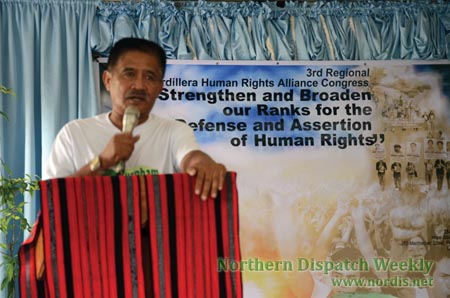
Ama Julio Longan, more than 70 years old elder from the Taloctoc sub-tribe of Kalinga, explained how multilateral bodong evolved and solidified the unity among the Kalinga and Bontoks in opposing the four dams that would be established along the Chico River that traverses the provinces of Mountain Province and Kalinga.
When then President Marcos was to implement the dam in the late 1970s, Ama Longan, a veteran anti-Chico dam oppositionist, shared that several inter-tribal bodong conferences were held by peace pact holders and elders in the bodong practicing villages to solidify their opposition to the dam project. These gatherings also led to the founding of the Kalinga-Bontoc Peace Pact Holders Association (KBPPHA) or peace pact holders association, which took a great role in the anti-dam struggle.
“A higher level of unity was achieved as a result,” Longan added. That they were able to adopt a provision to isolate and exclude from the bodong coverage the villagers who join the state military forces and work for the construction of the dam. This important provision was explained to binodngan villagers and as result they resolved to support the struggle against the dam.
The death of known peace pact holders from the state’s military forces also helped the strengthening of the multi-lateral bodong and the people’s unity to defend their land and territory.
At the height of the anti-Chico dam struggle, troopers from the Philippine Army led by Lt. Leodegario Adalem in the stealth of the night fired at houses in the village of Bugnay, Tinglayan, Kalinga on April 24, 1980. The attack led to the death of Macliing Dulag, a respected pangat (tribal leader) and injured Pedro Dungoc, who survived and joined the New People’s Army where he died as a member. The soldiers attacked people’s leaders after the state’s moves to bribe villagers to allow the project failed. Ama Longan remembered that leaders of the opposition were even jailed by the government but it failed to stop their opposition.
The attacked against these Kalinga leaders sowed fear for a while but such strengthened the binodngan people to heighten their struggle against the dam and their political consciousness of their common enemy – the state and the World Bank, an imperialist institution. Activism, too, spread n the Cordillera region, as well as their political consciousness in understanding imperialism was realized.
The Cordillera people’s struggle in opposing an imperialist project became well known internationally. It became a worldwide model that united villagers can stop such kind of project well funded by the World Bank, an institution by imperialist states. This is recognition of the contribution of the Cordilleras indigenous peoples in the anti-imperialist plunder of their land and resources.
Ama Longan shared that the bodong practice served well in the Cordillera struggle. From the KBPPHA, it became the Cordillera Bodong Association (CBA) to Binodngan Pongors Organization (BPO). In recognizing the role of indigenous systems, they continuously organized binodngan villagers but expanded it in areas with existing indigenous socio-political systems or practices like the dap-ay in western Mountain Province and the Tongtong in Benguet. Hence their organized was broadened into Cordillera Elders Association.
These indigenous socio-political systems will surely have a role in the present people’s struggle as their resources are threatened by resource extractive projects by companies of imperialist countries.
Aside from mining, Chevron, one of the biggest oil and energy producing companies owned by US capitalists, plans to venture in geothermal projects.
Like Ama Longan and other veterans of the anti-Chico dam struggle, they believed that present generations can easily understand imperialism as one of the root causes of these extractive resources projects being supported by the state. They, too, would have a rule in this new era of struggle against imperialists’ plunder of their land and resources. Imagenordis.net