













DOTC investigation finds Florida bus over speeding
3 MIN READ
By KIMBERLIE NGABIT-QUITASOL
www.nordis.net
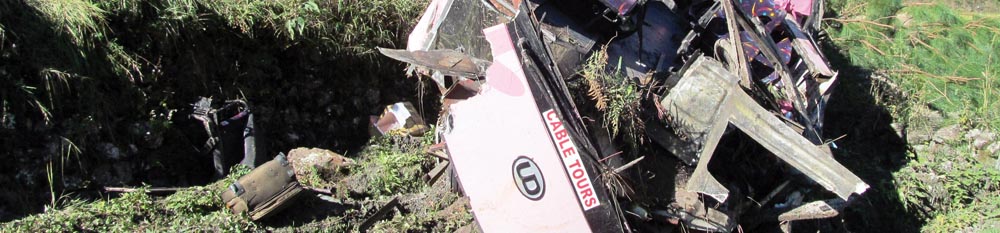
BAGUIO CITY — Department of Transportation and Communication (DOTC) Cordillera investigation showed that ill fated GV Florida Transportation bus that fell killing 15 passengers arrived two hours earlier than scheduled and that one of its tires exploded 100 meters before it crashed indicating it was in high speed.
The DOTC report stated that Bontoc, Mountain Province is around 390 kilometers away from Manila which is normally a 12-hour bus trip. “The Florida bus trip started at around 8:30 in the evening. The accident happened at around 7:20 in the morning at Talubin, Mt. Province which is 13 kilometers more or less to Poblacion, Bontoc or twenty minutes drive,” the DOTC report read. Following the 12-hour bus trip the bus should arrive in Poblacion at around 8:30 a.m.
According to the DOTC report, statements of some passengers taken by the police revealed that a passenger flagged down the bus somewhere in Sitio Bayyo, the sitio right before the crash site, but the bus did not stop. The report also noted that some passengers and even the spare driver told the driver, Edgar Reynon, to just ram the bus at the mountain slope but the driver seemed not to hear them even when they were shouting. “Thus, while he was trying to maneuver the bus, it gained speed as it descended until it approached a sharp curve where the driver lost control of the vehicle and which eventually fell into the ravine,” the report stated.
Working
Celina Claver, DOTC regional director, said the bus brake was working and “engaged” but somehow it did not stop the bus from falling of the 116 meter ravine in Sitio Pagang, Talubin village Bontoc. “The engineers who inspected the bus found out that the brakes were functioning well and engaged meaning the driver was able to step on the breaks but the bus did not stop and the speed and the weight of the bus are among the reasons why the bus did not stop,” she explained.
Angel San Jose, Jr., auto mechanic engineer 2 of the Department of Public Works and Highways (DPWH)-Bontoc, and Jerome C. Puyongan, auto equipment inspector of DPWH-Bontoc, in separate sworn statements said that the bus brakes were in good condition and that the break push rods were engaged. San Jose observed that “…the brake shoes are new and are in good condition and that the drag links, tie rod ends, clutch booster and air compressor were intact and without any leakage.”
According to Puyongan, he saw skid marks six meters and disturbances of wheels along the curve and gutter and rim marks on the road near the ravine where the bus fell.
Rebuilt
Claver said findings on the non-matching chasis and engine numbers of the Florida bus that fell indicates that it was rebuilt or assembled.
The DOTC report showed that the plate number, engine and chasis number of the Florida bus that fell do not match. “Per registration records, the subject Florida bus with engine no. DE12T-601104BD and chasis no. KTP 1011611 was last registered as private on April 4, 2013 with issued license plates UDO 762,” the DOTC report stated.
The DOTC report further showed that the plate TXT 827 attached to the Florida bus that fell was issued to a mini bus with engine number LX-004564 and chasis number KN2EAM912PK004452 under the name of Norberto Cue. But the fallen bus bears an engine with number DE12T-601104BD and chasi number KTP011611C entirely different from the engine and chasis authorized to the said plate number.
Claver pointed out that they already submitted their report to the central office of the Land Transportation Franchising and Regulatory Board (LTFRB) for final recommendations and proper action. # nordis.net