6 MIN READBy ARTHUR L. ALLAD-IW
www.nordis.net
BAGUIO CITY – PWDs or persons with disabilities, in the Philippines experience double marginalization. While they suffer the consequences of being poor and marginalized, they also face their particular issue and concerns due to their disabilities.
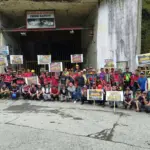
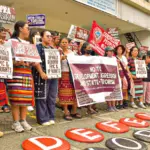
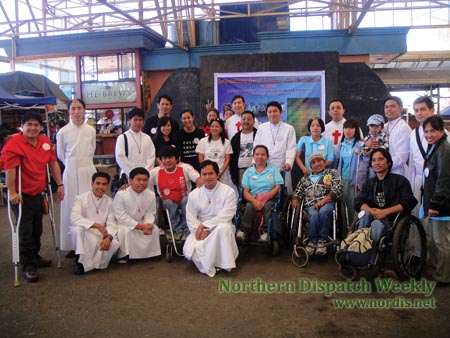
INTERNATIONAL DAY OF PERSONS WITH DISABILITIES. Various groups of persons with disabilities in Baguio City gathered on December 1 at the Porta Vaga parking area as a advance celebration of the International Day of Persons with Disabilities which is observed December 3 worldwide. Priests and church workers from the Baguio-Benguet diocese joined in the celebration. Photo by Arthur L. Allad-iw
While the Philippine state recognizes the United Nations Convention on the Rights of Persons with Disabilities (CRPD) and has adopted the Magna Carta on the Rights of Persons with Disabilities, and other laws, their rights contained in these standards are far from being realized, much more it is yet to be done by the government itself.
The Philippines’ National Statistic Office (NSO) census states that there are about 1.23 percent of the total national population who are considered as PWDs. In the Cordillera region, there are 6,781 PWDs, according to the Department of Social Welfare and Development – Cordillera Administrative Region (DSWD-CAR).
The PWDs are distributed as follows: Abra – 415; Apayao – 213; Baguio – 300; Benguet – 2039; Ifugao – 1,010; Kalinga – 1,360; Mountain Province – 1,444.
However, Baguio City, the City’s DSWD office claims that there are 1,375 PWDs in their list.
From the above government data, problems on data gathering are very common, and in instances, the same government agency – at different levels – have conflicting data. In addition, as the region is mostly inhabited by indigenous peoples, they have no classifications as to the tribal affiliation of the PWDs. Though it is safe to say that more than majority or a higher number are indigenous peoples, as based on PWD organizations in the city.
Sources from the local DSWD shared their problems on the master listing of PWDs.. They rely on PWDs who go to their office to get IDs (identification cards) as the basis for their listings. Master listings from provinces are hard to establish too, the source added. Aside from that, the source admitted, one problem is there is no government agency designated to be the primary agency in data gathering for the PWDs. Now it is like a pingpong ball thrown from the DSWD to the DOH or the otherway around.
From various interviews from different PWD organizations, they identify problems ranging from education of special children, rehabilitation, accessibility, livelihood, habitation as among the primariy problems. Including discrimination by “abled” persons they encounter in their daily existence.
Special education
Even the data for out of school youth and students with disabilities remain a problem. The same with special education for children with disabilities as Baguio City has at least two schools catering for the full programs for special education of children with disabilities.
“Children with disabilities are enrolled in the regular schools where curriculums are not specifically designed for their special education. They are forced to enter the regular schools mainly due to the meager income of their parents,” a parent with a special child said in an interview. The access to education by children with disabilities remain unrealized despite the mandate of RA 7277 or the Magna Carta for Persons with Disabilities and the UN Convention on the Rights of Persons with Disabilities, she added.
Accessibility
An organization of persons with orthopedic-related disabilities also complained about the low or non-compliance of building, or establishment owners and government institutions for the installment of facilities and other devices that would facilitate the mobility of PWDs.
Those who uphold the accebility law are concentrated in the urban centers. “The most violated structures which are not PWD-friendly are stairways, comforts rooms etc.,” says a member of FARAD-Baguio, an organization of persons with orthopedic-related disabilities.
Seats designated for PWD are commonly observed by big transport groups but how friendly it is remains to be a problem. “I cannot stretch my feet and I felt more disabled upon getting off from these buses as I regularly travel,” he adds. These seat designations are less complied with by small transport groups, particularly those plying the provinces. The practice of assigned seats for PWDs are not recognized and followed by public utility jeepneys and taxis in the Cordilllera.
Even government projects have a few designationated areas or none at all on pedestrian lanes assigned for PWDs. In Baguio City’s Central Business District, only one crossing is designated for PWDs (at the front of the Veniz Hotel). PWDs are expected to climb up to the overpasses and utilize designated crossings. Those with wheelchairs are forced to cross through the “no jaywalking signs”. A manifestation that local government units fail to recognize and implement the law on accessibility for PWDs.
Livelihood
A shocking revelation on economic engagement by PWDs. Most PWDs in Baguio City are engaged in livelihood where income is not regular. These odd jobs include vending, massage, repair shops, car wash etc. They receive less government support despite the institutionalized government policy for the economic independence of PWDs.
In Baguio City, a small area, under an overpass, is granted by government for a massage clinic for the blind. As the area is not enough for their massaging, most of them rent private areas for this business. “We have at least enough income to bring home during the peak season, but only little amount or none at all during the rainy season,” said Randy Fernandez, a member of the Federation of the Visually-Impaired Persons in the city.
Daniel Padilan, who uses a wheelchair and maintains a store under another overpass on Harrison Road, explained that sustainable livelihood for PWDs is among those things they need most. Most of them have no permanent jobs.
He shared that a capital for a livelihood program for PWDs was extended by DOLE in the year 2000. “But with livelihoods which is not sustainable, the beneficiaries used the DOLE-extended capital to buy food. A livelihood program that must be feasible and sustainable for the PWDs to survive,” he explained.
Shelter for PWDs
Most of those PWDs with ortho-related disabilities are actually from the Cordillera provinces. Since they have had accident-related disabilities, and with crutches or wheelchair, they cannot go home to their remote villages which are not accessible with their new condition. They decided to establish their residence in the city and face the new challenges to their new lives.
Padilan added that only few from the persons with ortho-related disabilities own homes in the city. Most of them rented homes where most are not PWD-friendly. Like other PWDs, he dreams of a house that he can call his home and is accessible to him in his condition.
20% discount unrealized
By law, PWDs have the privileges of 20 percent discounts on services, purchased medicines and medical services, transportation fares, selected goods, among others. “The irony is that establishment owners do not really comply with the law on these discounts. In fact, they only use the discounts to get tax discounts as mandated by law. “And you need an ID issued by government agencies before the discounts can be done,” a PWD added, with a loud laugh.
Various laws on rights of PWDs
Aside from the UN Convention on the Rights of Persons with Disabilities, there are various Philippine laws that enumerate the rights of PWDs.
· Batasang Pambansa 344 mandates to enhance the mobility of disabled persons by requiring certain buildings, institution, establishments, and other public utilities to install facilities and other devices.
· Republic Act 7229 or the Magna Carta on the Rights of Person with Disabilities mandates for the rehabilitation, self-development and self-reliance of disabled persons and their integration to the mainstream of society. Even their political rights, like the right to vote, and civil rights are assured by this law.
· RA 9442 mandates for at least 20 % discount from all establishments as to all their services (hotels, restaurants, theatres); medicines and medical and dental services; domestic air and sea travel, public railways and utilities, among others for PWDs. Also educational assistance and special commodities discount maybe granted. It also prohibits public ridicule and vilification of PWDs and classify such violation as criminal acts.
· RA 10070 institutionalize the mechanism to ensure programs and services for PWDs and creates the PDAO (Person With Disability Office) in the province, city and municipalities. This new law however has no implementing rules and regulations yet.
The implementation of these laws are far from reality however. Added to that: budget aloted by the government for PWDs services are not enough, which affect the realization of these services.
For the PWDs themselves, they need to be equipped with their rights. They must lead an advocacy for their rights and welfare, in fact also a way of strengthening their self-confidence. A positive with this sector in the Cordillera, various organizations were founded by them to work and advance for the rights and welfare of their members. It includes the Federation of Persons With Disabilities or FARAD, an organization of PWDs with orthopedic-related disabilities; Hope of Parents of Children with Disabilities (HOPE); Baguio Federation Organization of the Visually Impaired Persons, among others.
PWDs in the city challenged the government to address the rights and welfare of this sector of our society who have less in their lives. And the government needs to assess if they have done their part; they issued Executive Order 240 which declared the period from year 2003 to 2012 as Philippine decade of persons with disabilities.
But with or without any declaration by the government, a PWD states: “We the sector of the PWDs face a grim situation. We experience the issues of the poor and marginalized in our country. And we have particular issues and concerns due to our disabilities. We want our voice to be heard! We have rights too that must be recognized.” # nordis.net