4 MIN READBy ARTHUR L. ALLAD-IW
www.nordis.net
Inspired by art and indigenous practices, the stoneware pottery seems to be a viable small scale industry among the Kankanaey of Sagada, Mountain Province. Pottery, while introduced lately, tends to re-strengthen the Isagada’s indigenous cultural practices too, potters said. This can be traced to the nature of the Sagada community that holds on tight to its culture and traditions despite the badgering influence of western cultures, Anglicanism and the state or local governance.
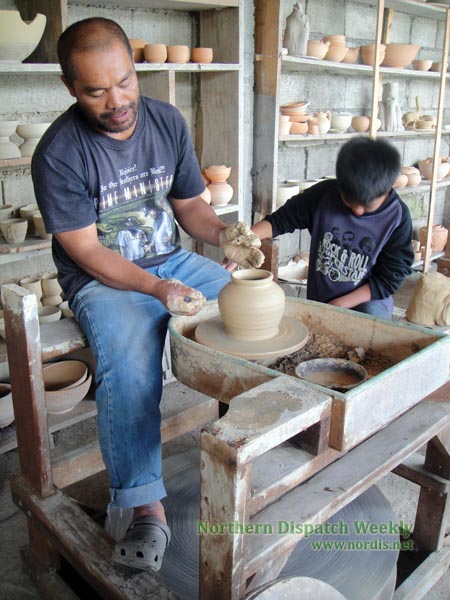
SAGADA POTTERY. Lope Bosaing, a Sagada stoneware potter, demonstrates the making of gusi to visitors in their workshop area in Nangonogan here. Photo by Arthur L. Allad-iw/nordis.net
Gusi, aside from the other pottery products, is mainly produced in Sagada’s stoneware pottery industry. For Lope Bosaing, a Sagada potter, he points that gusi making is his favored project. “Gusi “ is a center piece of Sagada culture.
“A ritual is recited every time that a gusi of tapey is opened and before the first cup is shared among the elders,” Bosaing explained. The jar is not for display. Most of all it is a tradition to have it to ferment and keep tapey for social occasions.
Gusi or jar is among the most valuable possessions of the Sagada community; it is significant to their culture, as Bosaing, describes it.
Traced to time-immemorial, the gusi is used to keep a tapey or rice wine; the longer the tapey is kept in the gusi, the stronger it will hit those who partake of it. During social occasions, an “am-ama” (male elder) would order a matured male member of his family to bring the gusi to the venue of the occasions, usually in begnas (agricultural thanksgiving), dawak (weddings), sangbo (house warming ritual), and other revered occasions. In the ceremony, the first cup of the tapey would be given to the “kaam-ama-an” (oldest male elder) for the pitik.
His pitik is a prayer to Kabunyan (the Igorot God), their ancestors’ spirits, and the “adi kaila” (spirits in the environs) to seek their blessings for prosperity and good health for the community or host of the occasion.
Sagada elders traced the acquisition of their jars to their ancestors’ trade with the Ilocanos, who also acquired these from Chinese traders in the ancient period. Most of the Chinese jars in possession of the Sagada Kankanaey were sold to the “antiqueros” (antique dealers). Only a few elders who are now in possession of these (gusi) would produce tapey, sometimes not enough for these community occasions.
With the viability of pottery in Sagada, however, it revived into a much livelier production of tapey, intended for social occasions that are celebrated the whole year round as scheduled by elders usually through the dap-ay, (the indigenous socio-political institution where elders gather to discuss community affairs). The rituals on these occasions could still be learned by the next generation, an elder observed as another positive development in the revival of the industry.
Jars produced have sell-able designs too. “People like the jar with the lizard design,” explained Siegrid Bangyay, one of the local potters in Sagada, a tourist frequented town in Mountain Province. She said that the jars they produced are perfect for the tapey as it is vitrified.
Other pottery products from Sagada are sold in the town or during exhibits in Baguio, Manila, Subic, including opportunities sponsored by foreign embassies.
The viability of the pottery industry here is assured: materials are available in the area, products produced actually helped in the re-strengthening of the indigenous culture and traditions, and potters uplift their skills through indigenous ub-ubbo (cooperation) in learning the trade.
Due to the availability of local materials, Bangyay shared that Sagada pottery is more of stoneware, a high fired pottery which means that it is vitrified so that it can hold water. The longer that a tapey is kept in a gusi, the more juice is produced.
“This explains also why the jars are perfect for tapey,” she said.
At least 80 percent of the materials are available in Sagada including those that they use for glaze, like the pine ash, lime and clay. The other 20 percent of kaolin, silica and China stone for glazing are bought usually in Manila.
Aside from stoneware, Bangyay said that the others are the high-fired porcelain and the low-fired earthenware, like that of Vigan.
As Sagada pottery is high-fired, the potters, though ub-ubbo (cooperation), established a mud and brick kiln in Nangonogan, Sagada. The firing 1300 degrees Centigrade kiln uses wood to fire jars and earthen pots, Bosaing explained while demonstrating the jar making in their workshop area in the said place.
“A day is needed to make a big jar provided that the clay is well prepared, a month to dry, three days to fire, and five days to cool off,” he added.
Commercial pottery started in the 1980s by Jaime De Guzman, an artist. In 1995, David Fowler set up a stoneware pottery in Latang, Sagada. In 2000, Archie Stapleton, a son of the former rector of Saint Mary’s Church and principal of the Saint Mary’s School, established a community training center at Danonoy, Sagada. Here, experimentation from local clay and minerals were tried for better pottery production.
But, as Bosaing puts it, “it is through observation and constant practice that we were able to improve our skills in pottery.” And it is their learned knowledge in community culture that gave indigenous flavor to their pottery making, like the gusi. # nordis.net