6 MIN READBy ALMA B. SINUMLAG
www.nordis.net
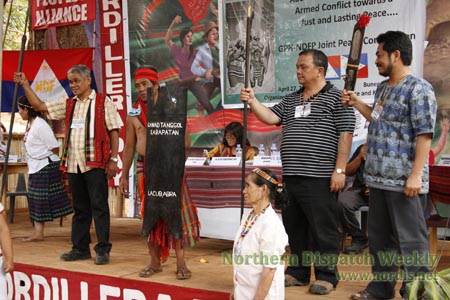
LACUB, Abra — The Reciprocal Working Committees on Social and Economic Reforms (RWC-SER) of the Government of the Philippines (GPh) and the National Democratic Front-Philippines (NDFP) heard the issues confronting the indigenous peoples (IP) in the region during the joint peace consultation organized by the Cordillera Peoples Alliance (CPA) during the 27th Cordillera Day celebration on April 27 held in Barangay Buneg of this town.
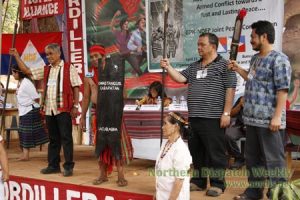 Rafael Baylosis represented the RWC-SER NDFP while Ednar Dayanghirang, Albert Alejo, and Jimid Mansayagan represented the RWC-SER of the government panel.
Beverly Longid, president of the Katribu Partylist and NDFP consultant on IP concerns said the joint peace consultation in Lacub is the first in the country where IPs from all the provinces in the Region are gathered.
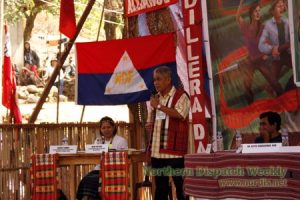
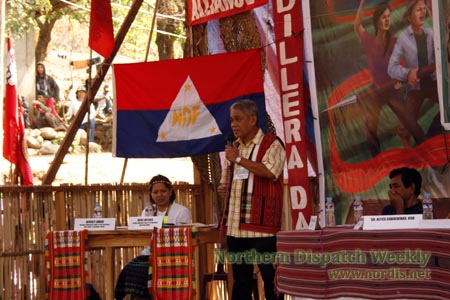
BAYLOSIS.
Windel Bolinget, chairperson of CPA, said the consultation was mainly to air the issues of the Cordillera IPs and let the committees take cognizance of these before both committees will come out with a Comprehensive Agreement on Socio Economic Reforms (CASER) which is the second substantive agenda of the on going peace negotiations. This agenda he said is the meat of the peace talks. It will according to him solve the root causes of the 42 year standing armed conflict.
Sr. Alyce Sobrevinas OSB, in her rationale said peace is not merely an absence of war but it lies in a just and equitable distribution of lands’ resources and free from evil born out of greed. This she said is a just and lasting peace.
The church she said has long been part of the Cordillera peoples struggle for the defense of their land, life and resources from the threats of development aggression and militarization.
Thus, she stressed that IP concerns must be a major topic in the talks for peace. “The respect to ancestral land rights and IP rights must be a part of the CASER,” she said.
Baylosis promised to put appropriate stress on IP concerns in their draft of the CASER. They accordingly formed a subcommittee on IP concerns which Longid is a resource person. Issues that they will be stressing are: recognition of the rights to ancestral domain, honest recognition to the free prior and informed consent (FPIC), giving back to the IPs their lands that have been grabbed, revision of the Indigenous Peoples Rights Act (IPRA), giving the appropriate social services, recognition to the IPs and their culture, demilitarization, and addressing the violations to IPs collective rights.
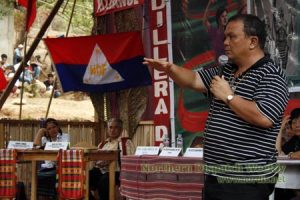
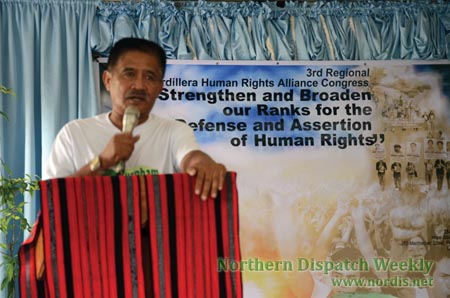
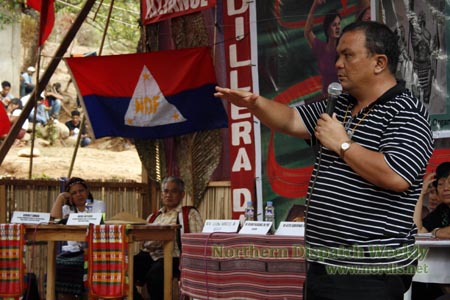
DAYANGHIRANG.
According to Dayanghirang, there are six root causes of the armed conflict which will be addressed by the CASER.These are: 1. poverty; 2. Lack or no delivery of basic services specially to the mountainous areas where IPs are located; 3. Continuing discrimination and marginalization of the IPs; 4. Inequitable distribution of wealth; 5. Unemployment and underemployment; 6. Environment destruction.
He cited data from one statistical study that from 1969 to 2009, there was no difference on the distribution of wealth. “Ibig sabihin, walang silbi ang mga nakaraang programa ng gobyerno,” (It means, the programs of the government are useless) he said. He added that the government has the obligation to provide jobs for the Filipino people.
He promised that in their draft of CASER, they will not only allot a sentence or paragraph for IP concerns but they will allot one chapter.
Baylosis iterated that in the 25 years of the peace negotiations, the government has caused the suspension or failure of the talks. He added that in 2004, they even proposed a concise agreement to end the civil war to the GRP however, the Arroyo administration unilaterally suspended the peace talks.
He added that despite the resumption of the peace talks and the Joint Agreement on Security and Immunity Guarantees (JASIG), their warrants of arrest were not cancelled while there are still 17 NDF consultants incarcerated. More than 350 political prisoners are still languishing in jails nationwide he stressed.
The genuine partnership of the panels he added can be seen if both panels will come out with an agreement and if the said agreement is recognized and implemented.
Cordillera communities air sentiments
Perlita Crisologo of Abra discussed Abra people’s agenda to both panels. She said, they want Cellophil Resources Corporation (CRC) to pay for the grave environment destruction its operations have caused, stop Lepanto Consolidated Mining Company (LCMC) from polluting the Abra River, stop the Local Government Unit (LGU) from supporting the mining exploration projects, enact a law that will punish whoever will cause the destruction of their forests and rivers, and they want the Peoples Mining Bill to be approved in Congress. She also stressed the pull-out of all military units in Lacub as well as neighboring municipalities.
A representative from Ifugao said they do not want their water system to be privatized and their culture to be commercialized.
The Apayao representative said they want the mining applications in their province to be cancelled. Also, they want to stop the logging companies, specifically Furnitures Group Incorporated from their logging operations.
She explained that because of the company’s logging activities, their water sources are depleted and this has caused meager harvest. Moreover, they want the government to cause an appropriate solution to climate change.
Jimmy Suwagon of Kalinga stressed that they want a stop to militarization resulting in human rights violations (HRVs) thus, he said they want the pull-out of military soldiers from their communities. Basic social services he said is lacking in their province. Also, they want the repeal of the Mining Act of 1995 that liberalized the the mining industry in the country.
Moreover, he said to both panels that majority of their jeepneys’ tires from Kalinga had been spiked along the Abra- Kalinga road thus, they want a sanction on the military soldiers who he said are perpetrators of the incident. He added that they want the punishment of the government forces who caused the massacre of farmers in Malapiat, San Pascual in Rizal, Kalinga in 2007.
Jaime Dugao of Mt Province called for both panels especially the GPh to respect the Comprehensive Agreement on the Respect on Human Rights and the International Humanitarian Law (CARHRIHL). He also called for the the government to recognize the IPs ownership of the Ancestral Domain. He added that the Certificate of Ancestral Domain Title (CADT) and others had brought discord to the IP communities. Morever, they want the government to recognize the traditional government as practiced by the community elders.
The government Dugao added should pay for the resources it had plundered in the Cordillera. Moreover, he stressed that Mt. Province has been neglected for a long time when it comes to budget allotment. He even said the pork barrel funds should go straight to communities. “Iwasan ti bureacracy ta isu ti pagtaudan ti corruption,” (Avoid bureacracy because it is the cause of corruption) he added.
Ampi Mangili of Benguet said “Tama na! Sobra na!”. Benguet he said is the victim of development aggression specifically the mines, logging and dams for a long time. “Kaming mga Kankana-ey, Karao, Ibaloi, at Kalanguya ang nagsakripisyo, kami ang naaggrabiyado,” he said citing more than a century of mining plunder, from underground mining to open pit mines and mega dams.
Moreover, he said instead of helping the farmers earn a decent living, the government acted for the importation of vegetables that pushed them further into poverty.
“Kung seryoso ang gobyerno sa kanyang paglutas sa nailahad nilang anim na ugat ng armed conflict, ngayon pa lang, kaming mga taga Benguet ay maniningil na,” Mangili said.
Benguet people want the rehabilitation of the mined out areas, appropriate relocation sites to the displaced communities, stop the liberalization of agriculture, revoke the mine permits specially those that are irregularly issued, give due compensation to the communities located in the mined out areas and the abolition of the National Commission on Indigenous Peoples (NCIP) because it is not serving its purpose.
Both panels agreed to work together to address the issues raised. “Sana ituloy niyo po ang pagtulak sa amin upang kami ay mapilit na sumunod,” Dayanghirang said. The people and the peace panels he said must continue persuading each other for the peace talks to be successful.
On the other hand, Ama Banag from the Butbut tribe of Kalinga challenged the Cordillera people to monitor the peace negotiations. If the negotiation this time will still fail, he is certain that the armed struggle will grow stronger. That is, he said, if the IPs in the region will continue to be marginalized and continue to be violated of their rights to land, life and resources there is no other way of defense but to join in the highest form of struggle.
He even pointed out his sentiments that in the 25 years of the negotiation, it did not succeed. “Agpaysu nga adda dayta CARHRIHL ngem haan met nga tumungtungpal ti GRP ijay,” (It is true that they came out with the CARHRIHL but the GRP is not recognizing and implementing it) he said.
“Isunga sapay koma ta daytoy nga negosasyon tatta ket agballigi,” he iterated. # nordis.net
Click here for photo gallery of GPh-NDFP consultation
Click here for photo gallery of Cordillera Day