










Peoples movement, factor in persistence of Cordi cultural values
4 MIN READ
By ALMA B. SINUMLAG
www.nordis.net
LA TRINIDAD, Benguet — During the panel discussion on costumary law and governance on the 1st National Conference on Biodiversity and Indigenous Knowledge held in Benguet State University (BSU) on October 6-8, it was shared that the progressive Cordillera peoples movement was one factor in the persistence of the Indigenous Socio Political Systems (ISPS) and cultural values.
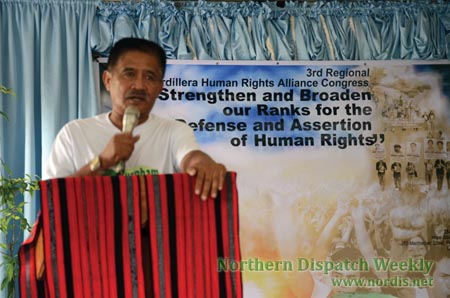
Ben Solang of the Center for the Development Projects in the Cordillera (CDPC) in his speech said that with the influence of the American colonization, and the capitalist system of values, the ISPS and cultural values continue to disintegrate. However, he said that with the advocacy of the progressive Cordillera peoples movement, there is a continuing process of persistence.
Solang shared that during the pre colonial Cordillera, ISPS and cultural values were manifested in their subsistence economy. The igorots he said depended on readily available forest products, hunting, swidden lot food production, domesticated fowls and pigs, pasture of cattle, settled wet rice agriculture exemplified by the rice terraces, and traditional small scale mining. He continued that in the above mentioned setting, an ISPS of bodong (peace pact), dap-ay/ator, hidit and tungtong as well as several cultural values like inayan, ayew, ipeyas nan gawis and kasiyana emerged and operated.
Solang explained that Bodong is a practice in the whole province of Kalinga and some parts of Apayao, Abra and Mt Province. This according to him is a system of inter tribal relations including war and peace. The Dap-ay/Ator in Mt Province, and in boundary area of Abra and Southern Ilocos is a system of governance and justice within the tribe. These ISPS he said are operated due to their strong assertion of tribe identity with defined system of defense and nurture of territory and resources.
ISPS manifested in cultural values
Inayan according to Solang is a community value similar to the popularly known karma or the concept of ‘you reap what you sow’. This value he said cautions an individual against violating cultural norms or taboos. He said this is a cultural value that instills discipline, order and harmony among individuals within families and clans, within the village or tribe, and with the environment. In other tribes, inayan is called paniyaw or paniyew.
Ayew is another cultural value that applies to all matters concerning resources or material things. “This is an exhortation to be good stewards of material things specially food items because these are essential for survival,” Solang said. He added that practicing ayew means survival because resources are scarce and responsible stewarship to resources should be practiced not only for the present but most specially to the future generations.
Ipeyas nan Gawis is also a cultural value of sharing. This value according to Solang manifests the social and not the individual character of ISPS. “Whatever good is for the benefit of all; in agriculture and other aspects of livelihood, in tribe governance or justice, in rituals and all aspects of tribal life,” he said. He added that this value counsels against individualizing or personalizing what is good that should be for all. “Intellectual Property Rights is anathema to ISPS,” he iterated. He also shared that ipeyas nan gawis among the Sagada Igorot has been co-opted and highlighted by Anglican Church Missionaries. They adopted this progressive value in their education system in St Mary’s School and other missionary work in the Cordillera with a theme; Adi tako bukodan di gawis.
Lastly is the cultural value of lifting each other in times of crisis which is called kasiyana. This value Solang said instills and evokes positive attitude in the midst of personal or family crisis like death, village crisis like landslide or pestilence. This value he said is combined with cleansing and nurturing activities of the tribe to overcome adversity and to move forward because the race lives on.
Solang reiterated that the Cordillera peoples movement has been genuinely upholding the ISPS like the Bodong appropriately and effectively to serve the peoples interest. Such ISPS like this he said continued to be relevant thus, continued to be practiced. “The bilateral feature of a bodong evolve in a multilateral peace pact in order to cater for wider problems like mega dams, destructive mining, indigenous peoples rights and human rights.
Moreover, Solang said that the progressive Cordillera peoples movement is continuing its decades of campaign on the irrelevance of tribal wars and that it advocates for negotiotiation and mediation of tribal conflicts rather than tribal wars.
Meanwhile, Solang enumerated how the ISPS and cultural values are integrated in the discipline and values of progressive cordillera peoples’ movement personified by activists. The cultural value of sharing the good things or the ipeyas nan gawis is manifested with activists’ concept of serving the people. He said, this concept is relegating individual interests for higher goals of service to the people. However, he said that this is not limited for the tribe alone but it encompasses the country’s economic and socio-political issues.
On the other hand, Solang said that the value of ayew is also manifested in activists’ “simple living”. With the influence of the capitalist market economy, and consumerism which he described as wasteful, the Cordillera peoples movement is practicing literally a simple life.
Moreover, Solang said “even with the great changes in the socio economic base, ISPS and cultural values persist because they evolve to serve for the peoples’ interest thus, they are relevant and they become part of peoples’ lives,” he said. He reiterated that the progressive intervention of vibrant peoples movements upholds peoples interest thereby ensuring continuous relevance. # nordis.net