








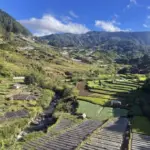






Tublay maintains its rural town appeal
3 MIN READ
TUBLAY, Benguet (Oct. 30) — This suburban town in its rugged terrain will maintain its rural countryside appeal with around 80% of its 13,680 inhabitants engaged in farming, according to local government officials in a recent press conference.
“Even if we like to industrialize, the town’s terrain would not afford it,” Tublay Mayor Ruben Paoad said, stressing that the town is now gearing at becoming an alternative tourism destination that offers its countryside characteristics as an option for urban-tired tourists.
Countryside appeal
Paoad said although the town is very near Baguio City and is just a stone’s throw from the Benguet capital La Trinidad, which is in turn also fast becoming an urban center, Tublay still has its countryside appeal.
The town’s rugged terrain rise to as high as 1,400 meters above sea level. Its temperature ranges from 6 to 27 degrees centigrade, depending on the elevation and the time of the year. The uneven elevation allows for the town’s diversified crops from lowland vegetables to temperate produce.
Traditional rice, the kintoman, still thrives in most of Tublay’s eight barangays but is planted more for domestic consumption. Almost all crops such as strawberries, cabbages and coffee are grown in Tublay, according to Paoad.
Strawberries produced in Tublay are among the juiciest there is, the town’s executives attest citing that an actor keeps coming back to Tublay for a supply of the succulent fruits.
Located 263 kilometers north of Manila and 13 kilometers north of Baguio City, Tublay may be reached through the Baguio-La Trinidad portion of the Halsema Highway. Due to its proximity to the Halsema Highway toll station, it has been regarded as the gateway to Mountain Trail. It has a land area of 57.3 square-kilometers, representing 2.2% of the land area of Benguet province.
Alternative livelihood
Councilor Felipe Cosalan, chair of the council education committee, said there is no other alternative livelihood for the farming population than to entice tourists to see the town’s natural endowments.
“Agparigat ti nateng,” (It is hard times for temperate vegetables) he said, apparently referring to the high cost of input, intensive labor and unfair trade characterizing the vegetable industry.
Tublay is the site of Bengaongao, Bungis and Paterno-Kitong Caves, probably larger than the now famous Sagada Caves in Mountain Province, according to Cosalan. Most parts of these caves are yet to be explored by tourist guides who have to get the required training as guides, said Cosalan. He said a group of at least five may be brought by guides to the caves.
Tuel hot springs also offer an alternative to Baguio’s Asin hot springs, added Paoad.
The tapestry of Benguet vegetable patches viewed from a high elevation also provides a panorama of rural Tublay.
Doing away with chemicals in the farms
Organic farms such as the Enca Farms in Barangay Caponga and Kidit Farms in Barangay Ambassador still have a long way to go to educate farmers of the benefits they could get from organic farming. Paoad looks forward to a shift from chemical-dependent agriculture to organic farming with the said farms as models.
“Because we remain an agricultural area, we might as well improve the lot of farmers,” he said. He added residents could be trained to produce their own fertilizers by turning their wastes into compost. He underscored the need for farmers to do away with chemical inputs that tend to make the soil acidic and to restore the fertility of the soil.
Tublay will celebrate its foundation day on November 19-22. It was established as a municipality in 1900. To date it is classified as a 5th class municipality.
The town’s civil registry is recently awarded as one of the best in the country in terms of quality of reports and civil registration programs. # Lyn V. Ramo for NORDIS