













Agri expansion, infra threathen Mt. Pulag biodiversity
3 MIN READ
BAGUIO CITY (Aug. 9) — Mt. Pulag’s mossy forests are threatened by the fast expansion of commercial vegetable gardens and infrastructure development, a government environmental watchdog disclosed last week.

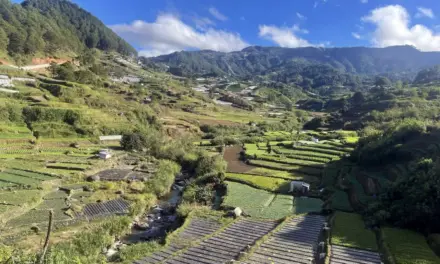
The picture is lake Tabeyo where a road traversed its middle. The half was leveled and turned as a garden. Once a mossy forest, the area is now surrounded by gardens. On the far left area, the new clearings started to climb up the mountain. Mt. Pulag is fast turning as vegetable garden. Photo courtesy of Engr. Sangao
New covert clearing allegedly done before the May elections covers more or less 20 hectares. Perpetrators of these vegetable expansion activities allegedly utilized modern equipment which included bulldozers, back hoe and other modern equipment.
Mt. Pulag, the second highest peak in the country, covers 11,550 hectares in Benguet, Nueva Viscaya, and Ifugao. It was declared through Proclamation 75 on February 19, 1987 as protected area by Pres. Corazon Aquino.
At least 100 hectares mossy forests of Mt. Pulag had already been cleared since 1991 due to vegetable gardens, claimed Emerita Albas, superintendent of the Protected Area of Mt. Pulag National Park.
The latest clearing covers at least 20 hectares covertly done in Ballay, Kabayan, Albas disclosed adding, the widest part of the 20-hectare clearing was allegedly done through the order of a barangay official from Amlimay, Buguias, while the two parcels of the clearings were done by a resident in Ballay, Kibungan, all in Benguet.
Albas said she had warned the perpetrators of the clearing to stop the activity. The protected area superintendent issued notices of their violations and made radio announcement warning them on the clearing.
“The trouble is, no one wants to testify who did the clearings,” she added.
The ground clearing is allegedly happening at the foot of Mt. Pulag where mossy forests are at its best. The clearings are said being done in the areas of Mt. Pulag in the provinces of Benguet, Nueva Viscaya and Ifugao.
Tabeyo Lake leveled
Aside from the threat to the mossy forests by the expansion, Mt. Pulag is also threatened by road projects that dissect other sensitive forests. In one instance a government road project crossed a lake in Mt. Pulag.
Prior to 1991, Lake Tabeyo used to be nestled in a mossy forest in Ballay, Kabayan. It is classified as strictly a protected zone.
“It used to be wider measuring about 10,000 square meters. Now it is reduced in half after a road to Tawangan, Kabayan dissected it. The right side, with that part of the road, is leveled and included as part of a garden. The surroundings of the lake are now all but gardens,” added Albas.
Aside from Tabeyo, there are at least two more lakes considered not ecologically stable. Two lakes considered stable are Ambulalakao and Latep Ngapos, the most pristine usually not open for tourist visits, claimed Albas.
Ancestral domain
Some residents in Mt. Pulag clamor they have rights over their ancestral lands.
At least four Certificate on Ancestral Land Claims (CALC) have been awarded to residents. Two CALCs were given to Barangay Ekip, Bokod of Benguet province, while one each for Barangays Lusod and Tawangan both of Kabayan, also of Benguet.
Ironically, the CALCs were granted under the Department of Environment and Natural Resources (DENR) Administrative Order No.2.
CALCs can now be transformed as Certificate of Ancestral Land Title (CALT) by the National Commission on Indigenous Peoples (NCIP) by virtue of the Indigenous Peoples Rights Act of 1997, where property rights of the beneficiaries are recognized.
Albas pointed out that the agricultural activities in the area are no longer traditional, however as it is done through the use of highly mechanized equipment. Some of the perpetrators are not from the areas where the clearings happened, she added.
Lack of inter-agency sustainable projects
A resident in one of the towns near Mt. Pulag claimed that the weakness of the conservation of Mt. Pulag is blamable to the government. He claimed that different stakeholders’ rights are affected by different government laws such as the NIPAS, IPRA, and agrarian programs.
The resident, who requested not to be named, pointed out that government agencies concerned lack coordination. His observation was also pointed out by Albas.
Both observed that a Department of Agriculture (DA) road project under the Highland Agricultural Development Program (HADP) traverses sensitive parts of the forests and lakes in Mt. Pulag.
“There is no clear inter-agency sustainable projects for Mt. Pulag,” the superintendent iterated.
Mt. Pulag lakes are also considered to be sources of water for the four Cordillera dams: Ambuklao, Binga, San Roque and Magat. # Arthur L. Allad-iw for NORDIS